Ultraviolet (UV) light detection can revolutionize industries such as civil engineering, military defense, aerospace exploration, and medical research. The future of electronics relies heavily on energy-efficient devices that can function independently, which makes the development of photoelectric UV detectors critical. These detectors come in two main types: photoconductive and photovoltaic, each with unique advantages and applications.
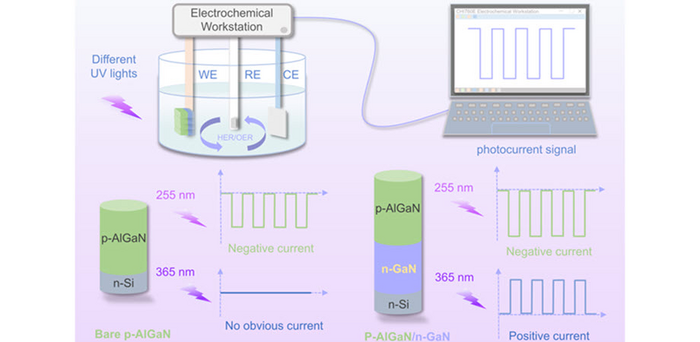
Credit: Wang et al. (NJUPT).
Ultraviolet (UV) light detection can revolutionize industries such as civil engineering, military defense, aerospace exploration, and medical research. The future of electronics relies heavily on energy-efficient devices that can function independently, which makes the development of photoelectric UV detectors critical. These detectors come in two main types: photoconductive and photovoltaic, each with unique advantages and applications.
Photoconductive detectors rely on the changes in the conductivity of semiconductors under UV light, but they require an external power source, which limits their practical application. Photovoltaic detectors ideally convert optical signals into electrical signals without needing an external power supply, but they also have low photoresponsivity, so an external supply is still needed. Also, traditional solid-state UV detectors are complex to make and not very convenient or cost-effective. New photoelectrochemical ultraviolet photodetector (PEC UV PD) devices have been developed to detect UV light by using a chemical reaction that generates an electrical signal when exposed to UV light. But most can only detect one type of ultraviolet light.
As reported in Advanced Photonics Nexus, researchers from Nanjing University of Posts and Telecommunications (NJUPT) and Nanjing University recently designed a PEC UV PD that can detect two types of ultraviolet light by using a special type of nanostructure made of different layers. This design makes the detector sensitive to changes in the environment, and the researchers were able to further enhance the detector’s performance by modifying its surface. This new design offers a promising strategy for developing multifunctional optoelectronic devices.
The research team used a layered aluminium gallium nitride (p-AlGaN/GaN) nanostructure as an electrode in a three-electrode system to study how it detects light. They found that tiny semiconductor GaN nanowires are essential in controlling the flow of electrical current and reversing the direction of photocurrent in response to different types of light. They discovered that the nanowires act as a light absorber under 365-nm light while also serving as an electron-donor when exposed to 255-nm light, which helps to regulate photoresponsivity at varying wavelengths.
The PEC UV PD design is able to distinguish between different light wavelengths by using layered AlGaN/GaN nanowires instead of bare AlGaN nanowires, achieving photocurrent polarity reversal at two different points. This makes it highly sensitive to changes in the surrounding environment, allowing for easy regulation of photoresponse through light intensity and external bias. Furthermore, by including platinum in the surface modification with the PEC PD, researchers were able to enhance the photoresponse and achieve ultrafast response speeds of 20 ms at 255-nm light.
According to Dunjun Chen, professor of Electronic Science and Engineering and one of the corresponding authors of the work, “We focused on the importance of the GaN segment in this system and showed how it affects the way the system transports energy.” Chen adds, “This self-powered PEC photodetection system offers a new way to understand the transport mechanisms in AlGaN/GaN nanowire PEC systems, which could lead to the development of even more advanced optoelectronic devices in the future.”
This breakthrough highlights the potential for manipulating nanowire construction and surface dynamics to improve the multifunctional performance of PEC PDs and may pave the way for more efficient and effective devices that can be used in a variety of applications.
Read the Gold Open Access article by S. Wang et al. “Structural designs of AlGaN/GaN nanowire-based photoelectrochemical photodetectors: carrier transport regulation in GaN segment as current flow hub,” Adv. Photon. Nexus 2(3) 036003 (2023), doi 10.1117/1.APN.2.3.036003.
Journal
Advanced Photonics Nexus
DOI
10.1117/1.APN.2.3.036003
Article Title
Structural designs of AlGaN/GaN nanowire-based photoelectrochemical photodetectors: carrier transport regulation in GaN segment as current flow hub
Article Publication Date
17-Apr-2023