• HOME
  • NEWS
  • EXPLORE
    • CAREER
      • Companies
      • Jobs
    • EVENTS
    • iGEM
      • News
      • Team
    • PHOTOS
    • VIDEO
    • WIKI
  • BLOG
  • COMMUNITY
    • FACEBOOK
    • INSTAGRAM
    • TWITTER
Saturday, May 2, 2026
BIOENGINEER.ORG
No Result
View All Result
  • Login
  • HOME
  • NEWS
  • EXPLORE
    • CAREER
      • Companies
      • Jobs
        • Lecturer
        • PhD Studentship
        • Postdoc
        • Research Assistant
    • EVENTS
    • iGEM
      • News
      • Team
    • PHOTOS
    • VIDEO
    • WIKI
  • BLOG
  • COMMUNITY
    • FACEBOOK
    • INSTAGRAM
    • TWITTER
  • HOME
  • NEWS
  • EXPLORE
    • CAREER
      • Companies
      • Jobs
        • Lecturer
        • PhD Studentship
        • Postdoc
        • Research Assistant
    • EVENTS
    • iGEM
      • News
      • Team
    • PHOTOS
    • VIDEO
    • WIKI
  • BLOG
  • COMMUNITY
    • FACEBOOK
    • INSTAGRAM
    • TWITTER
No Result
View All Result
Bioengineer.org
No Result
View All Result
Home NEWS Science News Chemistry

Boosting multi-hole water oxidation catalysis on hematite photoanodes under low bias

Bioengineer by Bioengineer
April 18, 2023
in Chemistry
Reading Time: 2 mins read
0
Boosting multi-hole water oxidation catalysis on hematite photoanodes under low bias
Share on FacebookShare on TwitterShare on LinkedinShare on RedditShare on Telegram

This study is led by Prof. Yuchao Zhang (Key Laboratory of Photochemistry, Chinese Academy of Sciences).
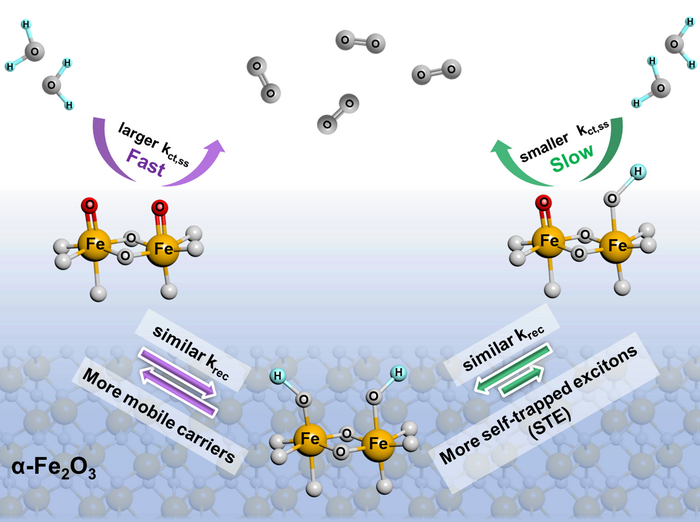
Boosting multi-hole water oxidation catalysis on hematite photoanodes under low bias

Credit: ©Science China Press

This study is led by Prof. Yuchao Zhang (Key Laboratory of Photochemistry, Chinese Academy of Sciences).

Photoelectrochemical (PEC) water oxidation reaction has attracted considerable attention in recent years because of its importance in solar energy conversion. For such a sluggish four-hole and four-proton transfer reaction in a long timescale of ms–s, more and more studies have shown that the accumulation of multiple surface-trapped holes (e.g., high-valent iron oxo on hematite surfaces) or “oxidizing equivalents” is a prerequisite for efficient PEC water oxidation process. Previous PEC water oxidation studies commonly apply high potentials (>1.2 VRHE) to achieve this key. But how to complete multi-hole transfer under low bias (near the onset potential) remains unknown.

Recently, Zhang’s research group studied the important role of excitation energy in the multi-hole accumulation process. PEC characterizations and rate law analysis showed that the UV excitation could significantly boost the accumulation of multiple surface-trapped holes, thereby cathodically shifting the onset potential by 220 mV and improving the PEC water oxidation activity by one order of magnitude. Subsequent bulk transport dynamics and surface charge-transfer kinetics demonstrated that compared with the visible-light excitation, the UV excitation reduced the formation probability of self-trapped excitons and resulted in ~3 to 5-fold increase of surface holes, which accounted for the promoted multi-hole accumulation process. These advantages enable the UV excitation to contribute about 40% to the total photocurrent under 1 solar illumination, even though its energy only occupies 6% of the incident light. This mechanism was also applicable to boost other multi-hole catalysis (such as the oxidation of thioether and nitrite) under low bias.

See the article:

Boosting multi-hole water oxidation catalysis on hematite photoanodes under low bias

https://engine.scichina.com/doi/10.1007/s11426-022-1527-9


Journal

Science China Chemistry

DOI

10.1007/s11426-022-1527-9

Share12Tweet8Share2ShareShareShare2

Related Posts

Using Epigenetics to Monitor Environmental Arsenic Exposure — Chemistry

Using Epigenetics to Monitor Environmental Arsenic Exposure

May 1, 2026
Innovative Nanoreactor Design Enhances Catalysis by Optimizing Transport and Reaction Kinetics — Chemistry

Innovative Nanoreactor Design Enhances Catalysis by Optimizing Transport and Reaction Kinetics

May 1, 2026

Swift Creation of Conductive Organic Compounds via Mechanochemistry

May 1, 2026

Scientists Reveal Atomic Mechanism Behind Water-Induced Hydroxylation in CoOx Nanostructures

May 1, 2026

POPULAR NEWS

  • Research Indicates Potential Connection Between Prenatal Medication Exposure and Elevated Autism Risk

    832 shares
    Share 333 Tweet 208
  • New Study Reveals Plants Can Detect the Sound of Rain

    714 shares
    Share 285 Tweet 178
  • Scientists Investigate Possible Connection Between COVID-19 and Increased Lung Cancer Risk

    67 shares
    Share 27 Tweet 17
  • Salmonella Haem Blocks Macrophages, Boosts Infection

    61 shares
    Share 24 Tweet 15

About

We bring you the latest biotechnology news from best research centers and universities around the world. Check our website.

Follow us

Recent News

Physical Disorders, ADLs, Cognition, Depression in Nursing Homes

Precise Spatiotemporal Cardiac Repair and Regeneration

Paul and Shelia Schlosberg Family Foundation Advances Military Brain Health with Pioneering $3 Million Grant

Subscribe to Blog via Email

Enter your email address to subscribe to this blog and receive notifications of new posts by email.

Join 82 other subscribers
  • Contact Us

Bioengineer.org © Copyright 2023 All Rights Reserved.

Welcome Back!

Login to your account below

Forgotten Password?

Retrieve your password

Please enter your username or email address to reset your password.

Log In
No Result
View All Result
  • Homepages
    • Home Page 1
    • Home Page 2
  • News
  • National
  • Business
  • Health
  • Lifestyle
  • Science

Bioengineer.org © Copyright 2023 All Rights Reserved.