LA JOLLA, CA—A new therapeutic designed by Scripps Research chemists can alter the molecular structure of the potent opioid carfentanil, inactivating the opioid and reversing a carfentanil overdose. The compound, which is described in an ACS Pharmacology & Translational Science paper published on April 17, 2023, and hasn’t yet been studied in humans, works in a fundamentally different way than existing treatments for opioid overdose.
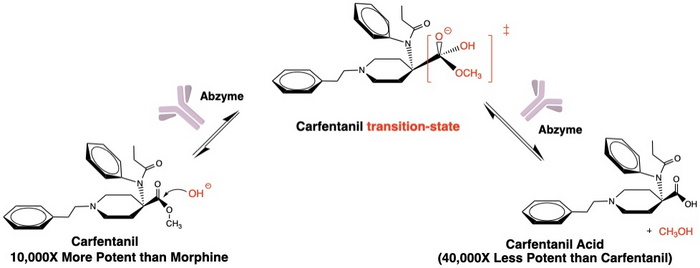
Credit: Kim Janda, PhD, Scripps Research
LA JOLLA, CA—A new therapeutic designed by Scripps Research chemists can alter the molecular structure of the potent opioid carfentanil, inactivating the opioid and reversing a carfentanil overdose. The compound, which is described in an ACS Pharmacology & Translational Science paper published on April 17, 2023, and hasn’t yet been studied in humans, works in a fundamentally different way than existing treatments for opioid overdose.
Carfentanil is up to 10,000 times more potent than morphine and 100 times stronger than fentanyl, making it one of the deadliest opioids. It is typically only used as a tranquilizer for large animals like elephants and rhinoceroses, but it is known to be added to street drugs, ingested accidentally or used in terrorist attacks.
“It has been a big challenge for the field to come up with ways to combat these incredibly strong synthetic opioids like carfentanil,” says senior author Kim Janda, PhD, the Ely R. Callaway, Jr. Professor of Chemistry at Scripps Research. “What is really different about our approach is that this antibody doesn’t just sequester the opioid in the body; it actually inactivates it.”
Opioid drugs—including morphine, codeine, oxycodone, and fentanyl—work by binding to opioid receptors in the brain and spinal cord. At low doses, they can act as painkillers and sedatives. At higher doses, they slow breathing and can cause death. In recent decades, the overuse and misuse of opioids has soared, with more than 71,000 deaths in the U.S. due to synthetic opioids in 2021 alone (CDC).
Overdoses of fentanyl, the most abused opioid, can be treated with naloxone (Narcan). Naloxone works by binding to the brain’s opioid receptors, thereby kicking fentanyl off those receptors and blocking its effect on the body in the process. But carfentanil binds to the receptors more strongly and sticks around the body for longer than fentanyl. Naloxone does not work as well—or works only temporarily—to treat carfentanil overdoses.
In the past, Janda has developed vaccines to sequester opioids away from their receptors in the body. More recently, he wondered whether there was a way to fully inactivate carfentanil and related synthetic opioids. He was particularly interested in a chemical entity embedded within carfentanil’s structure called a methyl ester. He knew that with the right machinery, this methyl ester could be converted to an acid, which he suspected would drastically change the properties of carfentanil and therefore make it unable to bind to the body’s opioid receptors. Molecules that can accelerate a chemical reaction—like the conversion of a methyl ester to an acid—are called catalysts or described as catalytic.
“Before we started designing a catalytic-biologic therapy to carry this reaction out, we had to make sure the drug would actually be inactive and unable to bind receptors without that methyl ester,” says Janda. “Going into this, no one knew whether that was the case.”
In the new work, Janda and his colleagues showed that, indeed, the acid form of carfentanil is about 40,000 times less potent at binding to the opioid receptor compared to the methyl ester form.
Armed with that knowledge, the researchers created a transition-state of carfentanil—partway toward the chemical conversion from a methyl ester to an acid. They then screened libraries of antibodies for one that would bind to this transition-state analogue, helping stabilize it. This kind of molecule, called a catalytic antibody or an “abzyme,” helps encourage a chemical reaction to proceed. Moreover, the better an antibody can bind to the transition state of carfentanil’s ester hydrolysis, the more it will help usher all the carfentanil molecules to convert to an acid.
Janda’s group pinpointed one promising catalytic antibody and showed that it was able to convert carfentanil to the acid form. What is more, treating a mouse respiratory depression model with the catalytic antibody reversed the symptoms of carfentanil overdose, boosting the animals’ breathing and heart rate.
“It was important that we not only showed the biochemistry of this catalytic antibody, but also that it could have translational value,” says Janda. “It is not quite ready for clinical trials, but we believe this proof of concept demonstrating a catalytic antibody degrading a synthetic opioid into an innocuous substance is a promising starting point, and it will help encourage other research groups to examine this line of research.”
The researchers are also planning to test whether the catalytic enzyme works to inactivate other strong opioids, including lofentanil, which is slightly stronger than carfentanil and has a matching methyl ester.
In addition to Janda, authors of the study, “Catalytic Antibody Blunts Carfentanil Induced Respiratory Depression,” are Mingliang Lin, Lisa Eubanks, Nishant Karadkhelkar and Steven Blake of Scripps Research.
This work was supported by the Skaggs Institute for Chemical Biology at Scripps Research.
About Scripps Research
Scripps Research is an independent, nonprofit biomedical institute ranked one of the most influential in the world for its impact on innovation by Nature Index. We are advancing human health through profound discoveries that address pressing medical concerns around the globe. Our drug discovery and development division, Calibr, works hand-in-hand with scientists across disciplines to bring new medicines to patients as quickly and efficiently as possible, while teams at Scripps Research Translational Institute harness genomics, digital medicine and cutting-edge informatics to understand individual health and render more effective healthcare. Scripps Research also trains the next generation of leading scientists at our Skaggs Graduate School, consistently named among the top 10 US programs for chemistry and biological sciences. Learn more at www.scripps.edu.
DOI
10.1021/acsptsci.3c00031