As Brazil seeks ways to protect its crucial Amazon Forest, a new study shows that excusing private landowners from conserving their precious land has come at a steep cost to global sustainability.
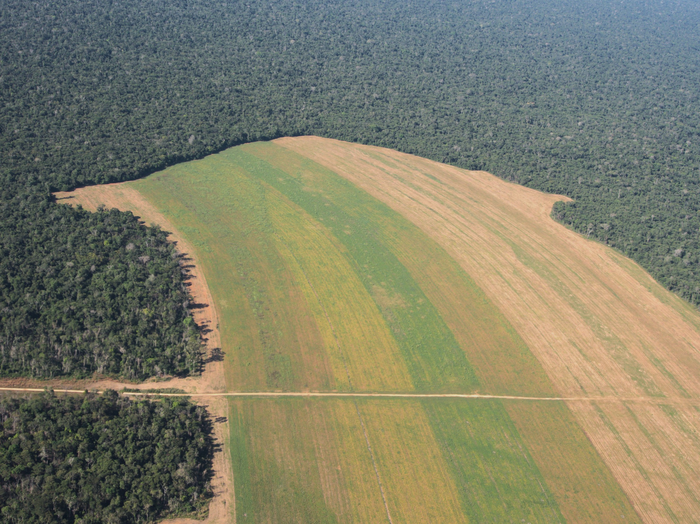
Credit: Ramon Bicudo, Michigan State University
As Brazil seeks ways to protect its crucial Amazon Forest, a new study shows that excusing private landowners from conserving their precious land has come at a steep cost to global sustainability.
In this week’s Nature Communications Earth & Environment, scientists at Michigan State University’s Center for Systems Integration and Sustainability (MSU-CSIS) as well as Brazil and the UK found that since 2012 more than half of the deforestation in the Brazilian Amazon has taken place on designated private conservation areas within rural private properties. However, those conservation areas were designed by the national conservation forest policy aimed at restoring natural vegetation.
The amnesty granted to 80% of landowners of small properties in the Amazon prevented the restoration of 14.6 million hectares of agricultural land, with a carbon sequestration potential of 2.5 gigatonnes.
“It’s important to enlist owners of private properties – especially those in global biodiversity hotspots such as Brazil – to participate in practices that reduce the carbon emissions and mitigate climate change through carbon sequestration,” said co-author Jianguo “Jack” Liu, Rachel Carson Chair in Sustainability and CSIS director. “Our work to reveal the true nature of private rural lands in Brazil has great impact not just for that country, but for the entire world. Local drivers of climate change mitigation truly are a global issue.”
Brazil has since 2012 been modifying its Native Vegetation Protection Law in to encourage more regrowth of natural vegetation. As part of that effort, the government began collecting information from private landowners about how their land was being used – for farming, development, or being covered by natural vegetation.
The international team used that information to provide a first deep dive into the state of natural growth across Brazil, integrating self-declared land ownership and conservation data from landowners, which improve the assessment of policy compliance and conservation beyond what can be learned from satellite remotely sensed data alone.
“We’ve been able to pinpoint whether private properties were in compliance with national rules,” said lead author Ramon Bicudo. “We’ve found that enforcing Brazil’s Forest Code and demanding landowners comply would greatly increase the Brazilian carbon stocks which it needs to offset emissions.”
Granting the amnesty from the 1965 Code freed landowners from restoring 14 million hectares in small private properties in the Amazon. The researchers also found 3 million hectares amnestied in the Atlantic Forest – a global hotspot of biodiversity and the most endangered biome in Brazil with only approximately 15% of natural vegetation remnants.
Bicudo noted that showing how imprecisions in self-declared data may lead to large overlapping areas between private lands and protected areas and providing a suite of ways to deal with the enormous datasets of quantitative validation methods to deal with such a large dataset is a crucial step. Brazil is under increasing pressure to produce more soybeans and beef in private lands for both international and domestic markets, so having a tool to understand the state of private lands, and identify paths forward in forest governance, is crucial.
In addition to Liu and Bicudo, Daniel de Castro Victoria, Fábio Ávila Nossack, Andrés Viña,
James D. A. Millington, Simone Aparecida Vieira, Mateus Batistella and Emilio Moran are authors of “Slow-down of deforestation following a Brazilian forest policy was less effective on private lands than in all conservation areas.”
The work was supported by the National Science Foundation and Michigan AgBioResearch.
Journal
Communications Earth & Environment
DOI
10.1038/s43247-023-00783-9
Article Title
Slow-down of deforestation following a Brazilian forest policy was less effective on private lands than in all conservation areas