“To our knowledge, this is the first functional study of POLDIP2 in retinal cells to understand its potential role in AMD.”
Credit: 2023 Nguyen et al.
“To our knowledge, this is the first functional study of POLDIP2 in retinal cells to understand its potential role in AMD.”
BUFFALO, NY- April 11, 2023 – A new research paper was published in Aging (listed by MEDLINE/PubMed as “Aging (Albany NY)” and “Aging-US” by Web of Science) Volume 15, Issue 6, entitled, “Knockout of AMD-associated gene POLDIP2 reduces mitochondrial superoxide in human retinal pigment epithelial cells.”
Genetic and epidemiologic studies have significantly advanced our understanding of the genetic factors contributing to age-related macular degeneration (AMD). In particular, recent expression quantitative trait loci (eQTL) studies have highlighted POLDIP2 as a significant gene that confers risk of developing AMD. However, the role of POLDIP2 in retinal cells such as retinal pigment epithelium (RPE) and how it contributes to AMD pathology are unknown.
In this new study, researchers Tu Nguyen, Daniel Urrutia-Cabrera, Luozixian Wang, Jarmon G. Lees, Jiang-Hui Wang, Sandy S.C. Hung, Alex W. Hewitt, Thomas L. Edwards, Sam McLenachan, Fred K. Chen, Shiang Y. Lim, Chi D. Luu, Robyn Guymer, and Raymond C.B. Wong from Royal Victorian Eye and Ear Hospital, University of Melbourne, St Vincent’s Institute of Medical Research, University of Tasmania, and The University of Western Australia report the generation of a stable human RPE cell line ARPE-19 with POLDIP2 knockout using CRISPR/Cas, providing an in vitro model to investigate the functions of POLDIP2.
“We conducted functional studies on the POLDIP2 knockout cell line and showed that it retained normal levels of cell proliferation, cell viability, phagocytosis and autophagy. Also, we performed RNA sequencing to profile the transcriptome of POLDIP2 knockout cells.”
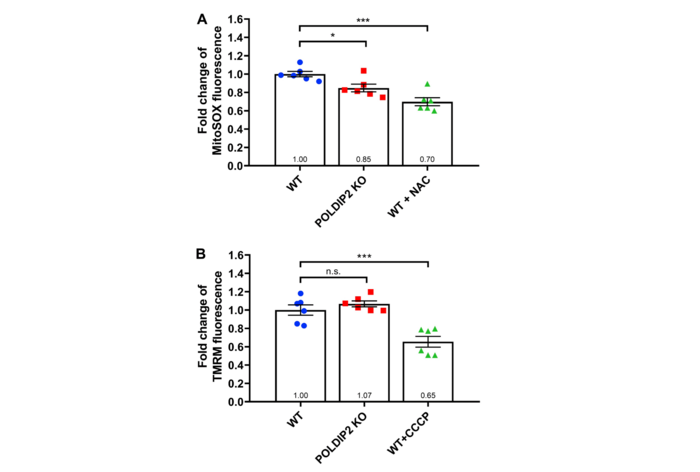
Their results highlighted significant changes in genes involved in immune response, complement activation, oxidative damage and vascular development. They showed that loss of POLDIP2 caused a reduction in mitochondrial superoxide levels, which is consistent with the upregulation of the mitochondrial superoxide dismutase SOD2. In conclusion, this study demonstrates a novel link between POLDIP2 and SOD2 in ARPE-19, which supports a potential role of POLDIP2 in regulating oxidative stress in AMD pathology.
“In summary, we have generated a POLDIP2 knockout ARPE-19 cell line using CRISPR/Cas9 and studied the biological functions of POLDIP2. To our knowledge, this is the first functional study of POLDIP2 in retinal cells to understand its potential role in AMD.”
Continue Reading: DOI: https://doi.org/10.18632/aging.204522
Corresponding Author: Raymond C.B. Wong
Corresponding Email: [email protected]
Keywords: age-related macular degeneration, retina, CRISPR/Cas, mitochondria superoxide, POLDIP2
Sign up for free Altmetric alerts about this article: https://aging.altmetric.com/details/email_updates?id=10.18632%2Faging.204522
About Aging-US:
Launched in 2009, Aging publishes papers of general interest and biological significance in all fields of aging research and age-related diseases, including cancer—and now, with a special focus on COVID-19 vulnerability as an age-dependent syndrome. Topics in Aging go beyond traditional gerontology, including, but not limited to, cellular and molecular biology, human age-related diseases, pathology in model organisms, signal transduction pathways (e.g., p53, sirtuins, and PI-3K/AKT/mTOR, among others), and approaches to modulating these signaling pathways.
Please visit our website at www.Aging-US.com and connect with us:
- SoundCloud
- YouTube
- LabTube
Click here to subscribe to Aging publication updates.
For media inquiries, please contact [email protected].
Aging (Aging-US) Journal Office
6666 E. Quaker Str., Suite 1B
Orchard Park, NY 14127
Phone: 1-800-922-0957, option 1
###
Journal
Aging-US
DOI
10.18632/aging.204522
Method of Research
Experimental study
Subject of Research
Human tissue samples
Article Title
Knockout of AMD-associated gene POLDIP2 reduces mitochondrial superoxide in human retinal pigment epithelial cells
Article Publication Date
16-Feb-2023