Scientists working on laser application at the RIKEN Center for Advanced Photonics (RAP) have employed a new technique using GHz bursts of femtosecond laser pulses grouped in MHz envelopes, termed BiBurst mode, to greatly increase the ablation speed of silicon without deterioration of ablation quality.
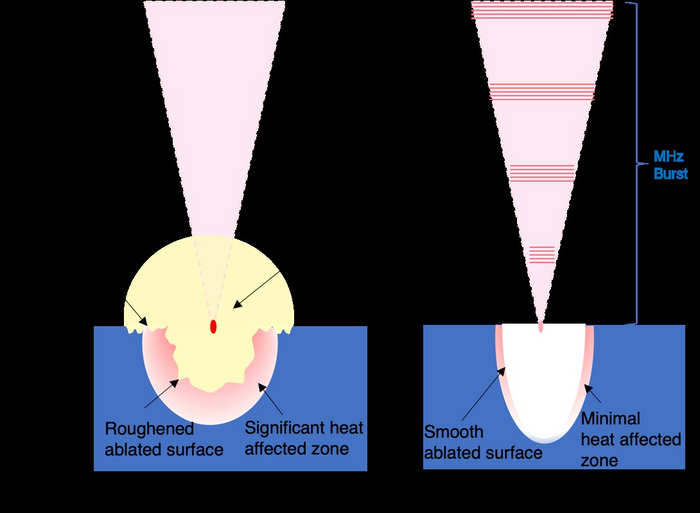
Credit: By Kotaro Obata, Francesc Caballero-Lucas, Shota Kawabata, Godai Miyaji and Koji Sugioka.
Scientists working on laser application at the RIKEN Center for Advanced Photonics (RAP) have employed a new technique using GHz bursts of femtosecond laser pulses grouped in MHz envelopes, termed BiBurst mode, to greatly increase the ablation speed of silicon without deterioration of ablation quality.
Published in International Journal of Extreme Manufacturing (IJEM), the team led by the researchers from the Advanced Laser Processing Research Team has successfully increased the throughput of silicon microfabrication by ablation for practical applications using the BiBurst mode.
The team has demonstrated that the BiBurst mode can etch silicon at an ablation speed 23 times faster than the single-pulse mode without deterioration of ablation quality under conditions where air ionization is avoided. Enhancement of ablation speed is highly desirable to improve throughput for practical applications. Thus, these findings could have a great impact on not only fundamental scientists but also industrial people.
In the previous work, the team has reported that the BiBurst mode femtosecond laser pulses improve the ablation efficiency and quality of crystalline silicon as compared with the single-pulse mode. In the GHz bursts, femtosecond laser pulse trains with extremely short pulse-to-pulse intervals of several hundred picoseconds (ps) are incident, controlling temporal energy deposition on silicon to improve ablation efficiency and quality. Then, the team has further explored the capability of high throughput micromachining of silicon at significantly higher BiBurst pulse energy, which corresponds to the integrated energy of each pulse in the BiBurst pulse.
Importantly, the energy of each femtosecond laser pulse (intra-pulse) in the BiBurst pulse is significantly smaller than the pulse energy for single-pulse mode when the same total laser energy was delivered. For the single-pulse mode, the ablated surface is seriously damaged at an intensity above the critical value due to air ionization. In contrast, BiBurst mode can deliver much higher total energy to ablate silicon without inducing air ionization due to its lower intra-pulse intensities.
Consequently, the BiBurst mode achieves 23 times higher ablation speed due to the synergetic effect of higher total energy and higher ablation efficiency as compared with the single-pulse mode under the condition at which the air ionization is avoided. In addition, temporal control of energy deposition by the BiBurst can maintain the high ablation quality even at such a higher total energy.
The team has proposed that the higher ablation efficiency by GHz burst can be achieved by the collaborative contribution of successive intra-pulses. Specifically preceding intra-pulses in the burst produces transient absorption sites for the succeeding intra-pulses due to free electron generation to enhance the ablation efficiency.
On the other hand, the ablation efficiency gradually decreases as the intra-pulse energy exceeds the ablation threshold energy for the single-pulse mode, because individual intra-pulses can directly induce ablation. The enhanced ablation efficiency due to the collaborative contribution of successive intra-pulses is no longer expected in this regime. The lower intra-pulse energy in the BiBurst mode can not only avoid air ionization but also maintain a higher ablation efficiency, thus achieving higher ablation speed than a single pulse of GHz burst or single-pulse mode.
Thus, BiBurst mode ablation has the potential to provide much higher throughput while maintaining high quality for practical applications of silicon micromachining.
Corresponding author, Prof. Koji Sugioka, said that “The first demonstration of GHz burst mode femtosecond laser ablation was implemented by Ilday’s group in 2016. They showed that GHz burst mode ablation can improve ablation efficiency due to its efficient energy deposition (one order of magnitude higher). These results highly impacted the laser micro- and nano-processing community, and multiple research groups followed them to investigate GHz burst mode ablation. Although the ablation efficiency is one of the important factors for the practical use, higher ablation rate per pulse is more critical to improving the throughput. In principle, increasing the laser intensity increases the ablation rate. However, the higher intensity of femtosecond laser pulses often suffers from incidental damage due to air ionization and excessive heat generation. We have shown for the first time that GHz/MHz BiBurst mode of femtosecond laser has the possibility to significantly improve throughput without deterioration of ablation quality. We expect that the BiBurst mode femtosecond laser processing will rewrite the common sense of the femtosecond laser process to overcome bottlenecks in the industrial applications.”
About IJEM:
International Journal of Extreme Manufacturing (IF: 10.036) is a new multidisciplinary, double-anonymous peer-reviewed and diamond open-access without article processing charge journal uniquely covering the areas related to extreme manufacturing. The journal is devoted to publishing original articles and reviews of the highest quality and impact in the areas related to extreme manufacturing, ranging from fundamentals to process, measurement and systems, as well as materials, structures and devices with extreme functionalities.
Visit our webpage, Like us on Facebook, and follow us on Twitter and LinkedIn.
Journal
International Journal of Extreme Manufacturing
DOI
10.1088/2631-7990/acc0e5
Article Title
GHz bursts in MHz burst (BiBurst) enabling high-speed femtosecond laser ablation of silicon due to prevention of air ionization
Article Publication Date
11-Apr-2023