• HOME
  • NEWS
  • EXPLORE
    • CAREER
      • Companies
      • Jobs
    • EVENTS
    • iGEM
      • News
      • Team
    • PHOTOS
    • VIDEO
    • WIKI
  • BLOG
  • COMMUNITY
    • FACEBOOK
    • INSTAGRAM
    • TWITTER
Sunday, February 8, 2026
BIOENGINEER.ORG
No Result
View All Result
  • Login
  • HOME
  • NEWS
  • EXPLORE
    • CAREER
      • Companies
      • Jobs
        • Lecturer
        • PhD Studentship
        • Postdoc
        • Research Assistant
    • EVENTS
    • iGEM
      • News
      • Team
    • PHOTOS
    • VIDEO
    • WIKI
  • BLOG
  • COMMUNITY
    • FACEBOOK
    • INSTAGRAM
    • TWITTER
  • HOME
  • NEWS
  • EXPLORE
    • CAREER
      • Companies
      • Jobs
        • Lecturer
        • PhD Studentship
        • Postdoc
        • Research Assistant
    • EVENTS
    • iGEM
      • News
      • Team
    • PHOTOS
    • VIDEO
    • WIKI
  • BLOG
  • COMMUNITY
    • FACEBOOK
    • INSTAGRAM
    • TWITTER
No Result
View All Result
Bioengineer.org
No Result
View All Result
Home NEWS Science News Chemistry

Correlate phonon modes with ion transport via isotope substitution

Bioengineer by Bioengineer
April 11, 2023
in Chemistry
Reading Time: 2 mins read
0
Correlate Phonon Modes with Ion Transport via Isotope Substitution
Share on FacebookShare on TwitterShare on LinkedinShare on RedditShare on Telegram

This study is led by Prof. Shou-Hang Bo (Global Institute of Future Technology, Shanghai Jiao Tong University, Shanghai Jiao Tong University) and Prof. Jun Cheng (College of Chemistry and Chemical Engineering, Xiamen University). The study was performed by using isotope substitution approach to modulate the lattice vibration mode of solid-state electrolytes and to study the relation between the lattice vibration and ion transport.
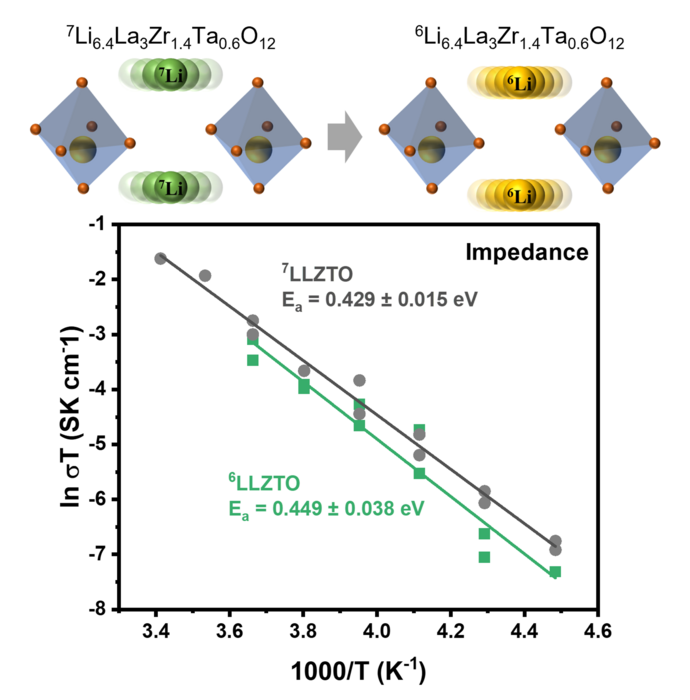
Correlate Phonon Modes with Ion Transport via Isotope Substitution

Credit: ©Science China Press

This study is led by Prof. Shou-Hang Bo (Global Institute of Future Technology, Shanghai Jiao Tong University, Shanghai Jiao Tong University) and Prof. Jun Cheng (College of Chemistry and Chemical Engineering, Xiamen University). The study was performed by using isotope substitution approach to modulate the lattice vibration mode of solid-state electrolytes and to study the relation between the lattice vibration and ion transport.

Understanding the correlations between lattice dynamics (phonons) and ion transport is important for improving the ionic conductivity of solid-state electrolytes. This understanding largely hinges on selective tuning or excitation of specific phonon modes without changing the chemical environments of atoms, which is, however, challenging to be achieved. In this work, 6Li isotope substitution to selectively change the phonon properties associated with lithium, without introducing additional defects or disorders which would affect the ion transport properties. The changes in the phonon modes were then related to ion transport properties through impedance measurements and deep potential molecular dynamics simulations. The results demonstrate that lower lithium vibration frequency leads to higher ionic conductivity and lower activation energy in the garnet solid-state electrolyte of Li6.4La3Zr1.4Ta0.6O12. The isotope substitution method can further quantitatively to assess the effect of changes in lattice vibrations on other physical parameters during ion transport, and the results show that the increase in the vibration frequency of lithium ions leads to a 1.08-fold increase in the attempt frequency and a 3.05 J K−1 mol–1 increase in migration entropy. This work suggests the effective isotope substitution method can decouple the effect of phonon modes to ion transport from that of other complex structural factors. The obtained insights can contribute to innovative understanding of ion transport in solids and strategies to optimize the ionic conductivity of solid-state electrolytes.

See the article:

Correlate phonon modes with ion transport via isotope substitution

https://www.sciengine.com/SCC/doi/10.1007/s11426-022-1488-9


Journal

Science China Chemistry

DOI

10.1007/s11426-022-1488-9

Share12Tweet8Share2ShareShareShare2

Related Posts

blank

Breakthrough in Environmental Cleanup: Scientists Develop Solar-Activated Biochar for Faster Remediation

February 7, 2026
blank

Cutting Costs: Making Hydrogen Fuel Cells More Affordable

February 6, 2026

Scientists Develop Hand-Held “Levitating” Time Crystals

February 6, 2026

Observing a Key Green-Energy Catalyst Dissolve Atom by Atom

February 6, 2026

POPULAR NEWS

  • Robotic Ureteral Reconstruction: A Novel Approach

    Robotic Ureteral Reconstruction: A Novel Approach

    82 shares
    Share 33 Tweet 21
  • Digital Privacy: Health Data Control in Incarceration

    63 shares
    Share 25 Tweet 16
  • Breakthrough in RNA Research Accelerates Medical Innovations Timeline

    53 shares
    Share 21 Tweet 13
  • Mapping Tertiary Lymphoid Structures for Kidney Cancer Biomarkers

    50 shares
    Share 20 Tweet 13

About

We bring you the latest biotechnology news from best research centers and universities around the world. Check our website.

Follow us

Recent News

Attitudes Toward Aging Impact Early Nursing Home Quality

Transforming Healthcare: Just Culture and Restorative Practices

Guiding Patients Through Obesity Diagnosis: A Primer

Subscribe to Blog via Email

Enter your email address to subscribe to this blog and receive notifications of new posts by email.

Join 73 other subscribers
  • Contact Us

Bioengineer.org © Copyright 2023 All Rights Reserved.

Welcome Back!

Login to your account below

Forgotten Password?

Retrieve your password

Please enter your username or email address to reset your password.

Log In
No Result
View All Result
  • Homepages
    • Home Page 1
    • Home Page 2
  • News
  • National
  • Business
  • Health
  • Lifestyle
  • Science

Bioengineer.org © Copyright 2023 All Rights Reserved.