Male beetles face a trade-off between competing with other males for mating opportunities and repairing damage to their sperm DNA, according to a study publishing April 4th in the open access journal PLOS Biology by Mareike Koppik from Uppsala University, Sweden, and colleagues.
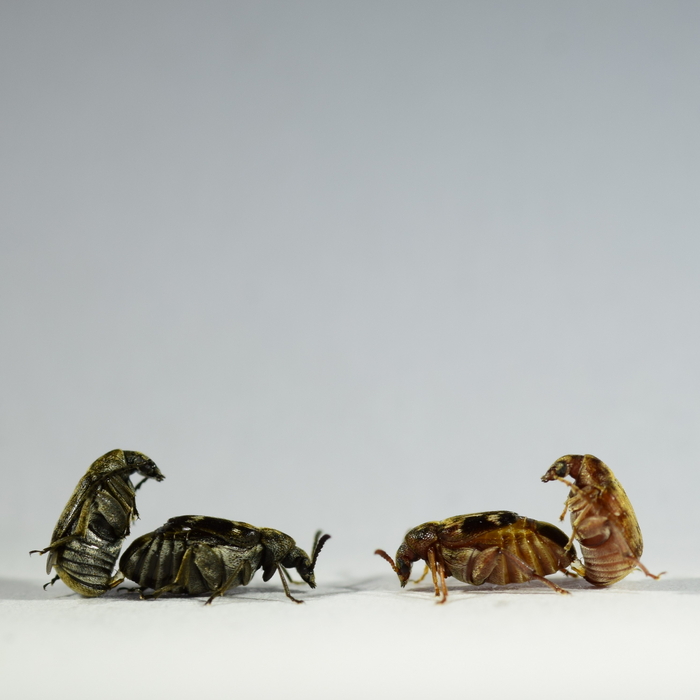
Credit: Mareike Koppik (CC-BY 4.0, https://creativecommons.org/licenses/by/4.0/)
Male beetles face a trade-off between competing with other males for mating opportunities and repairing damage to their sperm DNA, according to a study publishing April 4th in the open access journal PLOS Biology by Mareike Koppik from Uppsala University, Sweden, and colleagues.
Mutations in sperm and egg DNA can reduce the survival and fitness of offspring, so animals use a variety of repair and maintenance mechanisms in their reproductive cells. However, previous research has shown that sperm DNA has more mutations than egg DNA in a variety of species, suggesting that there may be a trade-off between competing for access to females and investing energy in repairing damaged DNA. The researchers investigated this hypothesis using laboratory colonies of the seed beetle (Callosobruchus maculatus) that had undergone 50 generations of experimental evolution. They compared male beetles from lineages that were manipulated to be monogamous, therefore minimizing sexual selection (“N males”) with lineages that had experienced intense sexual selection but minimal natural selection (“S males”). They found that S males fathered more offspring than N males in sperm competition experiments. However, after exposure to DNA-damaging radiation, S males produced lower quality offspring compared to N males and control males. Using RNA sequencing, the team identified 18 genes that changed their activity in the reproductive tracts of males in response to radiation. Several of these genes are thought to play roles in cellular maintenance and DNA repair. A male’s post-radiation gene expression profile was correlated with the survival and fertility of his offspring.
The authors say that males from lineages exposed to intense sexual selection invest more in competition with other males, at the expense of repairing DNA damage. This suggests that sexual selection can drive the evolution of greater flexibility in male reproductive traits.
“In these beetles, as in many other species with internal fertilization, intense male competition for mating success continues among the sperm of rival males inside the female after the mating itself is done,” coauthor David Berger adds. “Our study shows that males that invest too much into this competition, while winning the race for fertilization of female eggs, seem to care less about maintaining the quality of their sperm, with the cost of this strategy being paid by their future offspring.”
#####
In your coverage, please use this URL to provide access to the freely available paper in PLOS Biology: http://journals.plos.org/plosbiology/article?id=10.1371/journal.pbio.3002049
Citation: Koppik M, Baur J, Berger D (2023) Increased male investment in sperm competition results in reduced maintenance of gametes. PLoS Biol 21(4): e3002049. https://doi.org/10.1371/journal.pbio.3002049
Author Countries: Germany, Sweden
Funding: This work was financially supported by Vetenskapsrådet (https://www.vr.se, grant no. 2019-05024 to DB), by Carl Tryggers Stiftelse för Vetenskaplig Forskning (https://www.carltryggersstiftelse.se, grant no. CTS18:32 to DB), and by Fysiografiska sällskapet i Lund (https://www.fysiografen.se, “Nilsson-Ehle” to MK). The financial funders had no role in study design, data collection and analysis, decision to publish, or preparation of the manuscript.
Journal
PLoS Biology
DOI
10.1371/journal.pbio.3002049
Method of Research
Experimental study
Subject of Research
Animals
COI Statement
Competing interests: The authors have declared that no competing interests exist.