• HOME
  • NEWS
  • EXPLORE
    • CAREER
      • Companies
      • Jobs
    • EVENTS
    • iGEM
      • News
      • Team
    • PHOTOS
    • VIDEO
    • WIKI
  • BLOG
  • COMMUNITY
    • FACEBOOK
    • INSTAGRAM
    • TWITTER
Saturday, February 7, 2026
BIOENGINEER.ORG
No Result
View All Result
  • Login
  • HOME
  • NEWS
  • EXPLORE
    • CAREER
      • Companies
      • Jobs
        • Lecturer
        • PhD Studentship
        • Postdoc
        • Research Assistant
    • EVENTS
    • iGEM
      • News
      • Team
    • PHOTOS
    • VIDEO
    • WIKI
  • BLOG
  • COMMUNITY
    • FACEBOOK
    • INSTAGRAM
    • TWITTER
  • HOME
  • NEWS
  • EXPLORE
    • CAREER
      • Companies
      • Jobs
        • Lecturer
        • PhD Studentship
        • Postdoc
        • Research Assistant
    • EVENTS
    • iGEM
      • News
      • Team
    • PHOTOS
    • VIDEO
    • WIKI
  • BLOG
  • COMMUNITY
    • FACEBOOK
    • INSTAGRAM
    • TWITTER
No Result
View All Result
Bioengineer.org
No Result
View All Result
Home NEWS Science News Chemistry

Chinese scientists solve mystery of cubic ice

Bioengineer by Bioengineer
March 29, 2023
in Chemistry
Reading Time: 2 mins read
0
Observation of cubic ice formation on graphene at 102 K by in situ cryogenic TEM
Share on FacebookShare on TwitterShare on LinkedinShare on RedditShare on Telegram

Scientists from the Institute of Physics of the Chinese Academy of Sciences (CAS) have made a major breakthrough in the study of ice by confirming the formation of pure-phase cubic ice at low-temperature interfaces.
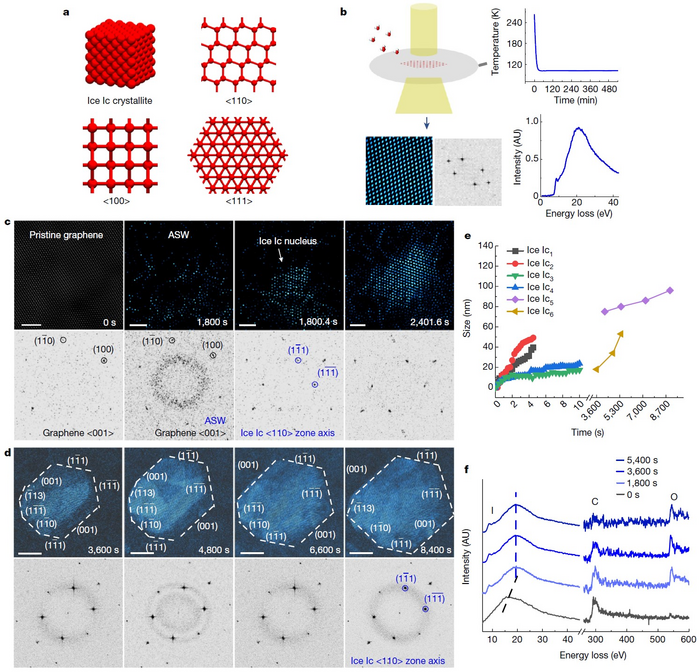
Observation of cubic ice formation on graphene at 102 K by in situ cryogenic TEM

Credit: Institute of Physics

Scientists from the Institute of Physics of the Chinese Academy of Sciences (CAS) have made a major breakthrough in the study of ice by confirming the formation of pure-phase cubic ice at low-temperature interfaces.

The findings, published in Nature on Mar. 29, have significant implications for a wide range of fields, from materials science to climate science.

Ice is a common substance that exists in a variety of forms, depending on the conditions under which it forms. The most common form of ice, known as ice Ih, has a hexagonal lattice structure, but under certain conditions, ice can form other structures, with 20 different forms found so far.

In the case of cubic ice, known as ice Ic, a hundred years ago it was thought to be responsible for a particular type of halo around the Sun or Moon. In fact, the question of whether cubic ice really exists has long been controversial, as it has been difficult to perfectly detect pure-phase ice Ic in a large number of experiments.

In this study, the researchers used in-situ cryogenic transmission electron microscopy (TEM) imaging and water vapor deposition on graphene to follow the formation of ice crystallites in real time at molecular resolution.

They found that the resulting ice was pure-phase ice I, with a majority being single crystalline ice Ic and a small amount ice Ih. The preferential nucleation of ice Ic on low-temperature substrates was demonstrated. The polymorphic diversity of ice may well explain why pure-phase ice has not previously been found by diffraction methods.

The cubic ice controversy has thus been resolved on the basis of direct and real-space imaging by in-situ cryogenic TEM. This achievement will contribute greatly to the development of both microscopy and ice physics.

This fundamental advance has important implications for our understanding of ice formation behavior under different conditions, which has broad applications in fields such as materials science, geology, and climate science.

This study was supported by the National Science Foundation, the Ministry of Science and Technology of China, and the Youth Innovation Promotion Association of CAS.


Journal

Nature

DOI

10.1038/s41586-023-05864-5

Method of Research

Experimental study

Subject of Research

Not applicable

Article Title

Tracking cubic ice at molecular resolution

Article Publication Date

29-Mar-2023

Share12Tweet8Share2ShareShareShare2

Related Posts

blank

Breakthrough in Environmental Cleanup: Scientists Develop Solar-Activated Biochar for Faster Remediation

February 7, 2026
blank

Cutting Costs: Making Hydrogen Fuel Cells More Affordable

February 6, 2026

Scientists Develop Hand-Held “Levitating” Time Crystals

February 6, 2026

Observing a Key Green-Energy Catalyst Dissolve Atom by Atom

February 6, 2026

POPULAR NEWS

  • Robotic Ureteral Reconstruction: A Novel Approach

    Robotic Ureteral Reconstruction: A Novel Approach

    82 shares
    Share 33 Tweet 21
  • Digital Privacy: Health Data Control in Incarceration

    63 shares
    Share 25 Tweet 16
  • Study Reveals Lipid Accumulation in ME/CFS Cells

    57 shares
    Share 23 Tweet 14
  • Breakthrough in RNA Research Accelerates Medical Innovations Timeline

    53 shares
    Share 21 Tweet 13

About

We bring you the latest biotechnology news from best research centers and universities around the world. Check our website.

Follow us

Recent News

Personalized Guide to Understanding and Reducing Chemicals

Inflammasome Protein ASC Drives Pancreatic Cancer Metabolism

Phage-Antibiotic Combo Beats Resistant Peritoneal Infection

Subscribe to Blog via Email

Enter your email address to subscribe to this blog and receive notifications of new posts by email.

Join 73 other subscribers
  • Contact Us

Bioengineer.org © Copyright 2023 All Rights Reserved.

Welcome Back!

Login to your account below

Forgotten Password?

Retrieve your password

Please enter your username or email address to reset your password.

Log In
No Result
View All Result
  • Homepages
    • Home Page 1
    • Home Page 2
  • News
  • National
  • Business
  • Health
  • Lifestyle
  • Science

Bioengineer.org © Copyright 2023 All Rights Reserved.