Tokyo, Japan – Researchers from Tokyo Metropolitan University have uncovered clues to understanding the behavior of high-entropy metal telluride superconductors. They found that features typical of glasses, solids with an amorphous structure, and “blurry” electronic states, induced by disorder in the atomic structure, were involved in the unique pressure dependence of the critical temperature where superconductivity arises. This might point to coupling between electrons and vibrations in the atomic lattice, giving rise to exotic superconductivity mechanisms.
Credit: Tokyo Metropolitan University
Tokyo, Japan – Researchers from Tokyo Metropolitan University have uncovered clues to understanding the behavior of high-entropy metal telluride superconductors. They found that features typical of glasses, solids with an amorphous structure, and “blurry” electronic states, induced by disorder in the atomic structure, were involved in the unique pressure dependence of the critical temperature where superconductivity arises. This might point to coupling between electrons and vibrations in the atomic lattice, giving rise to exotic superconductivity mechanisms.
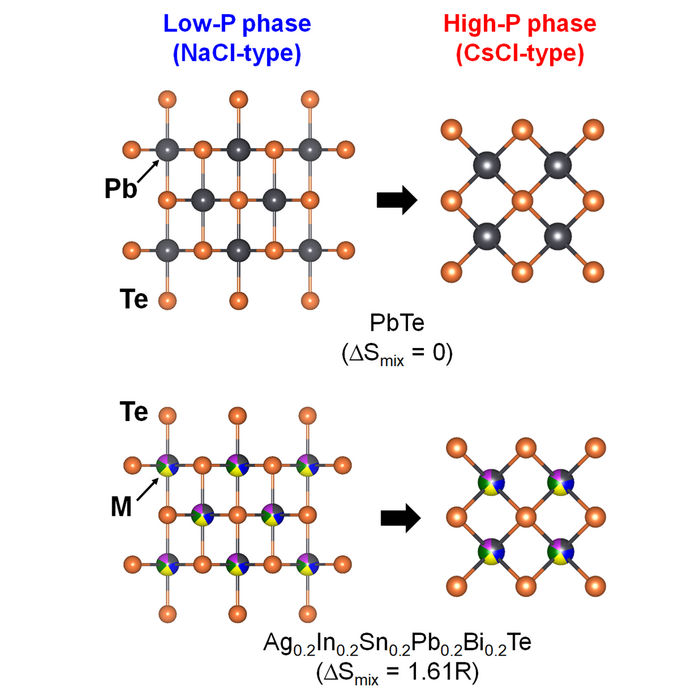
Entropy is a measure of disorder. The more ways there are of arranging things in a system, whether it be gas atoms in a box, people in a queue, parts in a mixture, or building blocks along a polymer chain, the higher the entropy is. The same applies to a unique class of alloys known as high-entropy alloys (HEAs). In a material like metal telluride, tellurium and metal ions are usually arranged in an ordered, crystalline pattern, in a low-entropy configuration. However, if the single type of metal is replaced with a blend of five different metals, there is a whole range of ways in which the metal sites can be filled. This leads to a high-entropy (or high entropy-of-mixing) state, with unique physical properties.
A team led by Associate Professor Yoshikazu Mizuguchi of Tokyo Metropolitan University have been studying the superconductivity of high-entropy metal telluride. At high pressures, the critical temperature (Tc) below which superconductivity arises is known to decrease with higher pressure in more conventional materials. However, recent research found that metal telluride high-entropy alloys with a large number of metals had a particularly robust superconductivity at high pressure, with a Tc that didn’t decrease much as the pressure was ramped up further.
Now, they have begun to figure out why by measuring and simulating the atomic structure, as well as what energies the electrons like to take (the band structure). It turns out that the disorder introduced by the range of metals that can sit in the metal sites has real implications for its properties. For example, the ways in which the atoms in the crystalline lattice can vibrate in a normal crystal are often confined to specific frequencies, like different modes of vibration on a guitar string. But thanks to the disorder in how the metal sites are filled, a simulation of the density of states, a map of the frequencies at which the atomic structure likes to vibrate, showed an extremely broadened structure, and not a series of peaks. This is typical of glasses, solids with a disordered structure, but not of crystalline materials like metal telluride. A similar broadening was found in the band structure, where the energies of states in which electrons can lie were blurred out. This was also found to correlate with real, experimentally measured local structural disorder using X-ray diffraction techniques.
Interestingly, it was found that this glassiness and blurriness only become prominent when the metal telluride structure had a high entropy. This also correlated with the critical temperature no longer dropping with pressure. The team believe there might be a unique coupling between the behavior of electrons in the material, the vibrational behavior of the atomic lattice, and the superconducting properties. They now have their sights set on experiments with single crystals of high-entropy telluride, continuing the search for exotic mechanisms that might explain how superconductivity works.
This work was supported by Grants-in-Aid for Scientific Research (KAKENHI) (No. 21H00151, 20H01874, 20H05619), the JST-ERATO Program (Grant Number JPMJER2201), and the Tokyo Metropolitan Government Advanced Research (No. H31-1).
Journal
Materials Today Physics
DOI
10.1016/j.mtphys.2023.101019
Article Title
Glassy atomic vibrations and blurry electronic structures created by local structural disorders in high-entropy metal telluride superconductors
Article Publication Date
15-Feb-2023