Microplastic pollution reduces energy production in a microscopic creature found in freshwater worldwide, new research shows.
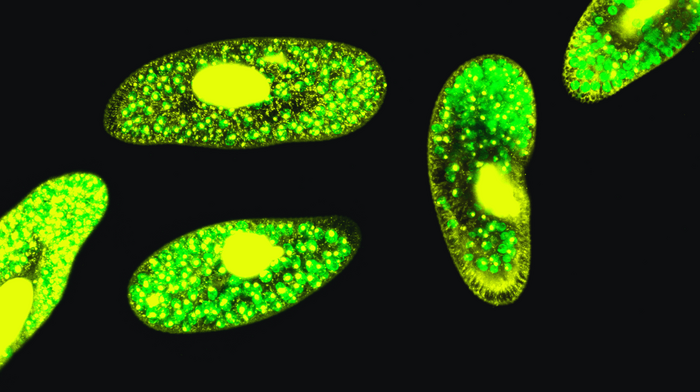
Credit: Dr Ben Makin
Microplastic pollution reduces energy production in a microscopic creature found in freshwater worldwide, new research shows.
Paramecium bursaria contain algae that live inside their cells and provide energy by photosynthesis.
The new study, by the University of Exeter, tested whether severe microplastic contamination in the water affected this symbiotic relationship.
The results showed a 50% decline in net photosynthesis – a major impact on the algae’s ability to produce energy and release oxygen.
“The relationship I examined – known as photosymbiosis – is commonly found both in freshwater and the oceans,” said Dr Ben Makin, lead author and associate researcher at the Environment and Sustainability Institute on Exeter’s Penryn Campus in Cornwall.
“We know climate change can damage photosymbiotic relationships, including in corals (leading to ‘bleaching’ events).
“Recent studies have shown that microplastics (plastic particles smaller than 5 mm) may also interfere with photosymbiosis – but more research is needed, especially in freshwater habitats.
“In this study, I chose a ‘classic’ example of photosymbiosis – Paramecium bursaria are found in freshwater around the world, and similar symbiotic relationships exist in the oceans.”
The study placed Paramecium bursaria in water contaminated with microplastics in the laboratory.
The level of contamination was higher than that usually seen in the natural world, but it has been found in some places.
“At this stage, the question I wanted to answer was whether severe contamination could affect this important relationship – and what those effects might be,” Dr Makin explained.
“This is a pilot experiment, and more research is needed to test different microplastic concentrations, different kinds of plastic and the effects on different species.”
The findings do not reveal how microplastics caused the observed impacts on photosymbiosis. Possibilities include Paramecium bursaria ingesting plastic particles, and/or chemicals from the plastics affecting biological processes.
The study tracked the impact of microplastics (compared to control water samples with no microplastics) on growth rate, symbiont density (how many algae were in each Paramecium bursaria), metabolic rate, feeding rate and net photosynthesis.
Only net photosynthesis was significantly affected – but this could be important, as it provides the organism with energy and underpins the “trade” in nutrients that allows the photosymbiosis to persist.
Strikingly, this type of association is responsible for a great deal of photosynthesis worldwide – roughly half of all photosynthesis in the ocean is underpinned by photosymbiosis.
“The findings could raise concern for the important contributions of photosymbiosis to primary production at a global level,” Dr Makin explained.
“Microplastics are a widespread contaminant, and their impacts on photosymbiosis – especially in freshwater – remain quite poorly characterised.”
The paper, published in the journal Aquatic Biology, is entitled: “Microplastic contamination reduces productivity in a widespread freshwater photosymbiosis.”
Journal
Aquatic Biology
Article Title
Microplastic contamination reduces productivity in a widespread freshwater photosymbiosis
Article Publication Date
23-Mar-2023