WASHINGTON, March 21, 2023 – Transportation systems in urban settings are vulnerable to a variety of factors including weather, traffic congestion, and special events. Bottlenecks, in particular, can cause major problems and lead to cascading failure of the entire system.
Credit: Zhuoran Chen
WASHINGTON, March 21, 2023 – Transportation systems in urban settings are vulnerable to a variety of factors including weather, traffic congestion, and special events. Bottlenecks, in particular, can cause major problems and lead to cascading failure of the entire system.
Scientists from Fudan University and Shanghai University of Electric Power in China developed a modeling technique to study urban traffic flows and verified it with real-world data from Shanghai. They describe their approach in Chaos, by AIP Publishing, and show that their model can be used to find previously unknown bottlenecks that could lead to failure of the entire road network.
This research sits at the intersection of physics and information science and is an innovative model involving the study of smart cities. The model uses a modified form of percolation theory, widely used to understand flow of liquids through porous media, such as soil and gels. When liquid flows through a network of pores, it is occasionally blocked in much the same way the flow of vehicles through roads can be blocked.
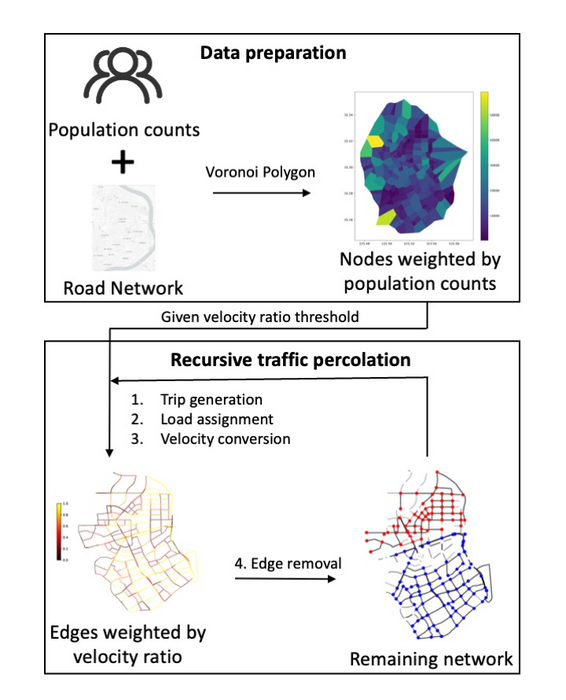
In constructing their model, the investigators considered the existing road network and population distribution in Shanghai. They generated trips between various population centers, assigning those trips to roads that provided the shortest travel distance.
“The urban area is an open system where, in addition to intraregional flows, there is also an exchange of flows between external regions. To simulate the effect of commuting, we increased the population of bordering regions,” author Yu-Gang Ma said.
The traffic load on each road was converted to a velocity. When the flow of traffic reached an unacceptably low velocity on a given road, that road was deemed dysfunctional and removed from the model.
By repeating this process in a recursive fashion, the investigators discovered that a massive cascading failure of the urban transportation system occurred in a sudden and discontinuous fashion, much the way a phase transition occurs suddenly when ice melts or water boils.
Author and project leader Dingding Han said, “We used publicly available maps for the Yangpu District in Shanghai and identified four roads that serve as major commuting thoroughfares. By applying our recursive traffic percolation model, we were able to identify one particular thoroughfare, Zhonghuan Road, as a potential bottleneck that could lead to cascading failure of the entire urban traffic system.”
When Zhonghuan Road becomes blocked, traffic flows into side streets that are eventually unable to handle the flow of vehicles. This leads to additional blockages and a breakdown of the entire system. When this occurs, the network of roads breaks into disconnected fragments.
“It is worth noting that the Zhonghuan Road bottleneck was found during the fifth round of road removal in our model,” author Jiang-Hai Qian said. “Through the dynamic process of cascading failure, the hidden bottleneck was discovered.”
###
The article “Recursive traffic percolation on urban transportation systems” is authored by Zhuoran Chen, Chao Yang, Jiang-Hai Qian, Dingding Han, and Yu-Gang Ma. It will appear in Chaos on March 21, 2023 (DOI: 10.1063/5.0137726). After that date, it can be accessed at https://doi.org/10.1063/5.0137726.
ABOUT THE JOURNAL
Chaos is devoted to increasing the understanding of nonlinear phenomena in all areas of science and engineering and describing their manifestations in a manner comprehensible to researchers from a broad spectrum of disciplines. See https://aip.scitation.org/journal/cha.
###
Journal
Chaos An Interdisciplinary Journal of Nonlinear Science
DOI
10.1063/5.0137726
Article Title
Recursive traffic percolation on urban transportation systems
Article Publication Date
21-Mar-2023