Cancer, which affects millions every year, requires proteins to spread through the body. In a new strategy to beat the wide-ranging disease, scientists are sabotaging its protein factories.
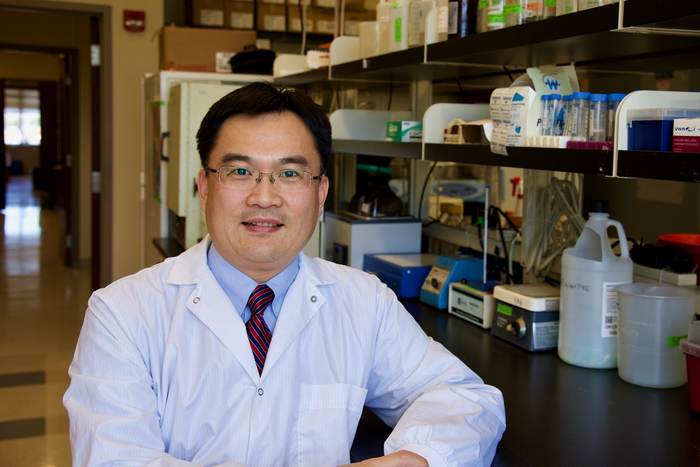
Credit: UNC Charlotte
Cancer, which affects millions every year, requires proteins to spread through the body. In a new strategy to beat the wide-ranging disease, scientists are sabotaging its protein factories.
In a new forum paper published in Trends in Biology, researchers from the University of North Carolina at Charlotte encapsulated the young field of nucleolar DNA damage response (DDR) pathways. The review highlights six mechanisms by which cells repair DNA damage, including one which was published five months ago in Nucleic Acids Research by the same authors. By attacking these mechanisms, future applied researchers will be able to trip up cancer’s reproduction and growth.
“The whole purpose of the Trends paper is to bring attention to scientists in the field and trigger their research,” says Shan Yan, the main author. “I did not realize the significance of this field, which is only fifteen years old, until a couple of years ago.”
In a groundbreaking 2007 paper published in Nature, researchers began the field by unveiling the first pathway within the nucleolus, an area within an organelle, or room, within the cell. Inside the nucleolus, different molecules help copy DNA, which contains the plans for cells. Different factors can cause glitches, such as strand breaks, in the copies. These researchers found a way to help heal glitches when copying ribosomal DNA, or the plans for the protein factories of the cell.
By studying these mechanisms, researchers can target cancer, which relies on ribosomal DNA to make the proteins they need to attack the human body. For instance, a Phase I clinical trial is already underway for a drug that targets the second mechanism listed in the paper—if the cancer cells can’t heal glitches, then they can’t make new factories and hence can’t make new proteins.
While the first four mechanisms take place inside the nucleolus, which is in a room cordoned off within the watery cell, the last two mechanisms use a new cellular process which won the 2023 Breakthrough Prize in Life Sciences. In the process, called liquid-liquid phase transition, proteins pop up their own liquid ‘tents’ to do their work instead of staying inside a room.
Before working on the nucleolar DDR, Yan researched a protein called APE1. When he discovered that APE1 could locate the nucleolus within a cell and could also pop up these liquid tents to do work, it launched his investigation into these pathways and ultimately to the review paper.
“What’s new is that APE1 acts like a GPS or a first responder,” Yan said. “It says there’s a problem here, we need a police car, a medic, and others to come and be concentrated here.”
Basic researchers like Yan will continue to better define these mechanisms, while more applied scientists can then use those mechanisms as points of attack in the war on cancer.
“This is an exciting and emerging area,” Yan said. “By testing this idea, and if the clinical trial is successful, then these mechanisms will be tickets into new clinical trials and treatments.”
###
“Molecular mechanisms of nucleolar DNA damage checkpoint response” by Jia Li and Shan Yan in Trends in Cell Biology.
“APE1 assembles biomolecular condensates to promote the ATR-Chk1 DNA damage response in nucleolus” by Jia Li, Haichao Zhao, Anne McMahon, and Shan Yan in Nucleic Acids Research online October 6, 2022 (https://academic.oup.com/nar/article/50/18/10503/6749544).
The Yan laboratory is supported in part by grants from the NIH/NCI (R01CA225637 and R03CA270663) and the NIH/NIEHS (R21ES032966) and funds from the University of North Carolina at Charlotte.
Journal
Trends in Cell Biology
DOI
10.1016/j.tcb.2023.02.003
Subject of Research
Cells
Article Title
Molecular mechanisms of nucleolar DNA damage checkpoint response
Article Publication Date
16-Mar-2023