• HOME
  • NEWS
  • EXPLORE
    • CAREER
      • Companies
      • Jobs
    • EVENTS
    • iGEM
      • News
      • Team
    • PHOTOS
    • VIDEO
    • WIKI
  • BLOG
  • COMMUNITY
    • FACEBOOK
    • INSTAGRAM
    • TWITTER
Saturday, May 2, 2026
BIOENGINEER.ORG
No Result
View All Result
  • Login
  • HOME
  • NEWS
  • EXPLORE
    • CAREER
      • Companies
      • Jobs
        • Lecturer
        • PhD Studentship
        • Postdoc
        • Research Assistant
    • EVENTS
    • iGEM
      • News
      • Team
    • PHOTOS
    • VIDEO
    • WIKI
  • BLOG
  • COMMUNITY
    • FACEBOOK
    • INSTAGRAM
    • TWITTER
  • HOME
  • NEWS
  • EXPLORE
    • CAREER
      • Companies
      • Jobs
        • Lecturer
        • PhD Studentship
        • Postdoc
        • Research Assistant
    • EVENTS
    • iGEM
      • News
      • Team
    • PHOTOS
    • VIDEO
    • WIKI
  • BLOG
  • COMMUNITY
    • FACEBOOK
    • INSTAGRAM
    • TWITTER
No Result
View All Result
Bioengineer.org
No Result
View All Result
Home NEWS Science News Chemistry

Researchers find access to new fluorescent materials

Bioengineer by Bioengineer
March 10, 2023
in Chemistry
Reading Time: 2 mins read
0
Cover picture of Chemical Science
Share on FacebookShare on TwitterShare on LinkedinShare on RedditShare on Telegram

“Phospholes can be modified by certain chemical reactions, which has a major impact on the colour and efficiency of the fluorescence of the molecule. Another special feature of these substances is their propeller-like structure,” explains König. When these molecules are dissolved in a solvent and exposed to UV light, they do not fluoresce. The absorbed energy is released in the form of rotational motion, causing the molecules to spin like a propeller in the solvent. In a crystalline state, however, the ability to rotate is severely limited, which makes the substances fluoresce strongly under UV light. This behaviour is known as aggregation-induced emission (AIE).
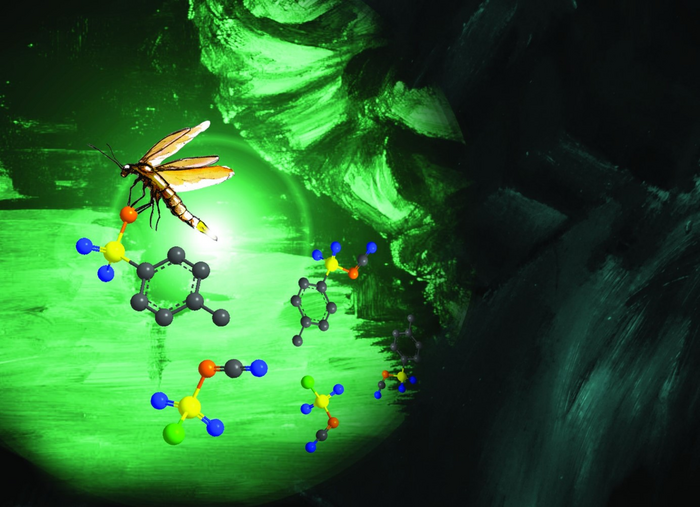
Cover picture of Chemical Science

Credit: Drawing: Dr Christoph Selg

“Phospholes can be modified by certain chemical reactions, which has a major impact on the colour and efficiency of the fluorescence of the molecule. Another special feature of these substances is their propeller-like structure,” explains König. When these molecules are dissolved in a solvent and exposed to UV light, they do not fluoresce. The absorbed energy is released in the form of rotational motion, causing the molecules to spin like a propeller in the solvent. In a crystalline state, however, the ability to rotate is severely limited, which makes the substances fluoresce strongly under UV light. This behaviour is known as aggregation-induced emission (AIE).

In the recently published paper, Nils König and his colleagues demonstrated a new reaction on AIE-based phospholes, which provided access to a new class of substances. Phospholes can be modified under mild conditions by isocyanates, a reactive class of substances consisting of the elements nitrogen, oxygen and carbon, which are inexpensive and widely available due to their industrial applications in the field of polymers and biochemistry. This reaction, which seems to contradict classical organic chemistry, is characterised by high yields and excellent atom economy.

The optical properties of the new substances were investigated in collaboration with the Institute of Surface Engineering (IOM) in Leipzig, as well as the Center for Nanotechnology (CeNTech) and the University of Münster (WWU). It turned out that the simple modification significantly increased the efficiency of fluorescence compared to the original substances. This is due to the formation of a unique interaction between parts of the molecular framework, which significantly strengthens the molecule in the solid state and leads to stronger fluorescence. The new modification method thus makes a major contribution to understanding the AIE concept and could serve as a tool for synthesising efficient new dyes for screens or as markers for biomolecules.


Journal

Chemical Science

DOI

10.1039/D3SC00308F

Method of Research

Experimental study

Subject of Research

Not applicable

Article Title

Facile modification of phosphole-based aggregation-induced emission luminogens with sulfonyl isocyanates

Article Publication Date

3-Feb-2023

Share12Tweet8Share2ShareShareShare2

Related Posts

Using Epigenetics to Monitor Environmental Arsenic Exposure — Chemistry

Using Epigenetics to Monitor Environmental Arsenic Exposure

May 1, 2026
Innovative Nanoreactor Design Enhances Catalysis by Optimizing Transport and Reaction Kinetics — Chemistry

Innovative Nanoreactor Design Enhances Catalysis by Optimizing Transport and Reaction Kinetics

May 1, 2026

Swift Creation of Conductive Organic Compounds via Mechanochemistry

May 1, 2026

Scientists Reveal Atomic Mechanism Behind Water-Induced Hydroxylation in CoOx Nanostructures

May 1, 2026

POPULAR NEWS

  • Research Indicates Potential Connection Between Prenatal Medication Exposure and Elevated Autism Risk

    832 shares
    Share 333 Tweet 208
  • New Study Reveals Plants Can Detect the Sound of Rain

    714 shares
    Share 285 Tweet 178
  • Scientists Investigate Possible Connection Between COVID-19 and Increased Lung Cancer Risk

    67 shares
    Share 27 Tweet 17
  • Salmonella Haem Blocks Macrophages, Boosts Infection

    61 shares
    Share 24 Tweet 15

About

We bring you the latest biotechnology news from best research centers and universities around the world. Check our website.

Follow us

Recent News

Family Health Needs of Disabled Elders Explored

Mcu Controls Bone Growth Through Mitochondrial Calcium

Physical Disorders, ADLs, Cognition, Depression in Nursing Homes

Subscribe to Blog via Email

Success! An email was just sent to confirm your subscription. Please find the email now and click 'Confirm' to start subscribing.

Join 82 other subscribers
  • Contact Us

Bioengineer.org © Copyright 2023 All Rights Reserved.

Welcome Back!

Login to your account below

Forgotten Password?

Retrieve your password

Please enter your username or email address to reset your password.

Log In
No Result
View All Result
  • Homepages
    • Home Page 1
    • Home Page 2
  • News
  • National
  • Business
  • Health
  • Lifestyle
  • Science

Bioengineer.org © Copyright 2023 All Rights Reserved.