• HOME
  • NEWS
  • EXPLORE
    • CAREER
      • Companies
      • Jobs
    • EVENTS
    • iGEM
      • News
      • Team
    • PHOTOS
    • VIDEO
    • WIKI
  • BLOG
  • COMMUNITY
    • FACEBOOK
    • INSTAGRAM
    • TWITTER
Wednesday, September 2, 2026
BIOENGINEER.ORG
No Result
View All Result
  • Login
  • HOME
  • NEWS
  • EXPLORE
    • CAREER
      • Companies
      • Jobs
        • Lecturer
        • PhD Studentship
        • Postdoc
        • Research Assistant
    • EVENTS
    • iGEM
      • News
      • Team
    • PHOTOS
    • VIDEO
    • WIKI
  • BLOG
  • COMMUNITY
    • FACEBOOK
    • INSTAGRAM
    • TWITTER
  • HOME
  • NEWS
  • EXPLORE
    • CAREER
      • Companies
      • Jobs
        • Lecturer
        • PhD Studentship
        • Postdoc
        • Research Assistant
    • EVENTS
    • iGEM
      • News
      • Team
    • PHOTOS
    • VIDEO
    • WIKI
  • BLOG
  • COMMUNITY
    • FACEBOOK
    • INSTAGRAM
    • TWITTER
No Result
View All Result
Bioengineer.org
No Result
View All Result
Home NEWS Science News Health

High-speed super-resolution microscopy via temporal compression

Bioengineer by Bioengineer
March 10, 2023
in Health
Reading Time: 2 mins read
0
Temporal compressive super-resolution microscopy (TCSRM) acquires a super-resolution image sequence from temporally compressed and transiently sampled measurements.
Share on FacebookShare on TwitterShare on LinkedinShare on RedditShare on Telegram

As an indispensable tool for observing the microcosmos, optical microscopy has boosted the development of various fields, including biology, medicine, physics, and materials. However, optical diffraction imposes a spatial resolution restriction on optical microscopy, which hampers exploration of finer structures.
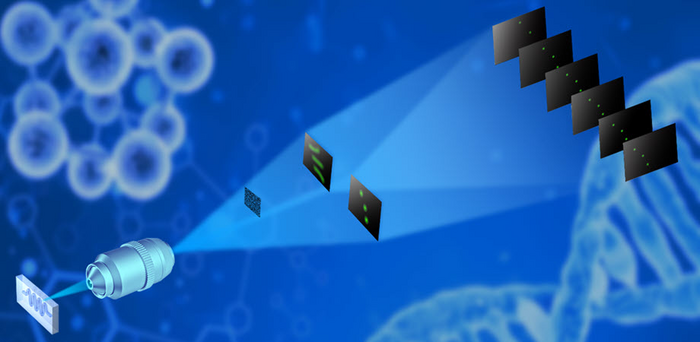
Temporal compressive super-resolution microscopy (TCSRM) acquires a super-resolution image sequence from temporally compressed and transiently sampled measurements.

Credit: Shian Zhang (East China Normal University).

As an indispensable tool for observing the microcosmos, optical microscopy has boosted the development of various fields, including biology, medicine, physics, and materials. However, optical diffraction imposes a spatial resolution restriction on optical microscopy, which hampers exploration of finer structures.

To overcome the resolution limitation, various super-resolution microscopy techniques based on diverse principles have been proposed. Yet these techniques commonly acquire super-resolution at the expense of reduced imaging speed, so achieving high-speed super-resolution imaging that can detect fast dynamics with fine structures has remained a great challenge.

Recently, a research team from East China Normal University, Shenzhen University, and Peking University resolved the contradiction between the spatial resolution and imaging speed. As reported in Advanced Photonics, they achieved high-speed super-resolution by developing an effective technique termed temporal compressive super-resolution microscopy (TCSRM). TCSRM merges enhanced temporal compressive microscopy with deep-learning-based super-resolution image reconstruction. Enhanced temporal compressive microscopy improves the imaging speed by reconstructing multiple images from one compressed image, and the deep-learning-based image reconstruction achieves the super-resolution effect without reduction in imaging speed. Their iterative image reconstruction algorithm contains motion estimation, merging estimation, scene correction, and super-resolution processing to extract the super-resolution image sequence from compressed and reference measurements.

Their studies verified the high-speed super-resolution imaging ability of TCSRM in theory and experiment. To demonstrate the imaging capability of TCSRM, they imaged flowing fluorescent beads in a microchannel, achieving a remarkable frame rate of 1200 frames per second and spatial resolution of 100 nm.

According to corresponding author Shian Zhang, Professor and Deputy Director of the State Key Laboratory of Precision Spectroscopy at East China Normal University, “This work provides a powerful tool for the observation of high-speed dynamics of fine structures, especially in hydromechanics and biomedical fields, such as microflow velocity measurement, organelle interactions, intracellular transports and neural dynamics.” Zhang adds, “The framework of TCSRM can also offer guidance for achieving higher imaging speed and spatial resolution in holography, coherent diffraction imaging, and fringe projection profilometry.”

Read the Gold Open Access article by Y. He, Y. Yao, et al., “Temporal compressive super-resolution microscopy at frame rate of 1200 frames per second and spatial resolution of 100 nm,” Adv. Photon. 5(2), 026003 (2023), doi 10.1117/1.AP.5.2.026003.


Journal

Advanced Photonics

DOI

10.1117/1.AP.5.2.026003

Article Title

Temporal compressive super-resolution microscopy at frame rate of 1200 frames per second and spatial resolution of 100 nm

Article Publication Date

9-Mar-2023

Share12Tweet8Share2ShareShareShare2

Related Posts

Wearable monitor improves diagnosis of heart rhythm disorders after fainting

August 31, 2026

Visualisation of magnetic field-induced nanoparticle clusters and mechanical property changes in a breast phantom for inductive moderate hyperthermia

August 31, 2026

Multidisciplinary intervention in frail elderly patients with cardiovascular diseases: a multicentre, single-blinded, randomised controlled trial

August 31, 2026

Machine Learning Model Development and Evaluation for Non-contact Lower Limb Injury Risk Prediction in Elite Male Rugby Union: A Multi-team, Multi-season Analysis

August 31, 2026

POPULAR NEWS

  • β-Sitosterol from Ipomoea carnea Jacq. As a promising anti-inflammatory agent: Evidence from in silico modeling and in vitro validation

    29 shares
    Share 12 Tweet 7
  • Design, fabrication and characterization of a wearable Fiber Bragg grating sensor for cardiorespiratory monitoring using finger plethysmography

    29 shares
    Share 12 Tweet 7
  • KAIST opens the era of industrial-scale microbial foods, proposing growth strategies for the next-generation protein market

    29 shares
    Share 12 Tweet 7
  • Virologist awarded $2 million NIH grant to investigate how virus-infected cells live and die

    29 shares
    Share 12 Tweet 7

About

We bring you the latest biotechnology news from best research centers and universities around the world. Check our website.

Follow us

Recent News

β-Sitosterol from Ipomoea carnea Jacq. As a promising anti-inflammatory agent: Evidence from in silico modeling and in vitro validation

Design, fabrication and characterization of a wearable Fiber Bragg grating sensor for cardiorespiratory monitoring using finger plethysmography

KAIST opens the era of industrial-scale microbial foods, proposing growth strategies for the next-generation protein market

Subscribe to Blog via Email

Success! An email was just sent to confirm your subscription. Please find the email now and click 'Confirm' to start subscribing.

Join 85 other subscribers
  • Contact Us

Bioengineer.org © Copyright 2023 All Rights Reserved.

Welcome Back!

Login to your account below

Forgotten Password?

Retrieve your password

Please enter your username or email address to reset your password.

Log In
No Result
View All Result
  • Homepages
    • Home Page 1
    • Home Page 2
  • News
  • National
  • Business
  • Health
  • Lifestyle
  • Science

Bioengineer.org © Copyright 2023 All Rights Reserved.