• HOME
  • NEWS
  • EXPLORE
    • CAREER
      • Companies
      • Jobs
    • EVENTS
    • iGEM
      • News
      • Team
    • PHOTOS
    • VIDEO
    • WIKI
  • BLOG
  • COMMUNITY
    • FACEBOOK
    • INSTAGRAM
    • TWITTER
Saturday, February 7, 2026
BIOENGINEER.ORG
No Result
View All Result
  • Login
  • HOME
  • NEWS
  • EXPLORE
    • CAREER
      • Companies
      • Jobs
        • Lecturer
        • PhD Studentship
        • Postdoc
        • Research Assistant
    • EVENTS
    • iGEM
      • News
      • Team
    • PHOTOS
    • VIDEO
    • WIKI
  • BLOG
  • COMMUNITY
    • FACEBOOK
    • INSTAGRAM
    • TWITTER
  • HOME
  • NEWS
  • EXPLORE
    • CAREER
      • Companies
      • Jobs
        • Lecturer
        • PhD Studentship
        • Postdoc
        • Research Assistant
    • EVENTS
    • iGEM
      • News
      • Team
    • PHOTOS
    • VIDEO
    • WIKI
  • BLOG
  • COMMUNITY
    • FACEBOOK
    • INSTAGRAM
    • TWITTER
No Result
View All Result
Bioengineer.org
No Result
View All Result
Home NEWS Science News

Growing tumors put the pressure on nutrient-supplying blood vessels

Bioengineer by Bioengineer
January 26, 2017
in Science News
Reading Time: 2 mins read
0
Share on FacebookShare on TwitterShare on LinkedinShare on RedditShare on Telegram
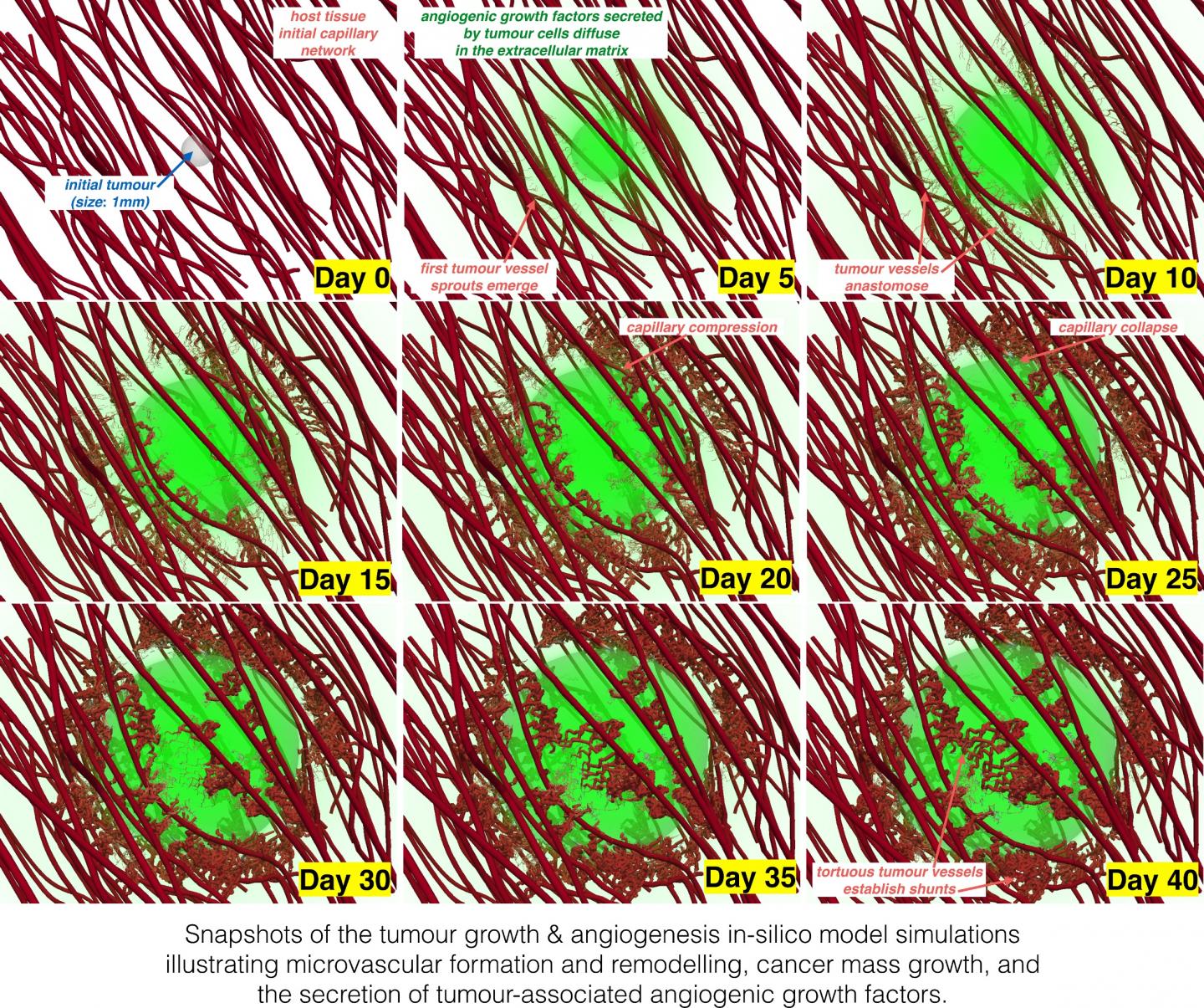
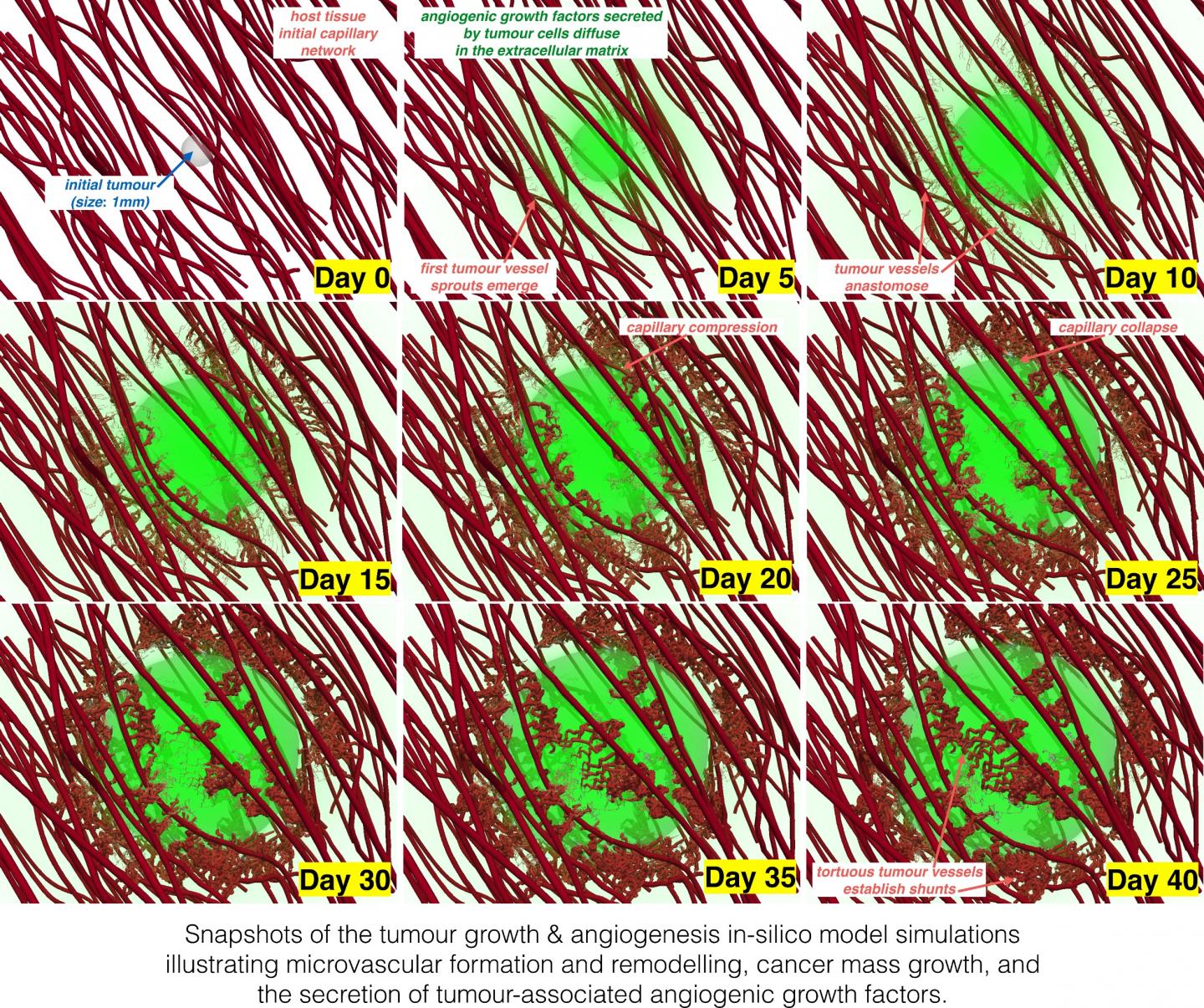
IMAGE

Credit: Vavourakis et al.

Mechanical pressure caused by cancer growth plays a key role in the development and distribution of blood vessels in tumors, according to a new UCL (University College London) study published in PLOS Computational Biology.

Previous research has shown that solid tumors (lung and brain tumors, for example) use biochemical signals to trigger the growth of new blood vessels that deliver nutrients and promote tumor growth. However, little is known about how mechanical forces exerted by a growing tumor affect these blood vessels.

In the new study, Vasileios Vavourakis of UCL and colleagues developed a three-dimensional computational model to simulate tumor-induced blood vessel development. Unlike previous models that only considered biochemical processes, their model also incorporates the mechanical processes at play during tumor growth.

Using the new model, the researchers demonstrated that a growing tumor can compress and sometimes collapse blood vessels, thus, blocking blood flow to parts of the tumor. This could deprive the tumor of oxygen and cause it to behave more invasively. It could also cause drugs to be delivered unevenly throughout the tumor, reducing the efficacy of treatment.

To help validate the model, the scientists compared its output with real-life observations of blood vessel formation in mice with cancer. They found that the model more accurately simulated blood vessel growth and distribution when mechanical processes–not just biochemical cues–were incorporated.

"The next steps of our research are to combine our computational modeling platform with experimental investigations to improve the delivery of anti-cancer drugs and the efficacy of radiotherapy," Vavourakis says. "Our aim is to reduce the dependence on animal studies in developing anti-cancer therapies, and to design more effective human clinical trials."

###

In your coverage please use this URL to provide access to the freely available article in PLOS Computational Biology: http://journals.plos.org/ploscompbiol/article?id=10.1371/journal.pcbi.1005259

Citation: Vavourakis V, Wijeratne PA, Shipley R, Loizidou M, Stylianopoulos T, Hawkes DJ (2017) A Validated Multiscale In-Silico Model for Mechano-sensitive Tumour Angiogenesis and Growth. PLoS Comput Biol 13(1): e1005259.doi:10.1371/journal.pcbi.1005259

Funding: VV is supported by a Marie Curie Intra-European Fellowship grant (FP7-PEOPLE-2013-IEF, 627025). PAW and DJH were supported by a European FP7 project (FP7-ICT-2011-9, 601040) and an Engineering & Physical Sciences Research

Competing Interests: The authors have declared that no competing interests exist.

Media Contact

Vasileios Vavourakis
[email protected]

Home

############

Story Source: Materials provided by Scienmag

Share12Tweet8Share2ShareShareShare2

Related Posts

Decoding Prostate Cancer Origins via snFLARE-seq, mxFRIZNGRND

February 7, 2026

Digital Health Perspectives from Baltic Sea Experts

February 7, 2026

Florida Cane Toad: Complex Spread and Selective Evolution

February 7, 2026

Exploring Decision-Making in Dementia Caregivers’ Mobility

February 7, 2026
Please login to join discussion

POPULAR NEWS

  • Robotic Ureteral Reconstruction: A Novel Approach

    Robotic Ureteral Reconstruction: A Novel Approach

    82 shares
    Share 33 Tweet 21
  • Digital Privacy: Health Data Control in Incarceration

    63 shares
    Share 25 Tweet 16
  • Study Reveals Lipid Accumulation in ME/CFS Cells

    57 shares
    Share 23 Tweet 14
  • Breakthrough in RNA Research Accelerates Medical Innovations Timeline

    53 shares
    Share 21 Tweet 13

About

We bring you the latest biotechnology news from best research centers and universities around the world. Check our website.

Follow us

Recent News

Decoding Prostate Cancer Origins via snFLARE-seq, mxFRIZNGRND

Digital Health Perspectives from Baltic Sea Experts

Florida Cane Toad: Complex Spread and Selective Evolution

Subscribe to Blog via Email

Enter your email address to subscribe to this blog and receive notifications of new posts by email.

Join 73 other subscribers
  • Contact Us

Bioengineer.org © Copyright 2023 All Rights Reserved.

Welcome Back!

Login to your account below

Forgotten Password?

Retrieve your password

Please enter your username or email address to reset your password.

Log In
No Result
View All Result
  • Homepages
    • Home Page 1
    • Home Page 2
  • News
  • National
  • Business
  • Health
  • Lifestyle
  • Science

Bioengineer.org © Copyright 2023 All Rights Reserved.