Deep down in the ocean at tectonic plate boundaries, hot fluids rise from so-called hydrothermal vents. The fluids are devoid of oxygen and contain large amounts of metals such as iron, manganese or copper. Some may also transport sulfides, methane and hydrogen. When the hot water mixes with the cold and oxygenated surrounding seawater, so-called hydrothermal plumes develop containing smoke-like particles of metal sulfide. These plumes rise hundreds of meters off the seafloor and disperse thousands of kilometers away from their source. Hydrothermal plumes might seem like a precarious place to make yourself at home. However, that does not stop certain bacteria from flourishing just there, a study now published in Nature Microbiology finds.
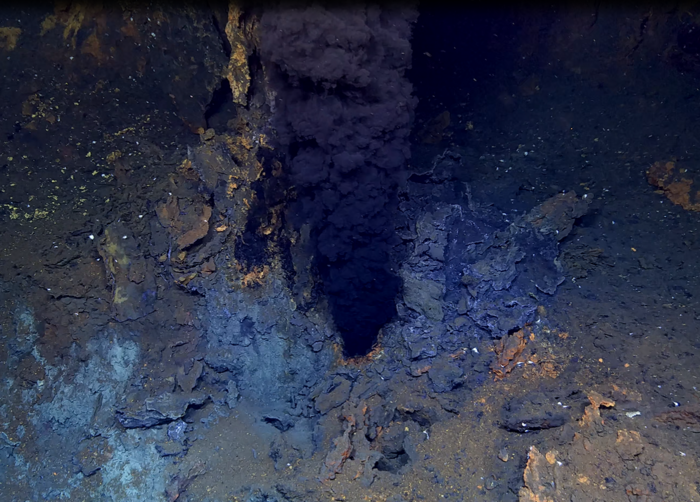
Credit: HACON cruise 2021, REV Ocean
Deep down in the ocean at tectonic plate boundaries, hot fluids rise from so-called hydrothermal vents. The fluids are devoid of oxygen and contain large amounts of metals such as iron, manganese or copper. Some may also transport sulfides, methane and hydrogen. When the hot water mixes with the cold and oxygenated surrounding seawater, so-called hydrothermal plumes develop containing smoke-like particles of metal sulfide. These plumes rise hundreds of meters off the seafloor and disperse thousands of kilometers away from their source. Hydrothermal plumes might seem like a precarious place to make yourself at home. However, that does not stop certain bacteria from flourishing just there, a study now published in Nature Microbiology finds.
More than just temporary visitors?
“We took a detailed look at bacteria of the genus Sulfurimonas”, says first author Massimiliano Molari from the Max Planck Institute for Marine Microbiology in Bremen, Germany. These bacteria have so far only known to grow in low-oxygen environments, but gene sequences had occasionally also been detected in hydrothermal plumes. As their name suggests, they are known to use energy from sulfide. “It was assumed that they were flushed there from seafloor vent-associated environments. But we wondered whether the plumes might actually be a suitable environment for some members of the Sulfurimonas group.”
Tough sampling conditions
Together with colleagues from the Alfred Wegener Institute, Helmholtz Centre for Polar and Marine Research in Bremerhaven (AWI) and the MARUM Center for Marine Environmental Sciences of Bremen University, Molari thus took on a challenging sampling trip to hydrothermal plumes in the Central Arctic and South Atlantic Ocean. “We sampled plumes in extremely remote areas of ultraslow spreading ridges that were never studied before. Collecting hydrothermal plume samples is very complicated, as they are not easy to locate. Sampling becomes even more difficult when the plume is located at depths of more than 2500 meters and below Arctic sea ice, or within the stormy zones of the Southern Ocean”, explains Antje Boetius, group leader at the Max Planck Institute for Marine Microbiology and director of the AWI, who was the Chief scientist on the Arctic missions. Onboard of the research vessel Polarstern the scientists managed to collect samples and within this water studied the composition and metabolism of bacteria.
Well-equipped and widespread
Molari and his colleagues identified a new Sulfurimonas species called USulfurimonas pluma (the superscript “U” stands for uncultivated) inhabiting the cold, oxygen-saturated hydrothermal plumes. Surprisingly, this microorganism used hydrogen from the plume as an energy source, rather than sulfide. The scientists also investigated the microbes’ genome and found it to be strongly reduced, missing genes typical for their relatives, but being well-equipped with others to allow them to grow in this dynamic environment.
“We think that the hydrothermal plume does not only disperse microorganisms from hydrothermal vents, but it might also ecologically connect the open ocean with seafloor habitats. Our phylogenetic analysis suggests that USulfurimonas pluma could have derived from a hydrothermal vent-associated ancestor, which acquired higher oxygen tolerance and then spread across the oceans. However, that remains to be further investigated”, Molari says.
A look at genome data from other plumes revealed that USulfurimonas pluma grows in these environments all over the world. “Obviously, they have found an ecological niche in cold, oxygen-saturated and hydrogen-rich hydrothermal plumes”, says Molari. “That means we have to rethink our ideas on the ecological role of Sulfurimonas in the deep ocean – they might be much more important that we previously thought.”
Journal
Nature Microbiology
DOI
10.1038/s41564-023-01342-w
Article Title
A hydrogenotrophic Sulfurimonas is globally abundant in deep-sea oxygen-saturated hydrothermal plumes.
Article Publication Date
9-Mar-2023