Like poles support a tent, microtubules—hollow cylindrical structures made of tubulin protein—support eukaryotic cells. But microtubules provide more than just mechanical strength; they help prepare the cell for cell division and migration and work as a railway track on which motor proteins transport materials within the cell. The formation of microtubules within cells resembles how a child assembles a Lego train track. The tubulins—Lego bricks—constantly assemble and disassemble to make the microtubule—train track—longer and shorter in processes called polymerization and depolymerization. The processes are regulated by microtubule-associated proteins such as CAMSAP3 that can stabilize the microtubules. A new study by Hanjin Liu and Tomohiro Shima of the University of Tokyo clarifies how CAMSAP3 stabilizes microtubules. The findings further our understanding of various cellular processes involving microtubules.
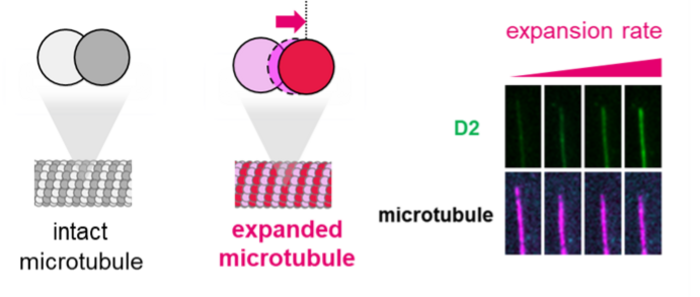
Credit: Liu and Shima et al 2023
Like poles support a tent, microtubules—hollow cylindrical structures made of tubulin protein—support eukaryotic cells. But microtubules provide more than just mechanical strength; they help prepare the cell for cell division and migration and work as a railway track on which motor proteins transport materials within the cell. The formation of microtubules within cells resembles how a child assembles a Lego train track. The tubulins—Lego bricks—constantly assemble and disassemble to make the microtubule—train track—longer and shorter in processes called polymerization and depolymerization. The processes are regulated by microtubule-associated proteins such as CAMSAP3 that can stabilize the microtubules. A new study by Hanjin Liu and Tomohiro Shima of the University of Tokyo clarifies how CAMSAP3 stabilizes microtubules. The findings further our understanding of various cellular processes involving microtubules.
“Maintaining the proper length and distribution of microtubules in the cell is critical for survival. So, microtubule-binding proteins control the microtubule dynamics,” says Shima. “CAMSAP3 is a recently found microtubule-binding protein. It specifically binds to one of the two tips of each microtubule and stabilizes the tip to prevent it from depolymerizing.”
How exactly does it stabilize the microtubule tips? To answer that, the researchers considered the structures of CAMSAPs and the microtubules. Unlike rigid Lego bricks, the tubulins in a microtubule show flexibility in their alignment. Some stabilized microtubules are known to have an expanded structure in which the distance between tubulins is greater than that of normal microtubules. And within CAMSAP3, a region called D2 contributes to microtubule stabilization. The researchers conducted an array of experiments to show that the D2 region preferentially attaches to expanded microtubules. Adding an excessive amount of D2 expanded the microtubule structure and slowed microtubule depolymerization by 18-fold. Voila! A possible mechanism for how CAMSAP3 protein stabilizes microtubules: the D2-induced expansion of the microtubule structure inhibits depolymerization.
“CAMSAP3 plays a role in various cellular phenomena, such as cell-cell binding and the development of neurons and cancer cells, through its microtubule-stabilizing ability,” says Shima. “Given the multifunctionality of microtubules, our findings provide a key concept to understanding how various cellular phenomena are controlled by tuning microtubule dynamics.”
“Also, an abnormal CAMSAP3 can cause diseases like kidney disease and malignant cancer,” explains Shima. “Although this study only examined the activity of the protein at the molecular level, it may contribute to better understanding the diseases and their treatment methods in the future.”
The researchers also hope to reveal how D2 discriminates between expanded and compact microtubules at the atomic level, which may allow them to engineer a protein with an even greater ability to discriminate between them. Such an engineered protein can be used as an anti-cancer drug to stabilize microtubules and stop cell division.
###
Related links
The School of Science, UTokyo: https://www.s.u-tokyo.ac.jp/en/
Journal
Life Science Alliance
DOI
10.26508/lsa.202201714
Method of Research
Experimental study
Subject of Research
Cells
Article Title
Preference of CAMSAP3 for expanded microtubule lattice contributes to stabilization of the minus end
Article Publication Date
9-Mar-2023