Mineral particles played a key role in raising oxygen levels in the Earth’s atmosphere billions of years ago, with major implications for the way intelligent life later evolved, according to new research.
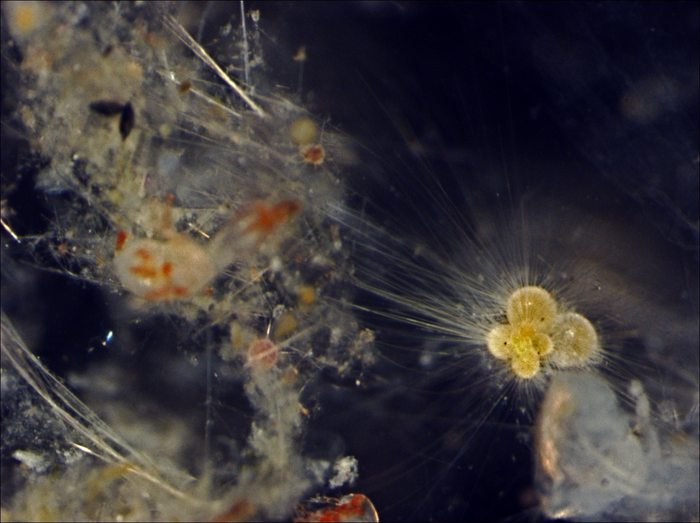
Credit: Dr Tracy Aze, University of Leeds
Mineral particles played a key role in raising oxygen levels in the Earth’s atmosphere billions of years ago, with major implications for the way intelligent life later evolved, according to new research.
Up to now, scientists have argued that oxygen levels rose as the result of photosynthesis by algae and plants in the sea, where oxygen was produced as a by-product and released into the atmosphere.
But a research team at the University of Leeds say the photosynthesis theory does not fully explain the increase in oxygen levels.
In a paper published today (Monday, March 6) in the journal Nature Geoscience, the researchers argue that when the algae and plants died, they would have been consumed by microbes, a process that takes oxygen from the atmosphere.
As a result, the amount of atmospheric oxygen was a balance between what was produced through photosynthesis and what was lost as a result of decomposition of the dead plant and algae.
To enable the atmospheric oxygen levels to get higher, the scientists say the process of decay must have been slowed or halted. This happened through what is known as mineral-organic carbon preservation, where minerals in the oceans, particularly iron particles, bind onto the dead algae and plants and inhibit their decay and decomposition.
The overall result is that oxygen levels were able to increase unhindered.
Caroline Peacock, Professor of Biogeochemistry in the School of Earth and Environment at Leeds who led the research, said: “Scientists have known for many years that mineral particles can bind with dead algae and plants, making them less susceptible to attack by microbes and shielding them from the decay process, but whether mineral particles helped fuel the rise of atmospheric oxygen had never been tested.”
The researchers set about testing their theory against known geological events when levels of mineral particles were likely to have been higher, for example, when the continents formed, resulting in a greater landmass from which minerals – including particles of iron – would have blown or been washed into the oceans.
For example, the Great Oxidation Event 2.4 billion years ago saw a spike in oxygen levels in the atmosphere. This coincided with the gradual formation of the continents, which would have caused a greater quantity of mineral particles to flow into the oceans.
Dr Mingyu Zhao, formerly at Leeds but now at the Chinese Academy of Sciences in Beijing, performed the study. He said: “The increase in mineral particles in the oceans would have reduced the rate at which algae was being decomposed. This had a major impact on oxygen levels, allowing them to rise.”
The increase in atmospheric oxygen had major ramifications for the development of life. It resulted in the evolution of increasingly complex organisms, which moved from inhabiting water to living on land.
For Professor Peacock, the study not only brings greater understanding to the way the Earth’s atmosphere became oxygenated, it also gives a glimpse of the conditions that are necessary for complex life to develop on other planets.
She said: “Our investigation is providing a new understanding of how the Earth’s atmosphere became oxygen rich, which eventually enabled complex life forms to evolve.
“That is giving us an important insight into the conditions that need to exist on other planets for intelligent life to develop.
“The existence of water on a planet is only part of the story. There needs to be dry land to provide a source of mineral particles that will eventually end up in the oceans.”
When the embargo lifts, the paper – titled ‘Oxygenation of the Earth aided by mineral-organic carbon preservation’ – will be available on the Nature website: https://www.nature.com/articles/s41561-023-01133-2
The paper was authored by Mingyu Zhao, Benjamin J. W. Mills, William B. Homoky and Caroline L. Peacock, all from the University of Leeds.
Journal
Nature Geoscience
DOI
10.1038/s41561-023-01133-2
Method of Research
Data/statistical analysis
Subject of Research
Not applicable
Article Title
Oxygenation of the Earth aided by mineral-organic carbon preservation
Article Publication Date
6-Mar-2023