Though wildlife trafficking has been effectively disrupted since the first World Wildlife Day—established 50 years ago today via the 1973 Convention on International Trade in Endangered Species (CITES) of Wild Fauna and Flora—a newly published case study on one of the world’s rarest tortoise species, the ploughshare tortoise, highlights how much room for improvement still exists.
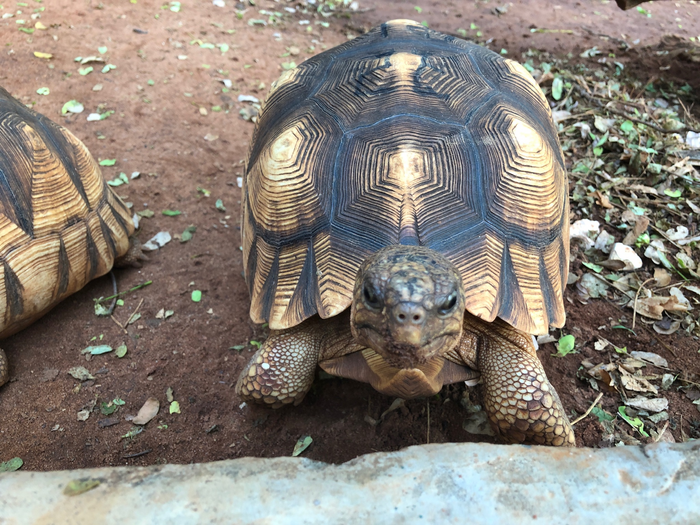
Credit: University of Maryland Associate Professor Meredith Gore
Though wildlife trafficking has been effectively disrupted since the first World Wildlife Day—established 50 years ago today via the 1973 Convention on International Trade in Endangered Species (CITES) of Wild Fauna and Flora—a newly published case study on one of the world’s rarest tortoise species, the ploughshare tortoise, highlights how much room for improvement still exists.
In a new paper published in the Proceedings of the National Academies of the Sciences, University of Maryland Associate Professor Meredith Gore and her coauthors—Babson College’s Emily Griffin, Bistra Dilkina and Aaron Ferber from the University of Southern California, Michigan State University’s Stanley E. Griffis, the University of Alabama’s Burcu B. Keskin, and John Macdonald from Colorado State University—detail a 2018 effort to map ploughshare tortoises’ location within and around Soalala, Madagascar; nearby villages; known trafficking pathways and transit routes; and the amount of trafficking risk associated with each of those areas. The group of approximately 50 stakeholders also shared more qualitative information that might play a role in poachers’ trafficking process, such as paths of cultural and spiritual significance, tides’ influence on decision-making; and where poachers met to plan their activities.
This information was drawn onto a clear, plastic sheet that was laid across a color-based map of the region. That information was then digitized into a geographic information system, creating what the researchers’ called a “mess” that nevertheless revealed novel information for the effective targeting of those ploughshare tortoise trafficking networks.
“Our science team used a cross-disciplinary and cross-sectoral approach to think about, measure, and analyze data,” explains Gore. “Not only were we able to shift the data landscape to clarify how important water routes are to the resilience of the illicit supply chain, we were able to normalize technical spatial data with insights from traditionally marginalized voices—women.”
Gore and her co-authors argue that if a process like this were to be paired with the latest advancements in computational science, operations engineering, and supply chain management, together, researchers could dramatically disrupt wildlife trafficking networks, and thereby conserve more animals, like the ploughshare tortoise, who are already on the brink of extinction.
“As we celebrate World Wildlife Day, our recent work highlights the urgent need for interdisciplinary collaboration to address the complex global issue of wildlife trafficking,” says Bistra Dilkina, an associate professor of computer science and industrial and systems engineering at the University of Southern California. “I feel privileged to have the opportunity to work with a trans-disciplinary team to synthesize a roadmap of how our different disciplines can work together to fight illegal wildlife trafficking and trade. In particular, I am excited to think deeply about the advantages that data-driven approaches in machine learning and optimization can bring to this important endeavor.”
Looking to the future, the researchers believe that with increased interdisciplinary collaborations, conservationists may one day be able to predict which path a trafficker will take, target areas where locals could undergo trainings and be empowered to play a part in preventing wildlife trafficking, better allocate limited resources to have the greatest interventional impact, and more.
“It’s easy to reflect on the array of conservation accomplishments that have been made since World Wildlife Day was first celebrated,” says Gore. “Our hope is that interdisciplinary science will produce additional high-return investments for the conservation sector in the future, most notably by advancing knowledge about changes and shifts in patterns of wildlife trafficking networks in a changing environment.”
To read the researchers’ full paper, visit doi.org/10.1073/pnas.2208268120.
To learn more about World Wildlife Day, visit wildlifeday.org/en.
DOI
10.1073/pnas.2208268120
Method of Research
Case study
Subject of Research
Animals
Article Title
Advancing interdisciplinary science for disrupting wildlife trafficking networks
Article Publication Date
27-Feb-2023
COI Statement
The authors declare no competing interest.