

• HOME
  • NEWS
  • EXPLORE
    • CAREER
      • Companies
      • Jobs
    • EVENTS
    • iGEM
      • News
      • Team
    • PHOTOS
    • VIDEO
    • WIKI
  • BLOG
  • COMMUNITY
    • FACEBOOK
    • INSTAGRAM
    • TWITTER
Saturday, May 2, 2026
BIOENGINEER.ORG
No Result
View All Result
  • Login
  • HOME
  • NEWS
  • EXPLORE
    • CAREER
      • Companies
      • Jobs
        • Lecturer
        • PhD Studentship
        • Postdoc
        • Research Assistant
    • EVENTS
    • iGEM
      • News
      • Team
    • PHOTOS
    • VIDEO
    • WIKI
  • BLOG
  • COMMUNITY
    • FACEBOOK
    • INSTAGRAM
    • TWITTER
  • HOME
  • NEWS
  • EXPLORE
    • CAREER
      • Companies
      • Jobs
        • Lecturer
        • PhD Studentship
        • Postdoc
        • Research Assistant
    • EVENTS
    • iGEM
      • News
      • Team
    • PHOTOS
    • VIDEO
    • WIKI
  • BLOG
  • COMMUNITY
    • FACEBOOK
    • INSTAGRAM
    • TWITTER
No Result
View All Result
Bioengineer.org
No Result
View All Result
Home NEWS Science News Chemistry

NASA awards $680,000 to study evolution of chemical systems on Titan

Bioengineer by Bioengineer
March 1, 2023
in Chemistry
Reading Time: 2 mins read
0
Vincent Chevrier
Share on FacebookShare on TwitterShare on LinkedinShare on RedditShare on Telegram

Vincent Chevrier, an associate professor at the U of A Center for Space and Planetary Sciences, has been awarded $680,000 from NASA to study the chemical reactions of complex carbon chains, called tholins, with liquid hydrocarbons. He will do so through experimental investigations designed to simulate conditions on the surface of Titan. 
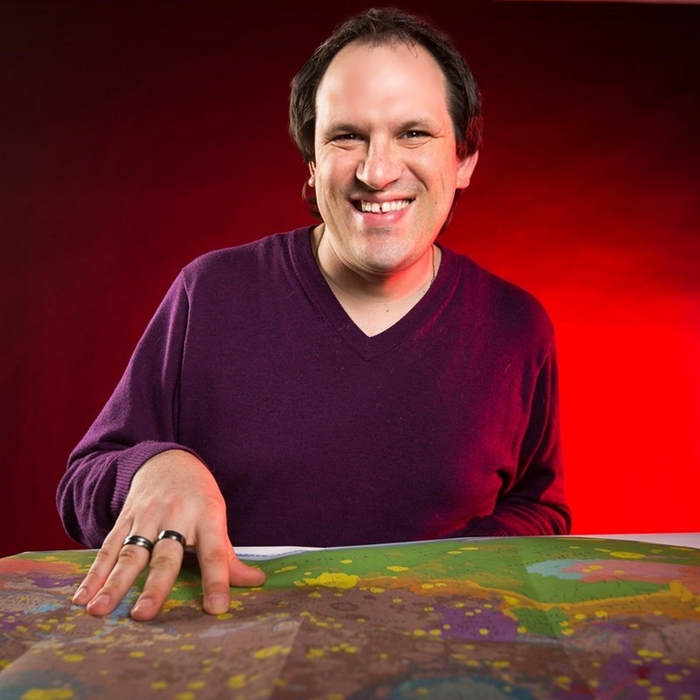
Vincent Chevrier

Credit: University Relations

Vincent Chevrier, an associate professor at the U of A Center for Space and Planetary Sciences, has been awarded $680,000 from NASA to study the chemical reactions of complex carbon chains, called tholins, with liquid hydrocarbons. He will do so through experimental investigations designed to simulate conditions on the surface of Titan. 

Known for its cloudy orange color, Titan is the largest satellite of Saturn and the second-largest moon in our solar system. Titan and Earth are the only two planetary bodies known to have stable bodies of liquid on their surface, providing a meaningful point of comparison.

Titan’s cloudy orange color is a result of solid organic molecules called tholins. In an article published in Discover, Korey Haynes stated that “broadly speaking, tholins are complex carbon chains made when ultraviolet light strikes carbon-rich molecules like methane, ethane or nitrogen. The result is a reddish, tarry substance.” Tholins were first identified by Carl Sagan and Bishun Khare in the 1970s and subsequently named by Sagan. 

In his proposal to NASA, Chevrier noted that “because of its complex organic chemistry, Titan has often been described as a ‘frozen’ prebiotic [before the emergence of life] Earth, and its study may bring valuable insights into our prebiotic atmosphere and how life emerged on Earth. Moreover, one of Titan’s most interesting aspects is the possibility for these exotic solvents to host prebiotic chemistry, which in turns has implications for possible exoplanets hosting similar hydrocarbon solvents.”

There are three questions Chevrier is seeking to answer by studying the interactions of tholins with liquid hydrocarbons:

  1. Are tholins soluble in the liquid hydrocarbons present at the surface of Titan? This question relates to the composition of Titan’s lakes. 
  2. Are tholins reacting with minor polar compounds dissolved in the lakes? This question relates to a possible chemical activity in the lakes. 
  3. Can tholins be detected in Titan’s lakes? This question relates to the detectability of complex organics in the lakes for future missions on Titan’s surface exploration.

Because Titan is 746 million miles from Earth, and $680,000 would barely cover pretzels on a SpaceX flight, Chevrier will have to simulate Titan-like conditions here on Earth. He’ll do this by utilizing a unique simulation chamber that can be reduced to -180 degrees Celsius. He and his team will simulate the atmosphere of Titan inside the chamber while introducing various synthetic tholins to it and exposing them to different liquid hydrocarbons. Over the course of three years, he plans to conduct dozens of different experiments involving a variety of solvents, like liquid methane, and different tholins at varying temperatures. 

The three-year award comes via the NASA ROSES (Research Opportunities in Space and Earth Sciences) 2022 Solar System Workings Program.



Share12Tweet8Share2ShareShareShare2

Related Posts

Using Epigenetics to Monitor Environmental Arsenic Exposure — Chemistry

Using Epigenetics to Monitor Environmental Arsenic Exposure

May 1, 2026
Innovative Nanoreactor Design Enhances Catalysis by Optimizing Transport and Reaction Kinetics — Chemistry

Innovative Nanoreactor Design Enhances Catalysis by Optimizing Transport and Reaction Kinetics

May 1, 2026

Swift Creation of Conductive Organic Compounds via Mechanochemistry

May 1, 2026

Scientists Reveal Atomic Mechanism Behind Water-Induced Hydroxylation in CoOx Nanostructures

May 1, 2026

POPULAR NEWS

  • Research Indicates Potential Connection Between Prenatal Medication Exposure and Elevated Autism Risk

    832 shares
    Share 333 Tweet 208
  • New Study Reveals Plants Can Detect the Sound of Rain

    714 shares
    Share 285 Tweet 178
  • Scientists Investigate Possible Connection Between COVID-19 and Increased Lung Cancer Risk

    67 shares
    Share 27 Tweet 17
  • Salmonella Haem Blocks Macrophages, Boosts Infection

    61 shares
    Share 24 Tweet 15

About

We bring you the latest biotechnology news from best research centers and universities around the world. Check our website.

Follow us

Recent News

Family Health Needs of Disabled Elders Explored

Mcu Controls Bone Growth Through Mitochondrial Calcium

Physical Disorders, ADLs, Cognition, Depression in Nursing Homes

Subscribe to Blog via Email

Success! An email was just sent to confirm your subscription. Please find the email now and click 'Confirm' to start subscribing.

Join 82 other subscribers
  • Contact Us

Bioengineer.org © Copyright 2023 All Rights Reserved.

Welcome Back!

Login to your account below

Forgotten Password?

Retrieve your password

Please enter your username or email address to reset your password.

Log In
No Result
View All Result
  • Homepages
    • Home Page 1
    • Home Page 2
  • News
  • National
  • Business
  • Health
  • Lifestyle
  • Science

Bioengineer.org © Copyright 2023 All Rights Reserved.