• HOME
  • NEWS
  • EXPLORE
    • CAREER
      • Companies
      • Jobs
    • EVENTS
    • iGEM
      • News
      • Team
    • PHOTOS
    • VIDEO
    • WIKI
  • BLOG
  • COMMUNITY
    • FACEBOOK
    • INSTAGRAM
    • TWITTER
Tuesday, December 23, 2025
BIOENGINEER.ORG
No Result
View All Result
  • Login
  • HOME
  • NEWS
  • EXPLORE
    • CAREER
      • Companies
      • Jobs
        • Lecturer
        • PhD Studentship
        • Postdoc
        • Research Assistant
    • EVENTS
    • iGEM
      • News
      • Team
    • PHOTOS
    • VIDEO
    • WIKI
  • BLOG
  • COMMUNITY
    • FACEBOOK
    • INSTAGRAM
    • TWITTER
  • HOME
  • NEWS
  • EXPLORE
    • CAREER
      • Companies
      • Jobs
        • Lecturer
        • PhD Studentship
        • Postdoc
        • Research Assistant
    • EVENTS
    • iGEM
      • News
      • Team
    • PHOTOS
    • VIDEO
    • WIKI
  • BLOG
  • COMMUNITY
    • FACEBOOK
    • INSTAGRAM
    • TWITTER
No Result
View All Result
Bioengineer.org
No Result
View All Result
Home NEWS Science News Chemistry

Solid-state thermal transistor demonstrated

Bioengineer by Bioengineer
February 21, 2023
in Chemistry
Reading Time: 2 mins read
0
The solid-state electrochemical thermal transistor
Share on FacebookShare on TwitterShare on LinkedinShare on RedditShare on Telegram

An effective, stable solid-state electrochemical transistor has been developed, heralding a new era in thermal management technology.
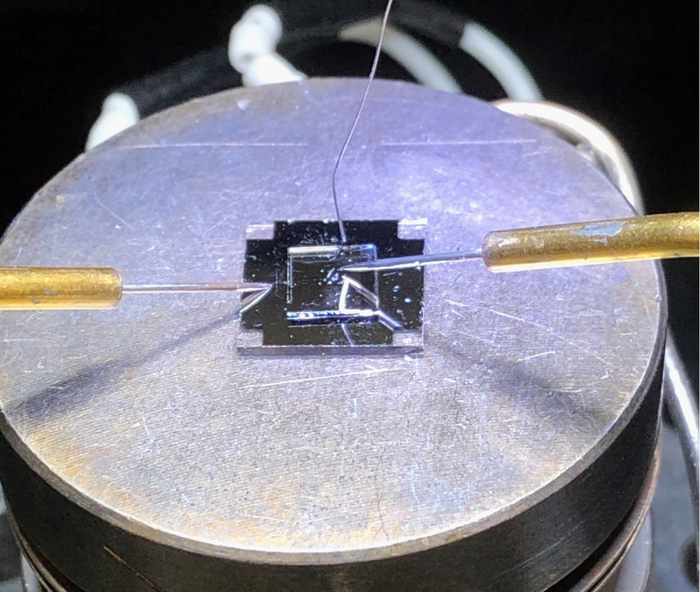
The solid-state electrochemical thermal transistor

Credit: Hiromichi Ohta

An effective, stable solid-state electrochemical transistor has been developed, heralding a new era in thermal management technology.

In modern electronics, a large amount of heat is produced as waste during usage—this is why devices such as laptops and mobile phones become warm during use, and require cooling solutions. In the last decade, the concept of managing this heat using electricity has been tested, leading to the development of electrochemical thermal transistors—devices that can be used to control heat flow with electrical signals. Currently, liquid-state thermal transistors are in use, but have critical limitations: chiefly, any leakage causes the device to stop working.

A research team at Hokkaido University lead by Professor Hiromichi Ohta at the Research Institute for Electronic science has developed the first solid-state electrochemical thermal transistor. Their invention, described in the journal Advanced Functional Materials, is much more stable than and just as effective as current liquid-state thermal transistors.

“A thermal transistor consists broadly of two materials, the active material and the switching material,” explains Ohta. “The active material has changeable thermal conductivity (), and the switching material is used to control the thermal conductivity of the active material.”

The team constructed their thermal transistor on a yttrium oxide-stabilized zirconium oxide base, which also functioned as the switching material, and used strontium cobalt oxide as the active material. Platinum electrodes were used to supply the power required to control the transistor.

The thermal conductivity of the active material in the “on” state was comparable to some liquid-state thermal transistors. In general, thermal conductivity of the active material was four times higher in the “on” state compared to the “off” state. Further, the transistor was stable over 10 use cycles, better than some current liquid-state thermal transistors. This behavior was tested across more than 20 separately fabricated thermal transistors, ensuring the results were reproducible. The only drawback was the operating temperature of around 300°C.

“Our findings show that solid-state electrochemical thermal transistors have the potential to be just as effective as liquid-state electrochemical thermal transistors, with none of their limitations,” concludes Ohta. “The main hurdle to developing practical thermal transistors is the high resistance of the switching material, and hence a high operating temperature. This will be the focus of our future research.”


Journal

Advanced Functional Materials

DOI

10.1002/adfm.202214939

Method of Research

Experimental study

Subject of Research

Not applicable

Article Title

Solid-State Electrochemical Thermal Transistors

Article Publication Date

21-Feb-2023
Share12Tweet8Share2ShareShareShare2

Related Posts

Cutting Electrolyte Reduction Boosts High-Energy Battery Performance

Cutting Electrolyte Reduction Boosts High-Energy Battery Performance

December 19, 2025
Microenvironment Shapes Gold-Catalysed CO2 Electroreduction

Microenvironment Shapes Gold-Catalysed CO2 Electroreduction

December 11, 2025

Photoswitchable Olefins Enable Controlled Polymerization

December 11, 2025

Cation Hydration Entropy Controls Chloride Ion Diffusion

December 10, 2025

POPULAR NEWS

  • Nurses’ Views on Online Learning: Effects on Performance

    Nurses’ Views on Online Learning: Effects on Performance

    70 shares
    Share 28 Tweet 18
  • NSF funds machine-learning research at UNO and UNL to study energy requirements of walking in older adults

    71 shares
    Share 28 Tweet 18
  • Unraveling Levofloxacin’s Impact on Brain Function

    54 shares
    Share 22 Tweet 14
  • Exploring Audiology Accessibility in Johannesburg, South Africa

    51 shares
    Share 20 Tweet 13

About

We bring you the latest biotechnology news from best research centers and universities around the world. Check our website.

Follow us

Recent News

Hydrocolloids Boost Orally Disintegrating Film Performance

Muscle Bursting Signals Impulse Control Issues in Parkinson’s

Racial Gaps in Cardiovascular Risk Control in Obesity

Subscribe to Blog via Email

Enter your email address to subscribe to this blog and receive notifications of new posts by email.

Join 70 other subscribers
  • Contact Us

Bioengineer.org © Copyright 2023 All Rights Reserved.

Welcome Back!

Login to your account below

Forgotten Password?

Retrieve your password

Please enter your username or email address to reset your password.

Log In
No Result
View All Result
  • Homepages
    • Home Page 1
    • Home Page 2
  • News
  • National
  • Business
  • Health
  • Lifestyle
  • Science

Bioengineer.org © Copyright 2023 All Rights Reserved.