WASHINGTON, Feb. 21, 2023 – It is a cruel paradox that on a planet with a surface mostly covered by water, hundreds of millions of people don’t have access to clean drinking water. As for the pollution of potable and natural water sources, one of the main culprits is arsenic, an abundant and toxic element in the earth’s crust. Arsenic is currently known as the cause of groundwater contamination in more than 100 countries – and can produce life-threatening diseases, especially for populations in developing countries. Such circumstances necessitate efficient and reliable arsenic detection methods for water, food, and soil.
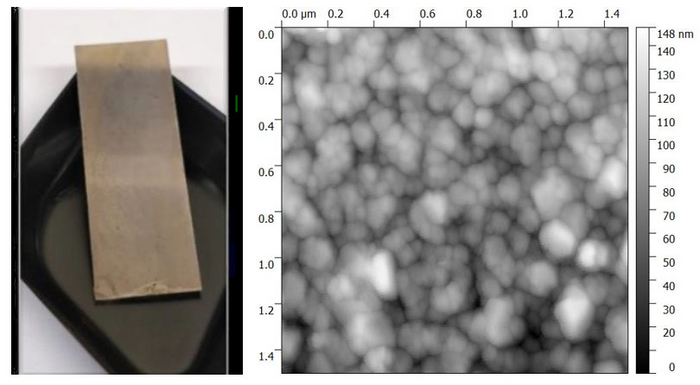
Credit: Credit: Dominique Vouagner
WASHINGTON, Feb. 21, 2023 – It is a cruel paradox that on a planet with a surface mostly covered by water, hundreds of millions of people don’t have access to clean drinking water. As for the pollution of potable and natural water sources, one of the main culprits is arsenic, an abundant and toxic element in the earth’s crust. Arsenic is currently known as the cause of groundwater contamination in more than 100 countries – and can produce life-threatening diseases, especially for populations in developing countries. Such circumstances necessitate efficient and reliable arsenic detection methods for water, food, and soil.
In Journal of Applied Physics, from AIP Publishing, a team of French scientists fabricated sensitive nanostructured silver surfaces to detect arsenic, even at very low concentrations.
The sensors make use of surface-enhanced Raman spectroscopy (SERS). As a molecule containing arsenic adheres to the surface, it is also hit with a laser. The arsenic compound scatters the laser light, creating an identifiable signature that indicates its presence.
“Arsenic exists in water in different forms, so it is important to be able to quantify the species, in addition to the global content,” said author Dominique Vouagner. “By using SERS, we can detect and speciate pollutants even at the lowest concentration. This includes arsenic, which should not exceed 10 ppb, as per the World Health Organization’s recommendations.”
The team compared the detection and speciation performances of two SERS substrates. One was prepared by conventional thermal evaporation, where material is heated until it vaporizes. The other was created with an electroless process, in which a coating is deposited on a material by submerging it in a liquid and instigating a chemical reaction. The latter was revealed to be much more sensitive and is relatively easy and safe to produce, according to Vouagner.
“Our technique for developing this SERS substrate makes it simple to manufacture because the electroless films can be easily deposited on various substrates,” she said. “Plus, the starting compounds have low environmental toxicity, which is a benefit for detection measurements in natural as well as potable water.”
The technique is a departure from existing reference methods for trace arsenic speciation, which are time-consuming and expensive. Conventional methods also require sample pre-treatment in a lab, so they are not ideally suited to on-site field assays.
Additionally, the new method employs the use of a solid substrate, which enables optical interrogation.
“Because they’re less ‘noisy,’ optical detection systems are much more sensitive than electronic systems,” said author Bernard Dussardier. “At the same time, they’re less sensitive to parasitic electromagnetic fields. Also, the SERS technique allows direct physical-chemical property measurements, whereas electronic systems, and some other optical systems, are indirect.”
###
The article “Towards surface-enhanced Raman scattering using electroless substrate for trace arsenic detection and speciation” is authored by Marie Adier, Anne‐Marie Jurdyc, Charlotte Hurel, François Goutaland, Jean‐Yves Michalon, Alexandre Merlen, Bernard Dussardier, and Dominique Vouagner. It will appear in Journal of Applied Physics on Feb. 21, 2023 (DOI: 10.1063/5.0126372). After that date, it can be accessed at http://aip.scitation.org/doi/full/10.1063/5.0126372.
ABOUT THE JOURNAL
Journal of Applied Physics is an influential international journal publishing significant new experimental and theoretical results in all areas of applied physics. See https://aip.scitation.org/journal/jap.
###
Journal
Journal of Applied Physics
DOI
10.1063/5.0126372
Article Title
Towards surface-enhanced Raman scattering using electroless substrate for trace arsenic detection and speciation
Article Publication Date
21-Feb-2023