ROCKVILLE, MD – Approximately three million Americans suffer from opioid use disorder, and every year more than 80,000 Americans die from overdoses. Opioid drugs, such as heroin, fentanyl, oxycodone and morphine, activate opioid receptors. Activating mu-opioid receptors leads to pain relief and euphoria, but also physical dependence and decreased breathing, the latter leading to death in the case of drug overdose. Preclinical studies have shown that blocking kappa-opioid receptors may offer a promising pharmacological approach to treating opioid dependence. By discovering drugs that inhibit the kappa-opioid receptor, Leslie Salas Estrada, in the lab of Marta Filizola, at the Icahn School of Medicine at Mount Sinai, hopes to alleviate opioid addiction. Salas Estrada, a postdoctoral researcher, will present her work on Monday, February 20 at the 67th Annual Biophysical Society Meeting in San Diego, California.
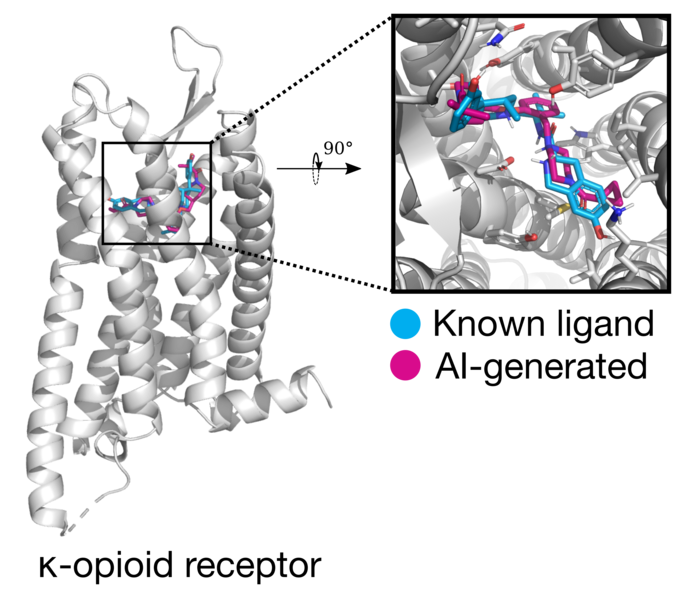
Credit: Image courtesy of Leslie Salas Estrada.
ROCKVILLE, MD – Approximately three million Americans suffer from opioid use disorder, and every year more than 80,000 Americans die from overdoses. Opioid drugs, such as heroin, fentanyl, oxycodone and morphine, activate opioid receptors. Activating mu-opioid receptors leads to pain relief and euphoria, but also physical dependence and decreased breathing, the latter leading to death in the case of drug overdose. Preclinical studies have shown that blocking kappa-opioid receptors may offer a promising pharmacological approach to treating opioid dependence. By discovering drugs that inhibit the kappa-opioid receptor, Leslie Salas Estrada, in the lab of Marta Filizola, at the Icahn School of Medicine at Mount Sinai, hopes to alleviate opioid addiction. Salas Estrada, a postdoctoral researcher, will present her work on Monday, February 20 at the 67th Annual Biophysical Society Meeting in San Diego, California.
Kappa-opioid receptors are known to mediate brain rewards. “If you’re addicted and you’re trying to quit, at some point you will get withdrawal symptoms, and those can be really hard to overcome,” Salas Estrada explained, “after a lot of opioid exposure, your brain gets rewired to need more drugs. Blocking the activity of the kappa opioid receptor has been shown in animal models to reduce this need to use drugs in the withdrawal period.”
However, discovering drugs that can block the activity of a protein, such as the kappa-opioid receptor, can be a long and expensive process. Using computational tools can make it more efficient, but it can take months to screen billions of chemical compounds. Instead, Salas Estrada is using artificial intelligence (AI) to optimize the process. “Artificial intelligence has the advantage of being able to take huge amounts of information and learn to recognize patterns from it. So, we believe that machine learning can help us to leverage the information that can be derived from large chemical databases to design new drugs from scratch. And in that way, we can potentially reduce the time and costs associated with drug discovery,” she said.
Using information about the kappa-opioid receptor and known drugs, they trained a computer model to generate compounds that might block the receptor with a reinforcement learning algorithm that rewarded properties that are favorable for drug treatments.
So far, the team has identified several compounds that have promising properties and they are working with collaborators to synthesize them and eventually test their ability to block the kappa-opioid receptor in cells, before testing them in animal models for safety and effectiveness. Ultimately, Salas Estrada said, “we hope we can help people struggling with addiction.”
###
The Biophysical Society, founded in 1958, is a professional, scientific Society established to lead development and dissemination of knowledge in biophysics. The Society promotes growth in this expanding field through its annual meeting, publications, and committee and outreach activities. Its 7,500 members are located throughout the United States and the world, where they teach and conduct research in colleges, universities, laboratories, government agencies, and industry.