Gas clouds in the Cygnus X Region, a region where stars form, are composed of a dense core of molecular hydrogen (H2) and an atomic shell. These ensembles of clouds interact with each other dynamically in order to quickly form new stars. That is the result of observations conducted by an international team led by scientists at the University of Cologne’s Institute of Astrophysics and at the University of Maryland. Until now, it was unclear how this process precisely unfolds. The Cygnus X region is a vast luminous cloud of gas and dust approximately 5,000 light years from Earth. Using observations of spectral lines of ionized carbon (CII), the scientists showed that the clouds have formed there over several million years, which is a fast process by astronomical standards. The results of the study ‘Ionized carbon as a tracer for the assembly of interstellar clouds’ will appear in the next issue of Nature Astronomy. The paper is already accessible online.
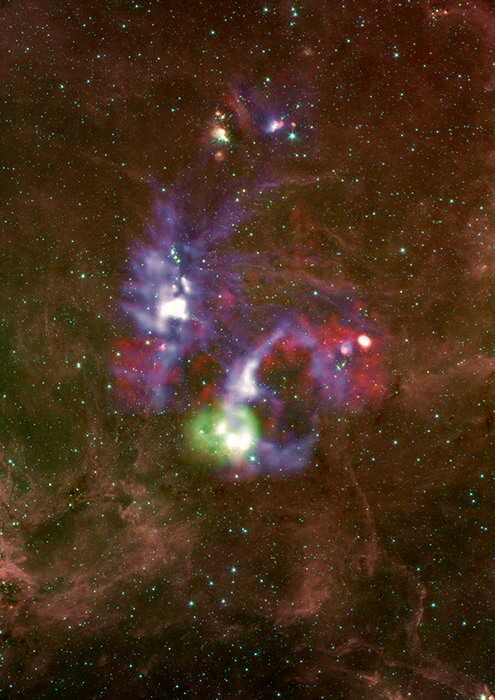
Credit: NASA Spitzer/IRAC MIPS, USRA/SOFIA (L. Proudfit, L. Bonne) and University of Cologne (N. Schneider)
Gas clouds in the Cygnus X Region, a region where stars form, are composed of a dense core of molecular hydrogen (H2) and an atomic shell. These ensembles of clouds interact with each other dynamically in order to quickly form new stars. That is the result of observations conducted by an international team led by scientists at the University of Cologne’s Institute of Astrophysics and at the University of Maryland. Until now, it was unclear how this process precisely unfolds. The Cygnus X region is a vast luminous cloud of gas and dust approximately 5,000 light years from Earth. Using observations of spectral lines of ionized carbon (CII), the scientists showed that the clouds have formed there over several million years, which is a fast process by astronomical standards. The results of the study ‘Ionized carbon as a tracer for the assembly of interstellar clouds’ will appear in the next issue of Nature Astronomy. The paper is already accessible online.
The observations were carried out in an international project led by Dr Nicola Schneider at the University of Cologne and Prof Alexander Tielens at the University of Maryland as part of the FEEDBACK programme on board the flying observatory SOFIA (Stratospheric Observatory for Infrared Astronomy). The new findings modify previous perceptions that this specific process of star formation is quasi-static and quite slow. The dynamic formation process now observed would also explain the formation of particularly massive stars.
By comparing the distribution of ionized carbon, molecular carbon monoxide and atomic hydrogen, the team found that the shells of interstellar gas clouds are made of hydrogen and collide with each other at speeds of up to twenty kilometres per second. “This high speed compresses the gas into denser molecular regions where new, mainly massive stars form. We needed the CII observations to detect this otherwise ‘dark’ gas,” said Dr Schneider. The observations show for the first time the faint CII radiation from the periphery of the clouds, which could not be observed before. Only SOFIA and its sensitive instruments were capable of detecting this radiation.
SOFIA was operated by NASA and the German Aerospace Center (DLR) until September 2022. The observatory consisted of a converted Boeing 747 with a built-in 2.7-metre telescope. It was coordinated by the German SOFIA Institute (DSI) and the Universities Space Research Association (USRA). SOFIA observed the sky from the stratosphere (above 13 kilometres) and covered the infrared region of the electromagnetic spectrum, just beyond what humans can see. The Boeing thus flew above most of the water vapour in the Earth’s atmosphere, which otherwise blocks out infrared light. This allowed the scientists to observe a wavelength range that is not accessible from Earth. For the current results, the team used the upGREAT receiver installed on SOFIA in 2015 by the Max Planck Institute for Radio Astronomy in Bonn and the University of Cologne.
Even though SOFIA is no longer in operation, the data collected so far are essential for basic astronomical research because there is no longer an instrument that extensively maps the sky in this wavelength range (typically 60 to 200 micrometres). The now active James Webb Space Telescope observes in the infrared at shorter wavelengths and focuses on spatially small areas. Therefore, the analysis of the data collected by SOFIA is ongoing and continues to provide important insights – also regarding other star-forming regions: “In the list of FEEDBACK sources, there are other gas clouds in different stages of evolution, where we are now looking for the weak CII radiation at the peripheries of the clouds to detect similar interactions as in the Cygnus X region,” Schneider concluded.
Journal
Nature Astronomy
Method of Research
Observational study
Subject of Research
Not applicable
Article Title
Ionized carbon as a tracer for the assembly of interstellar clouds’
Article Publication Date
16-Feb-2023