According to a new study published in Scientific Reports puppies – but not kittens and wolf pups – tend to spontaneously imitate human actions, even when they are not rewarded with food (or toys). The researchers of the Department of Ethology at Eötvös Loránd University (ELTE), Budapest, investigated whether young puppies, kittens and wolf pups have different tendencies to observe and imitate what a person did, without any pre-training and food reward.
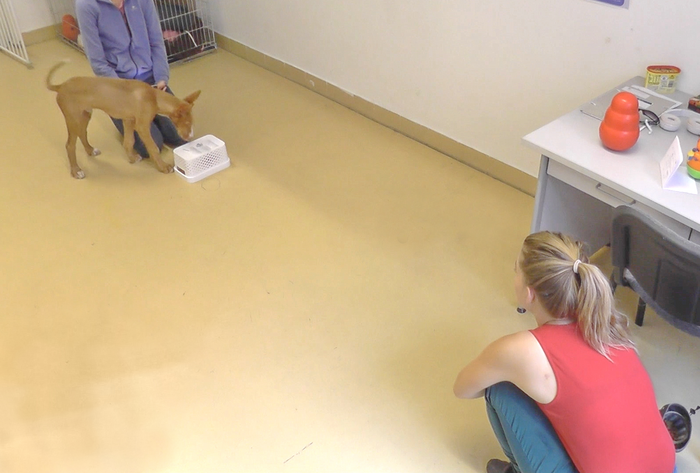
Credit: Photo: Claudia Fugazza
According to a new study published in Scientific Reports puppies – but not kittens and wolf pups – tend to spontaneously imitate human actions, even when they are not rewarded with food (or toys). The researchers of the Department of Ethology at Eötvös Loránd University (ELTE), Budapest, investigated whether young puppies, kittens and wolf pups have different tendencies to observe and imitate what a person did, without any pre-training and food reward.
Doing what others do in a new situation is a convenient way for young individuals to learn about the world. The tendency to copy the behaviour of others is not only useful to learn new skills or new information, but is also a way of promoting belonging to a social group.
Dogs, cats and wolves differ in their domestication histories and innate sociality,
which may influence their tendency to observe humans and learn socially from them.
The scientists first checked how 42 puppies, 39 kittens and 8 wolf pups, all socialized and living in human families, acted with a novel object placed in a room (e.g., touching it with the nose or paw). Next, while the owner was holding the subject, the experimenter demonstrated a different action on the object. For example, if the subject previously touched the object with its nose, then the experimenter touched it with her hand. Then the researchers observed whether the subject eventually performed the same action on the object.
“Since paying attention to the demonstration is a fundamental requisite for social learning, we first assessed whether the puppies, kittens and wolf pups looked at us when we performed the demonstration”, explains Claudia Fugazza, lead researcher of the group.
“While typically the puppies looked at us almost immediately, it took four-five times longer to get the attention of wolf pups and kittens”.
Puppies and wolf pups replicated the demonstrated actions in ca. 70% of the trials, twice as often as kittens, but only the puppies tended to imitate the action with a body part homologue to the human experimenter (e.g., paw – hand), even if that action differed from the action they performed when they had not observed a demonstration.
“Typically, most subjects touched the object with their nose, when they had not observed a demonstration. However, after observing the experimenter touching the object with her hand, the puppies tended to touch it using their paw”, reports Stefania Uccheddu, co-author of the study. Kittens and wolf pups did not copy the action.
The results seem to support the effect of both investigated factors – inherent sociality and domestication history: “While dogs’ and wolves’ ancestor was a group-living, social animal, with intense within-group cooperation for survival, cats’ ancestor was a solitary hunter”, explains Andrea Temesi, co-author of the study.
“Both, dogs and cats are domesticated species that today live in human families, but the dog was domesticated much earlier than the cat
(between 20000-40000 years vs. 10000 years ago) and dogs were selected for several forms of cooperation with humans. Cats had a different domestication process; they hunted mice and rats in the human environment, but did not have to cooperate or communicate with humans”, continues Márta Gácsi, co-author of the study.
Thus, it is not surprising that only puppies have developed the tendency to pay close attention to people and imitate their actions, even if there is no specific reason for doing so, such as getting food.
These results are intriguing, not only from a theoretical perspective, but also from an applied point of view:
“We believe that our findings can form the basis for the development of novel training methods
that rely on the tendency of puppies to learn by observation and to imitate human actions. This way, dog training can be less dependent on the use of food rewards and more able to take advantage of dogs’ natural propensity for social learning”, concludes Ákos Pogány.
Journal
Scientific Reports
DOI
10.1038/s41598-023-28959-5
Article Title
Spontaneous action matching in dog puppies, kittens and wolf pups
Article Publication Date
16-Feb-2023