EMBARGOED UNTIL THURSDAY 16 FEBRUARY 01:00 AM GMT/UTC (20:00 15 FEBRUARY ET)
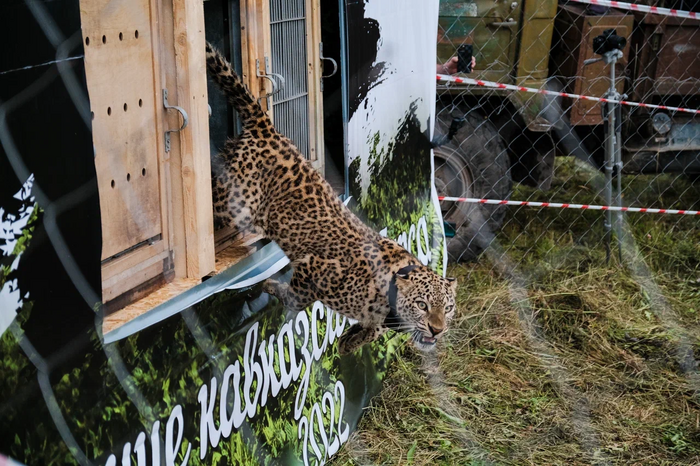
Credit: Caption: The 2022 release of a collared leopard into the North Ossetia (Central Caucasus), Russia. Image Source: Pavel Padalko.
EMBARGOED UNTIL THURSDAY 16 FEBRUARY 01:00 AM GMT/UTC (20:00 15 FEBRUARY ET)
- The findings are based on data from almost 300 relocations of large carnivores, from wolves to bears;
- Relocations showed a high overall success rate, and a significant increase over recent years;
- Key factors that boosted survival of relocated animals included using younger animals, using wild-born animals, and including an acclimatisation period;
- Low mating success of relocated animals indicates ongoing challenges for rewilding programmes.
New research published today has identified the top factors that determine whether efforts to relocate large carnivores to different areas are successful or not. The findings could support global rewilding efforts, from lynx reintroductions in the UK to efforts to restore logged tropical forests.
As apex predators, large carnivores play crucial roles in ecosystems, however their numbers have plummeted over recent decades. Relocating large carnivores can support their conservation, for instance to reintroduce a species to an area where it has been exterminated, or to reinforce an existing population to increase its viability. But to date, there has been little information about what factors determine whether these (often costly) efforts are successful or not.
The study was carried out by an international team led by researchers at the University of Oxford’s Department of Biology, Wildlife Conservation Research Unit (WildCRU), and School of Geography and the Environment. The group analysed data from almost 300 animal relocations which took place between 2007 and 2021. These spanned 22 countries in five continents, and involved 18 different carnivore species, including bears, hyaenas, big cats, and wild dogs.
Key findings:
- Overall, two thirds (66%) of the relocations were successful (where the animal survived in the wild for over 6 months).
- Success rates for large carnivore relocations have increased significantly since before 2007. For wild-born carnivores, success rates increased from 53% pre-2007 to 70%; and for captive-born animals, success rates doubled from 32% in pre-2007 to 64%.
- The species with the highest success rates included maned wolves, pumas, and ocelots which had a 100% success rate. The species with the lowest success rates (around 50%) were African lions, brown hyenas, cheetahs, Iberian lynx, and wolves.
- Overall, using a ‘soft release’ increased the odds of success by 2.5-fold. This involves acclimatising the animal to the new environment before it is fully released.
- Releasing younger animals (particularly 1 -2 year olds), also increased success rates. This may be because younger animals have greater behavioural plasticity to adapt to new environments, and they are less likely to have developed homing behaviours.
- For animals born in captivity, the success rate decreased by 1.5-fold, compared with animals born in the wild.
- However, just over a third (37%) of the relocated animals were observed to find a mate and/or raise a cub in their new habitat.
Although the fact that most relocated animals survived is encouraging, the authors say that the low mating success shows the ongoing challenges facing rewilding efforts and, crucially, the importance of protecting habitats that already exist.
Lead author Seth Thomas (Department of Biology, University of Oxford) remarked: ‘In the last 15 years we have become more successful at translocating and reintroducing large carnivores. This allows us to be optimistic for the future of rebuilding damaged ecosystems around the globe, but we must remember that it is always more important to protect large carnivore populations where they are now before we lose them. Even as we have grown to be more successful, 34% of individual translocations fail and they cannot be seen as a replacement for immediate conservation action to save these populations.’
In the near future, relocating large carnivores may become increasingly necessary as habitats become altered due to climate change, and if land use changes increase conflict between humans and animals.
In the UK, one of the most nature-deprived countries in the world, there have been calls to reintroduce formerly native apex predators, such as wolves and the Eurasian lynx.
Professor David Macdonald (WildCRU, Department of Biology, University of Oxford), a co-author for the study, said: ‘As the UN decade of ecosystem restoration gets underway, the ecological need and political appetite for relocations of large carnivores has never been greater, and they have the potential to contribute more now than ever before to biodiversity conservation. By scrutinising the most geographically comprehensive sample of relocated large carnivores to date, our study makes plain to conservationists and policy makers the urgency of improving rewilding efforts.’
Professor Alastair Driver, the Director of the charity Rewilding Britain (who were not directly involved in the study) said: ‘This study could not come at a better time here in the UK, with the devolved governments at last consulting positively on the merits of species reintroductions and various groups working hard on the feasibility of reintroducing species such as the European Wildcat and Eurasian Lynx. We still have a long way to go to overcome the misconceptions which dominate societal concerns around sharing our human-dominated landscape with other apex predators, but this report and the successes which it documents, will be hugely valuable in securing a more “grown-up” discussion on the subject. I have no doubt that this will, in turn, lead to well-planned and implemented carnivore reintroductions which only 10 years ago, I would have thought inconceivable in my lifetime.’
Dr. Miha Krofel (University of Ljubljana), a co-author who worked on lynx reintroductions included in the study said: ‘The main reason that allowed us to quantify the higher rate of success is the wider applicability of tracking technology compared to 15 years ago. Nowadays, many practitioners and scientists fit animals with tracking tags for better post-release monitoring of the translocated individuals. This allows us to learn from past releases to improve our interventions in the future.’
Notes for editors:
For media inquiries contact Seth Thomas: [email protected] Photographs of lynx, puma and leopard reintroductions are available on request.
The study ‘Evaluating the performance of conservation translocations in large carnivores across the world’ will be published in Biological Conservation at 01:00 AM GMT/UTC Thursday 16 February. Once published, the paper will be available at https://doi.org/10.1016/j.biocon.2023.109909 To view a pre-embargo copy of the paper, please contact Seth Thomas ([email protected])
About the University of Oxford
Oxford University has been placed number 1 in the Times Higher Education World University Rankings for the seventh year running, and number 2 in the QS World Rankings 2022. At the heart of this success are the twin-pillars of our ground-breaking research and innovation and our distinctive educational offer.
Oxford is world-famous for research and teaching excellence and home to some of the most talented people from across the globe. Our work helps the lives of millions, solving real-world problems through a huge network of partnerships and collaborations. The breadth and interdisciplinary nature of our research alongside our personalised approach to teaching sparks imaginative and inventive insights and solutions.
Through its research commercialisation arm, Oxford University Innovation, Oxford is the highest university patent filer in the UK and is ranked first in the UK for university spinouts, having created more than 200 new companies since 1988. Over a third of these companies have been created in the past three years. The university is a catalyst for prosperity in Oxfordshire and the United Kingdom, contributing £15.7 billion to the UK economy in 2018/19, and supports more than 28,000 full time jobs.
The Department of Biology is a University of Oxford department within the Maths, Physical and Life Sciences Division. It utilises academic strength in a broad range of bioscience disciplines to tackle global challenges such as food security, biodiversity loss, climate change and global pandemics. It also helps to train and equip the biologists of the future through holistic undergraduate and graduate courses. For more information visit www.biology.ox.ac.uk.
Journal
Biological Conservation
DOI
10.1016/j.biocon.2023.109909
Article Title
Evaluating the performance of conservation translocations in large carnivores across the world