“Our study suggests that platelets might contribute to limiting amyloid plaque size and neuronal damage, having a beneficial role in AD [Alzheimer’s disease].”
Credit: 2023 de Sousa et al.
“Our study suggests that platelets might contribute to limiting amyloid plaque size and neuronal damage, having a beneficial role in AD [Alzheimer’s disease].”
BUFFALO, NY- February 15, 2023 – A new research paper was published on the cover of Aging (listed as “Aging (Albany NY)” by Medline/PubMed and “Aging-US” by Web of Science) Volume 15, Issue 3, entitled, “Immune-mediated platelet depletion augments Alzheimer’s disease neuropathological hallmarks in APP-PS1 mice.”
In Alzheimer’s disease (AD), platelets become dysfunctional and might contribute to amyloid beta deposition. In a recent study, researchers Diana M. Bessa de Sousa, Ariane Benedetti, Barbara Altendorfer, Heike Mrowetz, Michael S. Unger, Katharina Schallmoser, Ludwig Aigner, and Kathrin Maria Kniewallner from Paracelsus Medical University and Austrian Cluster for Tissue Regeneration in Austria depleted platelets in one-year-old APP Swedish PS1 dE9 (APP-PS1) transgenic mice for five days, using intraperitoneal injections of an anti-CD42b antibody, and assessed changes in cerebral amyloidosis, plaque-associated neuritic dystrophy and gliosis.
“The potential role of platelets in amyloid beta deposition led to the hypothesis that reducing platelet numbers might ameliorate AD pathology [30]. Here, we performed immune-mediated platelet depletion in APP-PS1 mice with an already fully developed amyloidosis and investigated its effects on classical hallmarks of AD: amyloid plaque pathology, plaque-associated neuritic dystrophy and gliosis.”
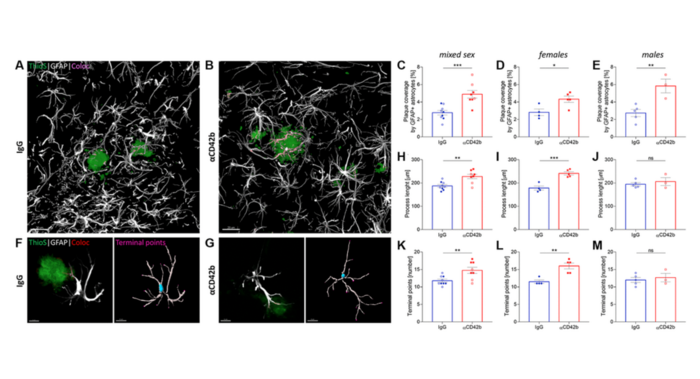
In APP-PS1 female mice, platelet depletion shifted amyloid plaque size distribution towards bigger plaques and increased neuritic dystrophy in the hippocampus. In platelet-depleted females, plaque-associated Iba1+ microglia had lower amounts of fibrillar amyloid beta cargo and GFAP+ astrocytic processes showed a higher overlap with thioflavin S+ amyloid plaques. In contrast to the popular hypothesis that platelets foster plaque pathology, data from this study suggest that platelets might limit plaque growth and attenuate plaque-related neuritic dystrophy at advanced stages of amyloid plaque pathology in APP-PS1 female mice. Whether the changes in amyloid plaque pathology are due to a direct effect on amyloid beta deposition or are a consequence of altered glial function needs to be further elucidated.
“In APP-PS1 females, acute thrombocytopenia aggravates AD neuropathology, suggesting that platelets might have a protective function in AD. However, the underlying molecular mechanisms by which platelets modulate amyloid plaque deposition remain elusive and need to be investigated in future experiments.”
DOI: https://doi.org/10.18632/aging.204502
Corresponding Author: Kathrin Maria Kniewallner – [email protected]
Keywords: Alzheimer’s disease, platelets, amyloid-beta, microglia, astrocytes
Sign up for free Altmetric alerts about this article: https://aging.altmetric.com/details/email_updates?id=10.18632%2Faging.204502
About Aging-US:
Launched in 2009, Aging (Aging-US) publishes papers of general interest and biological significance in all fields of aging research and age-related diseases, including cancer—and now, with a special focus on COVID-19 vulnerability as an age-dependent syndrome. Topics in Aging go beyond traditional gerontology, including, but not limited to, cellular and molecular biology, human age-related diseases, pathology in model organisms, signal transduction pathways (e.g., p53, sirtuins, and PI-3K/AKT/mTOR, among others), and approaches to modulating these signaling pathways.
Please visit our website at www.Aging-US.com and connect with us:
- SoundCloud
- YouTube
- LabTube
For media inquiries, please contact [email protected].
Aging (Aging-US) Journal Office
6666 E. Quaker Str., Suite 1B
Orchard Park, NY 14127
Phone: 1-800-922-0957, option 1
###
Journal
Aging-US
DOI
10.18632/aging.204502
Method of Research
Experimental study
Subject of Research
Animals
Article Title
Immune-mediated platelet depletion augments Alzheimer’s disease neuropathological hallmarks in APP-PS1 mice
Article Publication Date
1-Feb-2023