The European Commission has awarded IMPACTIVE almost €7.7 million to reinvent and reinforce the pharmaceutical supply chain. Currently, the production of drugs is associated with high levels of carbon emissions, as well as other environmental impacts linked to the excessive production of chemical waste. IMPACTIVE, a collaboration led by the University of Montpellier, in France, envisions an efficient and simple solution: mechanochemistry.
Credit: Impactive
The European Commission has awarded IMPACTIVE almost €7.7 million to reinvent and reinforce the pharmaceutical supply chain. Currently, the production of drugs is associated with high levels of carbon emissions, as well as other environmental impacts linked to the excessive production of chemical waste. IMPACTIVE, a collaboration led by the University of Montpellier, in France, envisions an efficient and simple solution: mechanochemistry.
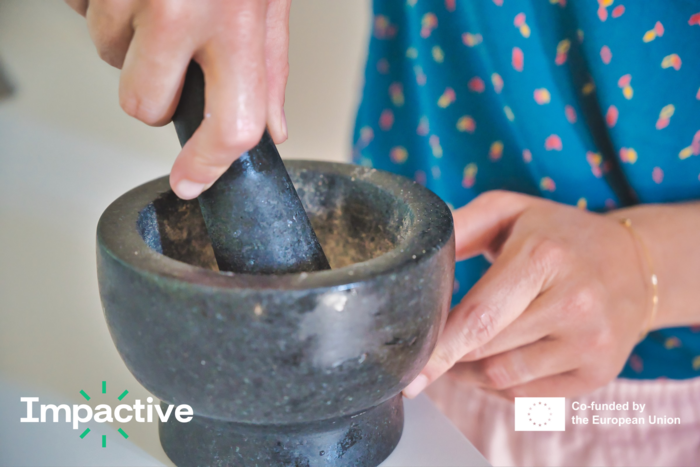
Mechanochemistry is a method that mashes molecules together, using ball mills. The mechanical force drives the chemical reactions with high efficacy and low cost. The main advantage of mechanochemistry is its independency of solvents, usually the basis of all traditional reactions and often linked to the generation of high quantities of toxic waste. In fact, currently the manufacture of 1 kilogram of active pharmaceutical ingredients (APIs) is unavoidably linked with almost 200 kilograms of waste. The elimination of solvents from synthesis and purification could minimise the ecological impact of industrial chemistry.
The most recent results report that mechanochemistry could reduce ecotoxicity and carbon emissions by up to 85% and, at the same time, optimise production costs by 12%. Already studied in small laboratory scales and used in production plants in fields like plastic production and materials’ manufacturing, mechanochemistry is now ready for the pharmaceutical industry. IMPACTIVE will study the synthesis of three families of API, and develop pilot production process ready for scale up. On top with key leaders in the field from academia and industry, the project also counts on two partners in the pharmaceutical industry – Novartis and Merck. This interdisciplinary collaboration will facilitate and accelerate the commercial implementation of the technology.
Beyond ball mills, the partners in IMPACTIVE will investigate other mechanochemical methods, more suitable for the scales required by pharmaceutical manufacturers. Among others, this will include twin-screw extrusion, resonant acoustic mixing and spray drying – all of which have showcased an interesting potential in preliminary studies.
“Overall, mechanochemistry avoids high temperatures and hazardous solvents, providing a more environmentally friendly alternative that reduces waste, and maximizes efficiency,” explains IMPACTIVE coordinator Evelina Colacino, based at the University of Montpellier. “These concepts constitute gold standards of green chemistry and the circular economy, and IMPACTIVE wants to transfer them to the European pharmaceutical landscape,” she adds.
Moreover, cost reduction and efficient manufacturing could help Europe tackle the current fragility of the supply chain, linked to severe shortages in drugs and pharmaceuticals. Mechanochemistry could become a key tool to improve crisis preparedness and API development during emergencies, thanks to innovative production processes and excellent efficiency.
IMPACTIVE grows on the success of two previous projects, in particular COST Action CA18112 ‘Mechanochemistry for Sustainable Industry’, also funded by the European Union, which helped establish efficient networks of researchers, innovators and industry leaders working in mechanochemistry. In the future, IMPACTIVE partners plan to become a reference in the field as well, further contributing to cross-collaboration between academia and industry to boost the possibilities of greener manufacturing methods with mechanochemistry.
IMPACTIVE is a big project, funded by the European Commission through its Horizon Europe programme. It’s led by the University of Montpellier, in France, and counts on seventeen partners from nine EU countries, as well as Switzerland and Israel. The consortium includes universities, research centres, industry leaders and SMEs, i.e.:
- University of Montpellier, France
- SATT Axlr, France
- Radboud Universiteit, Netherlands
- Université Catholique de Louvain, Belgium
- Taltech, Estonia
- BAM Institut, Germany
- RWTH Aachen University, Germany
- Max Planck Institut für Kohlenforschung, Germany
- Trinity College Dublin, Ireland
- Technion, Israel
- Center for Colloid and Surface Science (Universities of Cagliari, Parma and Salerno), Italy
- IST-ID, Portugal
- DES-Solutio, Portugal
- AGATA Comunicación Científica, Spain
- Haute École Spécialisée de Suisse Occidentale (HES·SO), Switzerland
- MERCK, Switzerland
- Novartis, Switzerland