Cultures from across the globe have used plant and animal extracts as food and traditional medicine. For instance, Asians, especially in Korea, China, and Japan, have used sea cucumber extracts to treat arthritis, frequent urination, impotence, and even cancer. While it is easy to be dismissive of these traditional medicines, sea cucumbers and, in fact, several other marine invertebrates may hold the key to new medicine.
Credit: Seon Beom Kim from Pusan National University, Korea
Cultures from across the globe have used plant and animal extracts as food and traditional medicine. For instance, Asians, especially in Korea, China, and Japan, have used sea cucumber extracts to treat arthritis, frequent urination, impotence, and even cancer. While it is easy to be dismissive of these traditional medicines, sea cucumbers and, in fact, several other marine invertebrates may hold the key to new medicine.
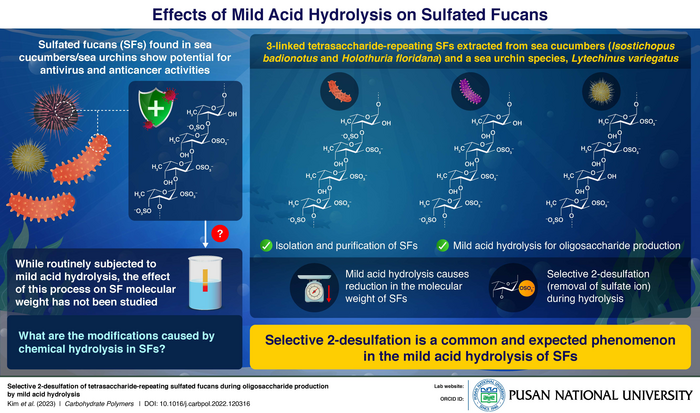
A class of compounds called “sulfated fucans” (SFs), essentially fucose-rich sulfated polysaccharides found in sea cucumbers and sea urchins, are renowned for their anticoagulant, antiviral, and anticancer properties. Recently, they have been investigated for their potency against the SARS-CoV-2 virus. To study these SFs, one needs to reduce their molecular weight by breaking them down into oligosaccharides. This is often done using a process called “mild acid hydrolysis.” Therefore, it is important to know the structural modifications caused by this mild acid hydrolysis on SFs.
This is where a team of researchers led by Professor Seon Beom Kim from Pusan National University in Korea and Assistant Professor Vitor H. Pomin from the University of Mississippi, USA came in. In a recent study made available online on 9 November 2022 and published in Volume 301, Part A of the journal Carbohydrate Polymers on 1 February 2023, they studied the mild acid hydrolysis of SFs extracted from two sea cucumber species, Isostichopus badionotus and Holothuria floridana, and one sea urchin species, Lytechinus variegatus, to see the effects of this process during oligosaccharide production. The study involved contributions from Dr. Marwa Farrag, Dr. Sushil K. Mishra, Dr. Sandeep K. Mishra, Dr. Joshua S. Sharp, and Dr. Robert J. Doerksen, all of them collaborating with Dr. Pomin’s group.
Speaking about the motivation behind their study, Prof. Kim explains, “One of the keys to being an antiviral agent without showing other biological activities is controlling the molecular weight of the polysaccharide. However, specific enzymes that can depolymerize marine polysaccharides are not widely known. As a result, the mild acid hydrolysis route is often the way to go. Therefore, there is an urgent need for physiochemical studies of SFs during the chemical hydrolysis process.”
Following the extraction of the SFs, the team characterized the structure of each of these SFs, revealing that they take the form of long chains of repeating blocks of four sugars containing sulfate (SO42-) ions. Thus, they were classified as 3-linked tetrasaccharide-repeating SFs. Next, these SFs were subjected to mild sulfuric acid and the oligosaccharide produced was investigated to see the changes caused by the hydrolysis. The researchers found that all three SFs showed a selective 2-desulfation in which the second sugar in the repeating tetrasaccharide lost the sulfate ion attached to it. This caused the long chains to break up and produce an 8-sugar-long oligosaccharide.
“The phenomenon of acid hydrolysis is constantly emphasized for the depolymerization of sulfated fucans. Our study shows that selective 2-desulfation is a common and expected phenomenon in oligosaccharide production by mild acid hydrolysis of SFs,” highlights Prof. Kim. “These results will help further the research on the medicinal properties of SFs, and could potentially result in new medicines for a wide variety of illnesses.”
We certainly hope his vision is realized and soon!
***
Reference
DOI: https://doi.org/10.1016/j.carbpol.2022.120316
Authors: Seon Beom Kima,b, Marwa Farraga,c, Sushil K. Mishraa, Sandeep K. Misraa, Joshua S. Sharpa,d, Robert J. Doerksena,e, Vitor H. Pomina,e,
Affiliations:
a Department of BioMolecular Sciences, University of Mississippi
b Department of Food Science & Technology, College of Natural Resources and Life Science, Pusan National University
c Department of Pharmacognosy, Faculty of Pharmacy, Assiut University
d Department of Chemistry and Biochemistry, University of Mississippi
e Research Institute of Pharmaceutical Sciences, School of Pharmacy, University of Mississippi
About Pusan National University
Pusan National University, located in Busan, South Korea, was founded in 1946, and is now the no. 1 national university of South Korea in research and educational competency. The multi-campus university also has other smaller campuses in Yangsan, Miryang, and Ami. The university prides itself on the principles of truth, freedom, and service, and has approximately 30,000 students, 1200 professors, and 750 faculty members. The university is composed of 14 colleges (schools) and one independent division, with 103 departments in all.
Website: https://www.pusan.ac.kr/eng/Main.do
About the author
Seon Beom Kim is a Professor at the Department of Food Science & Technology at Pusan National University, Korea and a faculty at the Department of BioMolecular Sciences at the University of Mississippi in the USA. His research interests include Food Chemistry, Natural Products Chemistry, Pharmacognosy, and polysaccharides. He has 56 publications to his name with over 900 citations to his credit.
Journal
Carbohydrate Polymers
DOI
10.1016/j.carbpol.2022.120316
Method of Research
Experimental study
Subject of Research
Animals
Article Title
Selective 2-desulfation of tetrasaccharide-repeating sulfated fucans during oligosaccharide production by mild acid hydrolysis
Article Publication Date
1-Feb-2023
COI Statement
The authors declare that they have no known competing financial interests or personal relationships that could have appeared to influence the work reported in this paper.