• HOME
  • NEWS
  • EXPLORE
    • CAREER
      • Companies
      • Jobs
    • EVENTS
    • iGEM
      • News
      • Team
    • PHOTOS
    • VIDEO
    • WIKI
  • BLOG
  • COMMUNITY
    • FACEBOOK
    • INSTAGRAM
    • TWITTER
Sunday, May 3, 2026
BIOENGINEER.ORG
No Result
View All Result
  • Login
  • HOME
  • NEWS
  • EXPLORE
    • CAREER
      • Companies
      • Jobs
        • Lecturer
        • PhD Studentship
        • Postdoc
        • Research Assistant
    • EVENTS
    • iGEM
      • News
      • Team
    • PHOTOS
    • VIDEO
    • WIKI
  • BLOG
  • COMMUNITY
    • FACEBOOK
    • INSTAGRAM
    • TWITTER
  • HOME
  • NEWS
  • EXPLORE
    • CAREER
      • Companies
      • Jobs
        • Lecturer
        • PhD Studentship
        • Postdoc
        • Research Assistant
    • EVENTS
    • iGEM
      • News
      • Team
    • PHOTOS
    • VIDEO
    • WIKI
  • BLOG
  • COMMUNITY
    • FACEBOOK
    • INSTAGRAM
    • TWITTER
No Result
View All Result
Bioengineer.org
No Result
View All Result
Home NEWS Science News Chemistry

Surface-lattice-confinement effect accelerate hydrogen spillover

Bioengineer by Bioengineer
February 9, 2023
in Chemistry
Reading Time: 2 mins read
0
Surface-lattice-confinement effect accelerate hydrogen spillover
Share on FacebookShare on TwitterShare on LinkedinShare on RedditShare on Telegram

Hydrogen spillover depicts the dynamic migration of surface adsorbed hydrogen species from hydrogen-rich sites to hydrogen-poor sites. It plays an important role in many H-involving reaction processes.
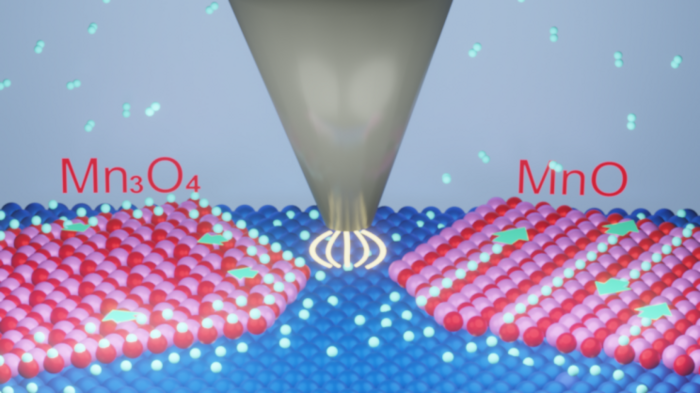
Surface-lattice-confinement effect accelerate hydrogen spillover

Credit: DICP

Hydrogen spillover depicts the dynamic migration of surface adsorbed hydrogen species from hydrogen-rich sites to hydrogen-poor sites. It plays an important role in many H-involving reaction processes.

In order to enhance the catalytic performance of H-involving reactions, it is important to understand the detailed mechanism of hydrogen spillover, and uncover how hydrogen transfers and what factors control hydrogen conductivity on solid surface.

Recently, a research team led by Prof. MU Rentao and Prof. FU Qiang from the Dalian Institute of Chemical Physics (DICP) of the Chinese Academy of Sciences (CAS) directly observed the acceleration of hydrogen spillover via surface-lattice-confinement effect.

This work was published in Nature Communications on February 04.

The researchers constructed stripe-like MnO(001) and grid-like Mn3O4(001) monolayers on Pt(111) substrate, and investigated their hydrogen spillover atop by a combination of surface science investigation and theoretical calculation.

They found that hydrogen species from Pt diffused unidirectionally along the stripes on MnO(001), whereas it exhibited an isotropic pathway on Mn3O4(001).

Moreover, by using dynamic surface imaging in H2 atmosphere, they revealed that hydrogen diffused four times more rapidly on MnO than the case on Mn3O4, which was promoted by one-dimension surface-lattice-confinement effect.

Theoretical calculations indicated that a uniform and medium O-O distance favored hydrogen diffusion while low-coordinate surface O atom inhibited it.

“Our study illustrates the surface-lattice-confinement effect of oxide catalysts on hydrogen spillover and provides a promising route to improve the hydrogen spillover efficiency.” said Prof. FU.

This work was supported by the National Key R&D Program of China, the National Natural Science Foundation of China, and Photon Science Center for Carbon Neutrality.


Journal

Nature Communications

DOI

10.1038/s41467-023-36044-8

Method of Research

Commentary/editorial

Subject of Research

Not applicable

Article Title

Direct observation of accelerating hydrogen spillover via surface-lattice-confinement effect

Article Publication Date

4-Feb-2023

Share12Tweet8Share2ShareShareShare2

Related Posts

Using Epigenetics to Monitor Environmental Arsenic Exposure — Chemistry

Using Epigenetics to Monitor Environmental Arsenic Exposure

May 1, 2026
Innovative Nanoreactor Design Enhances Catalysis by Optimizing Transport and Reaction Kinetics — Chemistry

Innovative Nanoreactor Design Enhances Catalysis by Optimizing Transport and Reaction Kinetics

May 1, 2026

Swift Creation of Conductive Organic Compounds via Mechanochemistry

May 1, 2026

Scientists Reveal Atomic Mechanism Behind Water-Induced Hydroxylation in CoOx Nanostructures

May 1, 2026

POPULAR NEWS

  • Research Indicates Potential Connection Between Prenatal Medication Exposure and Elevated Autism Risk

    832 shares
    Share 333 Tweet 208
  • New Study Reveals Plants Can Detect the Sound of Rain

    714 shares
    Share 285 Tweet 178
  • Scientists Investigate Possible Connection Between COVID-19 and Increased Lung Cancer Risk

    67 shares
    Share 27 Tweet 17
  • Salmonella Haem Blocks Macrophages, Boosts Infection

    61 shares
    Share 24 Tweet 15

About

We bring you the latest biotechnology news from best research centers and universities around the world. Check our website.

Follow us

Recent News

Family Health Needs of Disabled Elders Explored

Mcu Controls Bone Growth Through Mitochondrial Calcium

Physical Disorders, ADLs, Cognition, Depression in Nursing Homes

Subscribe to Blog via Email

Success! An email was just sent to confirm your subscription. Please find the email now and click 'Confirm' to start subscribing.

Join 82 other subscribers
  • Contact Us

Bioengineer.org © Copyright 2023 All Rights Reserved.

Welcome Back!

Login to your account below

Forgotten Password?

Retrieve your password

Please enter your username or email address to reset your password.

Log In
No Result
View All Result
  • Homepages
    • Home Page 1
    • Home Page 2
  • News
  • National
  • Business
  • Health
  • Lifestyle
  • Science

Bioengineer.org © Copyright 2023 All Rights Reserved.