The endangered Bahama Warbler may be surviving on just one island following Hurricane Dorian’s devastation in 2019, according to researchers at the University of East Anglia.
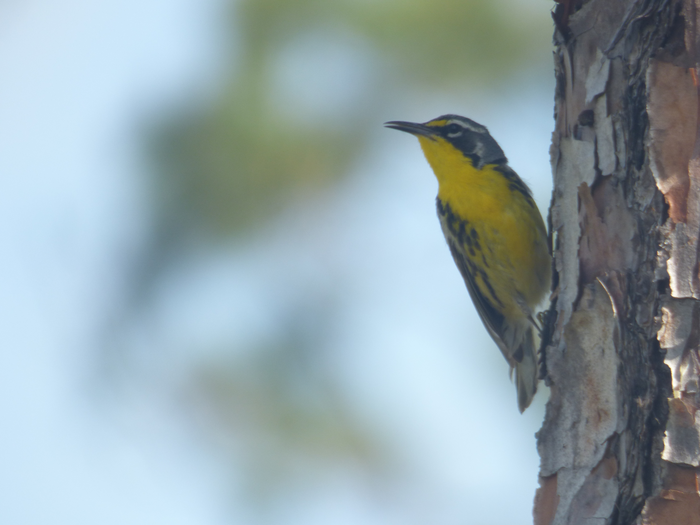
Credit: David Pereira
The endangered Bahama Warbler may be surviving on just one island following Hurricane Dorian’s devastation in 2019, according to researchers at the University of East Anglia.
A new study shows the bird’s distribution and ecology on Grand Bahama before the hurricane struck.
But the team says that the warbler may now only survive on neighbouring Abaco island, after hurricane Dorian destroyed the bird’s forest habitat on Grand Bahama.
The research comes from the same team that found what is thought to have been the last living Bahama Nuthatch, previously thought to have been extinct.
The fieldwork was conducted by two students on UEA’s Masters in Applied Ecology and Conservation, David Pereira and Matthew Gardner, who spent three months surveying the island for the Bahama Warbler and Bahama Nuthatch.
Their supervisor Prof Diana Bell, from UEA’s School of Biological Sciences, said: “Although more than half the endemic birds of the Bahamas are judged in danger of global extinction, there has been little international engagement to help remedy the situation.”
The Bahama Warbler is a little grey and yellow bird with a long bill and is only found on the islands of Grand Bahama and Abaco in the Bahamas.
But it is now classed as an endangered species – largely because its pine forest habitat has been seriously affected by urban development, human-induced fires, fly-tipping, logging and increased strength and frequency of hurricanes.
The team wanted to assess the birds’ conservation status and determine its habitat requirements after a Category 4 Hurricane (Matthew) hit the island in 2016. They also wanted to find out more about its habitat preferences for conservation purposes.
Pereira and Gardner searched for the little bird across 464 pine forest locations in Grand Bahama. They played recorded warbler song to attract the birds and also surveyed the habitat at each location, paying close attention to habitat damaged by hurricanes and fires.
They found a total of 327 warblers present in 209 of the 464 points surveyed. 71 per cent of sightings were in forests in the centre of the island and 29 per cent were in the East.
David Pereira said: “We found that the warblers were more likely to be present in sites with fewer needleless mature trees and some burnt vegetation. They seem to prefer living among taller, more mature, Thatch Palms. This is likely because these trees are capable of surviving forest fires and are also home to insects that warblers feed on.
“They also found that the species are quite adaptable, particularly when it comes to areas that have been affected by fire. This is probably because they can forage on tree trunks and use their bills to get under burnt peeling bark.”
Their co-supervisor Prof Nigel Collar, from BirdLife International, said: “We assume that Hurricane Matthew, which struck Grand Bahama only 18 months before our 2018 survey began, killed a significant proportion of the Bahama Warblers on the island. And it is possible that our findings on the bird’s preferences largely reflect the habitat that provided the best shelter.”
Fifteen months after the fieldwork ended, Hurricane Dorian devastated Grand Bahama with winds of 295 km per hour for over 24 hours, creating such human misery and economic damage that three years later the situation of the island’s wildlife remains unclear.
Matthew Gardner said: “It is possible that Grand Bahama’s entire population of Bahama Warblers was wiped out, but we know that the only other population of the species, on Abaco, has survived in the south of the island, where much of the forest remained standing.”
“We hope that our ecological insights will help conservation management on Abaco, but both islands now need to be surveyed,” added Prof Bell.
This research was funded by Thrigby Hall Wildlife Gardens and the Sir Philip Reckitt Educational Trust. The project was led by the University of East Anglia and BirdLife International in collaboration with the University of Chester.
‘Distribution and habitat requirements of the Bahama Warbler Setophaga flavescens on Grand Bahama in 2018’ is published in the journal Bird Conservation International.
ENDS
Journal
Bird Conservation International
Method of Research
Observational study
Subject of Research
Animals
Article Title
Distribution and habitat requirements of the Bahama Warbler Setophaga flavescens on Grand Bahama in 2018’
Article Publication Date
9-Feb-2023