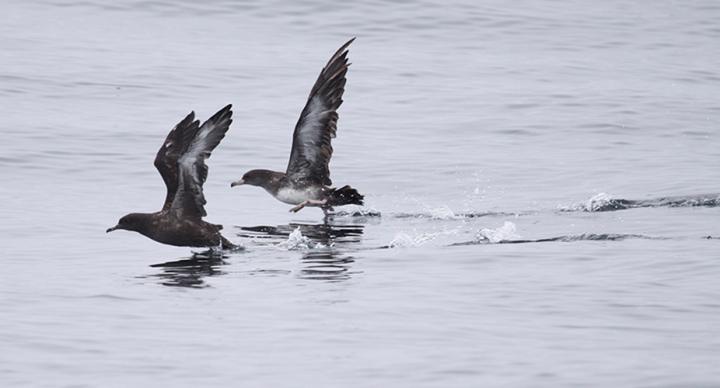
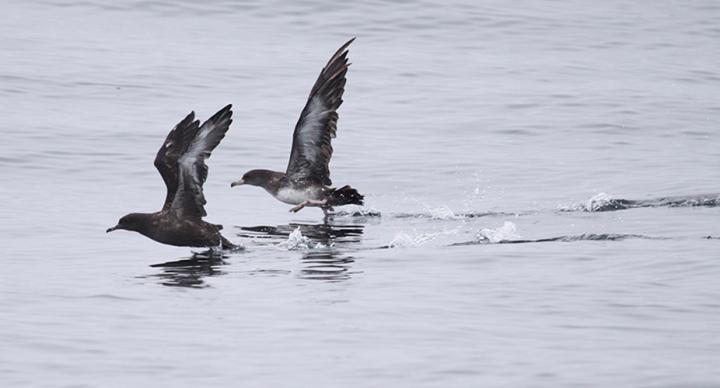
Credit: Sophie Webb, Point Blue/NOAA-ONMS/ACCESS)
A new study published Wednesday by SF State researchers could benefit ocean zoning for coastal development plans and prove life-saving for foraging seabirds along the Central California coastline in the event of an oil spill.
SF State geographer Anna Studwell and her collaborators published "Modeling Nonresident Seabird Foraging Distributions to Inform Ocean Zoning in Central California," which appears today in the journal PLOS ONE. The paper was actually the first chapter in Studwell's master's thesis in Geography and Environment at SF State under the supervision of Professor Ellen Hines. Studwell is interested in both conservation and in seabirds, which face threats at sea such as entanglement in fishing gear, she said. A 2015 study published in PLOS ONE recorded a 69.5 percent decline in seabird populations between 1950 and 2010 that's due in part to increased commercial fishing and pollution.
In the recent study, Studwell looked at 10 years (2004-2013) of data on six species of nonresident seabirds collected at the Greater Farallones and Cordell Bank national marine sanctuaries by researchers with the Applied California Current Ecosystem Studies (ACCESS) partnership. Nonresident seabirds are animals that are not breeding on the nearby islands off Central Calif., but rather are migrating or visiting to forage in the surrounding sea. There's already a lot of research on the Farallon Islands and the birds that live there, but the importance of Studwell's study is identifying the areas where seabirds that do not breed locally concentrate.
At least three times a year for 10 years, the ACCESS team and other researchers took to the sea and counted seabirds along specific routes called transect lines. But that left some parts of the sea unsampled. Studwell's research shows how it's possible to identify these offshore areas with existing data and then using predictive modeling. "Offshore areas, where seabirds spend a lot of their time when they forage are extremely challenging to predict," she said. "We found a way to identify areas that could have protections and we are overcoming those challenges."
The study fills a gap in terms of identifying and prioritizing important seabird areas around the two sanctuaries.
"We already are aware that breeding sites should be targeted for protection. It's much more challenging to target offshore areas, or areas that are far at sea," she said. "They are areas that are fluid. An island is something you can protect and lay a pretty clear boundary around. For those areas where birds go when they are no longer breeding, it's very difficult to identify a specific location that should have higher management and potentially more protection."
The next step in Studwell's research is to look at the specific threats seabirds face and how to prioritize seabird conservation, while considering disturbances posed by maritime activities that share the ocean.
Professor Hines, an SF State professor of geography and environment and associate director of the Romberg Tiburon Center for Environmental Studies, also worked on the study with Studwell. According to Hines, what's really important about the research is that it establishes a baseline of data for the foraging seabirds. "I want to see this kind of research continue," she said. "If we can figure out ways to keep funding this research to get these kind of data and can continue modeling environmental relationships over time, we can look at some very important correlations between climate change and human use and how it affects these animals. Marine megafauna are the indicators of the health of the food chain outside the San Francisco Bay."
###
"Modeling Nonresident Seabird Foraging Distributions to Inform Ocean Zoning in Central California" by Anna J. Studwell, Ellen Hines, Meredith L. Elliot, Julie Howar, Barbara Holzman, Nadav Nur and Jaime Jahncke is available at PLOS ONE. http://journals.plos.org/plosone/article?id=10.1371/journal.pone.0169517
Media Contact
Mary Kenny
[email protected]
415-338-7108
@SFSU
http://www.sfsu.edu
############
Story Source: Materials provided by Scienmag