**Strictly embargoed until 16:00 (GMT) Wednesday 8 February 2023**
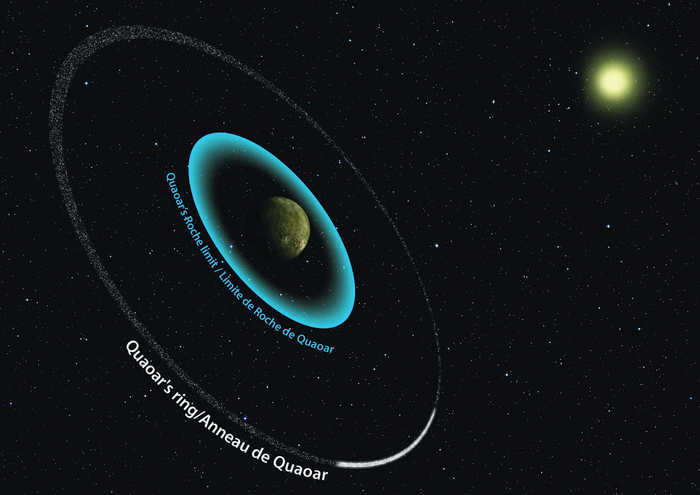
Credit: Paris Observatory
**Strictly embargoed until 16:00 (GMT) Wednesday 8 February 2023**
A new ring system discovered in our Solar System
-
Astronomers from the University of Sheffield have found a new ring system in our Solar System
-
The rings are around Quaoar, which is a Pluto-sized dwarf planet orbiting beyond Neptune
-
Quaoar’s rings are unique, orbiting much further away from the planet than the rings around Saturn, posing a challenge to ring formation theories
-
The discovery was made by a large team of international scientists using HiPERCAM – an extremely sensitive camera developed by scientists at the University of Sheffield which is mounted on the world’s largest optical telescope on La Palma
Scientists have discovered a new ring system around a dwarf planet on the edge of the Solar System. The ring system orbits much further out than is typical for other ring systems, calling into question current theories of how ring systems are formed.
The ring system is around a dwarf planet, named Quaoar, which is approximately half the size of Pluto and orbits the Sun beyond Neptune.
The discovery, published in Nature, was made by an international team of astronomers using HiPERCAM – an extremely sensitive high-speed camera developed by scientists at the University of Sheffield which is mounted on the world’s largest optical telescope, the 10.4 metre diameter Gran Telescopio Canarias (GTC) on La Palma.
The rings are too small and faint to see directly in an image. Instead, the researchers made their discovery by observing an occultation, when the light from a background star was blocked by Quaoar as it orbits the Sun. The event lasted less than a minute, but was unexpectedly preceded and followed by two dips in light, indicative of a ring system around Quaoar.
Ring systems are relatively rare in the Solar System – as well as the well-known rings around the giant planets Saturn, Jupiter, Uranus and Neptune, only two other minor planets possess rings – Chariklo and Haumea. All of the previously known ring systems are able to survive because they orbit close to the parent body, so that tidal forces prevent the ring material from accreting and forming moons.
What makes the ring system around Quaoar remarkable is that it lies at a distance of over seven planetary radii – twice as far out as what was previously thought to be the maximum radius according to the so-called `Roche limit’, which is the outer limit of where ring systems were thought to be able to survive. For comparison, the main rings around Saturn lie within three planetary radii. This discovery has therefore forced a rethink on theories of ring formation.
Professor Vik Dhillon, co-author of the study from the University of Sheffield’s Department of Physics and Astronomy, said: “It was unexpected to discover this new ring system in our Solar System, and it was doubly unexpected to find the rings so far out from Quaoar, challenging our previous notions of how such rings form. The use of our high-speed camera – HiPERCAM – was key to this discovery as the event lasted less than one minute and the rings are too small and faint to see in a direct image.
“Everyone learns about Saturn’s magnificent rings when they’re a child, so hopefully this new finding will provide further insight into how they came to be.”
The study involved 59 academics from all over the world, led by the Federal University of Rio de Janeiro in Brazil. The research was partly funded by the Science and Technology Facilities Council (STFC) and included six UK universities – Sheffield, Edinburgh, St Andrews, Warwick, Birmingham, and the Open University.
Ends
For more information please contact:
George Dean, Media and PR Assistant, University of Sheffield, 07984 335211, [email protected]
Journal
Nature
DOI
10.1038/s41586-022-05629-6
Method of Research
Observational study
Subject of Research
Not applicable
Article Title
A dense ring of the trans-Neptunian object Quaoar outside its Roche Limit
Article Publication Date
8-Feb-2023