• HOME
  • NEWS
  • EXPLORE
    • CAREER
      • Companies
      • Jobs
    • EVENTS
    • iGEM
      • News
      • Team
    • PHOTOS
    • VIDEO
    • WIKI
  • BLOG
  • COMMUNITY
    • FACEBOOK
    • INSTAGRAM
    • TWITTER
Sunday, October 4, 2026
BIOENGINEER.ORG
No Result
View All Result
  • Login
  • HOME
  • NEWS
  • EXPLORE
    • CAREER
      • Companies
      • Jobs
        • Lecturer
        • PhD Studentship
        • Postdoc
        • Research Assistant
    • EVENTS
    • iGEM
      • News
      • Team
    • PHOTOS
    • VIDEO
    • WIKI
  • BLOG
  • COMMUNITY
    • FACEBOOK
    • INSTAGRAM
    • TWITTER
No Result
View All Result
Bioengineer.org
No Result
View All Result
Home NEWS Science News Chemistry

Deep learning for quantum sensing

Bioengineer by Bioengineer
February 7, 2023
in Chemistry
Reading Time: 2 mins read
0
Machine learning for adaptive multiphase estimation with an integrated photonic quantum sensor.
Share on FacebookShare on TwitterShare on LinkedinShare on RedditShare on Telegram

Quantum sensing represents one of the most promising applications of quantum technologies, with the aim of using quantum resources to improve measurement sensitivity. In particular, sensing of optical phases is one of the most investigated problems, considered key to developing mass-produced technological devices. 
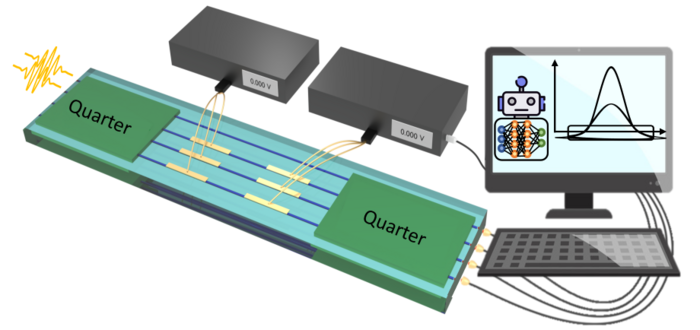
Machine learning for adaptive multiphase estimation with an integrated photonic quantum sensor.

Credit: Cimini et al., doi 10.1117/1.AP.5.1.016005.

Quantum sensing represents one of the most promising applications of quantum technologies, with the aim of using quantum resources to improve measurement sensitivity. In particular, sensing of optical phases is one of the most investigated problems, considered key to developing mass-produced technological devices. 

Optimal usage of quantum sensors requires regular characterization and calibration. In general, such calibration is an extremely complex and resource-intensive task — especially when considering systems for estimating multiple parameters, due to the sheer volume of required measurements as well as the computational time needed to analyze those measurements. Machine-learning algorithms present a powerful tool to address that complexity. The discovery of suitable protocols for algorithm usage is vital for the development of sensors for precise quantum-enhanced measurements.

A particular type of machine-learning algorithm known as “reinforcement learning” (RL) relies on an intelligent agent guided by rewards: depending on the rewards it receives it learns to perform the right actions to achieve the desired optimization. The first experimental realizations using RL algorithms for the optimization of quantum problems have been reported only very recently. Most of them still rely on prior knowledge of the model describing the system. What is desirable is instead a completely model-free approach, which is possible when the agent’s reward does not depend on the explicit system model.

As reported in Advanced Photonics, a team of researchers from the Physics Department of Sapienza University of Rome and the Institute for Photonics and Nanotechnologies (IFN-CRN) recently developed a model-free approach that widens the range of possible applications to that of adaptive multiphase estimation. They demonstrated the effectiveness of their model-free approach in a highly reconfigurable integrated photonic platform. They experimentally employ the RL algorithm to optimize estimation of multiple parameters and combine it with a deep neural network that updates after each measurement the Bayesian posterior probability distribution.

The protocol handles the quantum multiparameter sensor in a completely black-box manner, since at any step the system functioning model is not required. Importantly, they proved the enhanced performance obtained with their protocol on experimental data in a resource-limited regime and compared it to that of nonadaptive strategies, achieving significantly better estimations.

According to corresponding author Fabio Sciarrino, head of the Quantum Lab, “The protocol developed by our team provides a significant step toward fully artificial-intelligence-based quantum sensors.”

Read the Gold Open Access article by Cimini et al., “Deep reinforcement learning for quantum multiparameter estimation,” Adv. Photon. 5(1), 016005 (2023), doi 10.1117/1.AP.5.1.016005.


Journal

Advanced Photonics

DOI

10.1117/1.AP.5.1.016005

Article Title

Deep reinforcement learning for quantum multiparameter estimation

Article Publication Date

6-Feb-2023

Share12Tweet8Share2ShareShareShare2

Related Posts

Banana Peels Turn Into Catalysts That Boost Bio-Oil From Sewage Sludge

Banana Peels Turn Into Catalysts That Boost Bio-Oil From Sewage Sludge

October 4, 2026
Squeezing Polypropylene Flips Its Insulation From Rubbery to Glassy Conduction

Squeezing Polypropylene Flips Its Insulation From Rubbery to Glassy Conduction

October 4, 2026

Sulfated Seaweed Polymer Helps Gels Protect Anthocyanins Until the Gut

October 4, 2026

Nickel and Lithium Doping Face Off in Zinc Oxide Films for Supercapacitors

October 4, 2026

POPULAR NEWS

  • Alloys That Shrink Their Own Grains: New PIX Mechanism Refines Metals With Heat Alone

    Alloys That Shrink Their Own Grains: New PIX Mechanism Refines Metals With Heat Alone

    29 shares
    Share 12 Tweet 7
  • Endurance Exercise Reshapes the Liver in Males and Females Through Distinct Molecular Routes

    29 shares
    Share 12 Tweet 7
  • Single Transcription Factor PU.1 Rapidly Converts Fibroblasts into Macrophage-Lineage Cells

    29 shares
    Share 12 Tweet 7
  • New Scale Measures How Ready Nurse Educators Really Are for the AI Era

    29 shares
    Share 12 Tweet 7

About

We bring you the latest biotechnology news from best research centers and universities around the world. Check our website.

Follow us

Recent News

Alloys That Shrink Their Own Grains: New PIX Mechanism Refines Metals With Heat Alone

Endurance Exercise Reshapes the Liver in Males and Females Through Distinct Molecular Routes

Single Transcription Factor PU.1 Rapidly Converts Fibroblasts into Macrophage-Lineage Cells

Subscribe to Blog via Email

Enter your email address to subscribe to this blog and receive notifications of new posts by email.

Join 85 other subscribers
  • Contact Us

Bioengineer.org © Copyright 2023 All Rights Reserved.

Welcome Back!

Login to your account below

Forgotten Password?

Retrieve your password

Please enter your username or email address to reset your password.

Log In
No Result
View All Result
  • Homepages
    • Home Page 1
    • Home Page 2
  • News
  • National
  • Business
  • Health
  • Lifestyle
  • Science

Bioengineer.org © Copyright 2023 All Rights Reserved.