Humans continue to amplify global warming by emitting billions of tons of carbon dioxide into the atmosphere each year. A new study reveals that a distant human relative plays an outsize role in damping the impacts of this greenhouse gas by pumping large amounts of carbon from the ocean surface to the deep sea, where it contributes nothing to current warming.
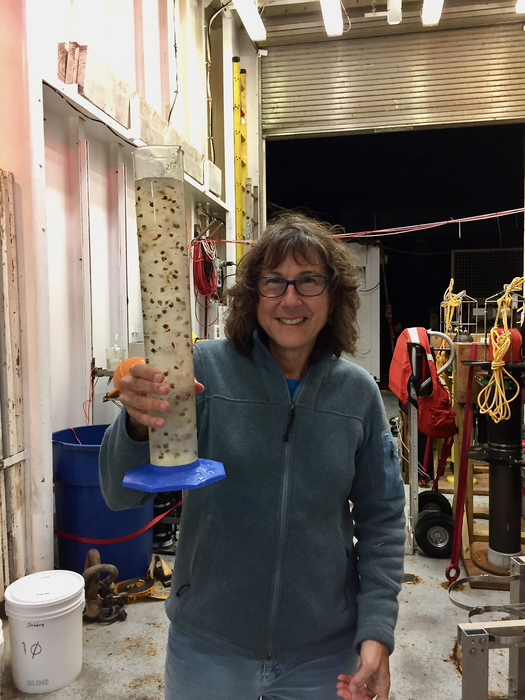
Credit: © Jason Graff/Oregon State University
Humans continue to amplify global warming by emitting billions of tons of carbon dioxide into the atmosphere each year. A new study reveals that a distant human relative plays an outsize role in damping the impacts of this greenhouse gas by pumping large amounts of carbon from the ocean surface to the deep sea, where it contributes nothing to current warming.
The study, led by Dr. Deborah Steinberg of William & Mary’s Virginia Institute of Marine Science, appeared in the latest issue of Global Biogeochemical Cycles. It reports on research conducted as part of EXPORTS, a 4-year, multi-institutional field program funded by NASA. Co-authors hail from marine institutes in Maine, Bermuda, California, Newfoundland, British Columbia, and Alaska.
The goal of EXPORTS, for EXport Processes in the Ocean from RemoTe Sensing, is to combine shipboard and satellite observations to more accurately quantify the global impact of the “biological pump.” This is a suite of biological processes that transport carbon and other organic matter from sunlit surface waters to the deep sea, effectively removing carbon dioxide from the surface ocean and atmosphere. Tiny drifting animals called zooplankton play a key role in the pump by eating phytoplankton, which incorporate carbon from carbon dioxide into their tissues during photosynthesis, then exporting that carbon to depth.
During a month-long EXPORTS expedition to the northeast Pacific Ocean in 2018, Steinberg and colleagues chanced upon a large bloom of a poorly studied player in the biological pump: a species of gelatinous zooplankton named Salpa aspera. Like other salps, these “jelly barrels” begin life with a notochord—the structure that develops into the spinal cord in humans and other vertebrates—and as adults drift through the world’s oceans like tiny transparent whales, filtering microscopic plants afloat in the water.
Three features keyed the team’s interest in salps, and S. aspera in particular. One is that these organisms can reproduce asexually, rapidly cloning into immense blooms under the right conditions. Second is that S. aspera is bigger and filters more water than most other zooplankton, thus producing larger, heavier fecal pellets. Third is that it migrates up and down through the water each day, rising to feed on phytoplankton during the cover of night and jetting to the perpetual darkness of the deep sea during sunlit hours to avoid its own predators, which include sea turtles, marine birds, and fishes.
Together, these features had led researchers to suspect that salps might play an important role in the biological pump, as large blooms of these relatively bulky zooplankton could effectively transport carbon to depth through their heavy, fast-sinking fecal pellets; vertical migrations that give those pellets a head start on their journey to depth; and the sinking of countless salp carcasses during a bloom (individual salps live only a few weeks).
But the proof is in the pudding, and the ephemeral life cycle and uneven distribution of salps has long challenged efforts to study their role in carbon export and deep-sea food webs. “Salps follow a ‘bloom or bust’ life cycle,” says Steinberg, “with populations that are inherently patchy in space and time. That makes it hard to observe or model their contribution to the export of carbon to the deep sea.”
During the 2018 EXPORTS expedition to the Pacific, Steinberg and colleagues were able to overcome these challenges by deploying a wide range of ocean-observation tools, from traditional plankton nets and sediment traps to underwater video recorders and sonar-based computer models. Moreover, by using two research vessels—the 277-ft Roger Revelleand the 238-ft Sally Ride—the scientists were able to observe conditions not only inside the salp bloom but in surrounding waters, providing a broader geographic context for their study.
The results of the team’s unprecedented field campaign were clear. “High salp abundances, combined with unique features of their ecology and physiology, lead to an outsized role in the biological pump,” says Steinberg.
To put things in perspective, the observed salp bloom covered more than 4,000 square miles (~11,000 km2), about the size of Connecticut. With onboard experiments showing salps capable of exporting a daily average of 9 milligrams of carbon through each square meter at 100 meters below the bloom, the amount of carbon exported to the deep sea was about 100 metric tons per day. For comparison, a typical passenger car emits 4.6 metric tons per year. Comparing these values shows the carbon removed from the climate system each day of the bloom is equal to taking 7,500 cars off the road. Adjusting these values using the team’s highest measured rate of salp-mediated export (34 mg of C per day) increases the carbon offset to more than 28,000 vehicles.
Moving forward, the team calls for increased recognition of the key role that salps play in global carbon export. “Blooms like the one we observed often go undetected,” says Steinberg, “and their contributions to the biological pump are rarely quantified, even in some of the best-studied regions of the world’s oceans.” Incorporation of salp dynamics into a recent carbon-cycle model illustrates the potential of salp-mediated export. In this global model, salps and other tunicates exported 700 million metric tons of carbon to the deep sea each year, equal to emissions from more than 150 million cars.
“Greater use of new technologies, such as adding video imaging systems to autonomous floats, would help detect these salp blooms,” says Steinberg. “Our study serves as a ‘call to arms’ to better detect and quantify these processes, using technology and sampling schemes that enable their inclusion in measurements and models of the biological carbon pump.”
Journal
Global Biogeochemical Cycles
DOI
10.1029/2022GB007523
Method of Research
Observational study
Subject of Research
Animals
Article Title
The outsized role of salps in carbon export in the subarctic Northeast Pacific Ocean
Article Publication Date
16-Dec-2022