Osaka, Japan – Scientists from the Institute of Laser Engineering at Osaka University determined the mechanism and functional form for the yield of neutrons from a laser-driven source, and used it to carry out a neutron resonance analysis much faster than conventional methods. This work may help bring non-invasive testing to more applications in manufacturing and medicine.
Credit: ILE, Osaka University
Osaka, Japan – Scientists from the Institute of Laser Engineering at Osaka University determined the mechanism and functional form for the yield of neutrons from a laser-driven source, and used it to carry out a neutron resonance analysis much faster than conventional methods. This work may help bring non-invasive testing to more applications in manufacturing and medicine.
While most microscopes use photons or even electrons to study small samples, scientists have also employed neutrons in a wide array of tests, such as in neutron scattering, to study both manufactured samples as well as biological specimens. As neutral particles, neutrons are ideal for non-destructive investigation of the magnetic and atomic properties of objects under consideration, since they are unaffected by electric charge. Newer methods exist for producing neutrons in large numbers, like using laser-driven neutron sources, but the underlying mechanism remains unclear.
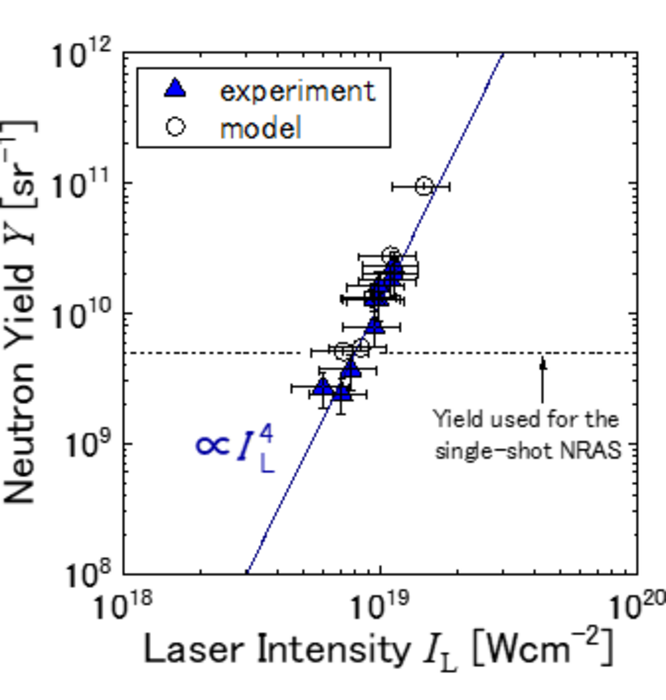
Now, a team of researchers lead by Osaka University developed a laser-driven neutron source and determined a new scaling law between the laser intensity and the number of neutrons produced. They found that increasing the intensity yielded neutrons proportional to the fourth power, which can lead to very large changes based on relatively small investments of additional power. Using this law, an analysis called neutron resonance absorption was performed to identify the elements in the experimental sample. “Neutron sources can be used in applications ranging from radiography, spectroscopy, security, to medicine,” says first author Akifumi Yogo.
In an experiment, the researchers directed an extremely powerful laser beam at a foil of deuterated polystyrene. The ions that came out collided with a block of beryllium, which in turn created a large flux of neutrons. A small moderator device was used to slow the neutrons so they would be moving the correct speed to pass through the sample. Based on the neutron absorption rate, the atoms in the sample could be determined. “We successfully reduced the measurement time from several hours to a tiny fraction of a second, enabling single-shot experiments involving fast phenomena,” says senior author Ryosuke Kodama.
Processes that occur over the course of seconds or minutes can now be monitored in real time, which was not possible using older methods with lower neutron intensities. The results of this research can lead to significant increases in speed for industrial quality control or biological sample identification.
###
The work is published in Physical Review X as “Laser-driven Neutron Generation Realizing Single-Shot Resonance Spectroscopy” DOI: https://journals.aps.org/prx/abstract/10.1103/PhysRevX.13.011011
Journal
Physical Review X
DOI
10.1103/PhysRevX.13.011011
Method of Research
Experimental study
Subject of Research
Not applicable
Article Title
Laser-driven Neutron Generation Realizing Single-Shot Resonance Spectroscopy
Article Publication Date
31-Jan-2023