Smart voice assistants are a popular way for people to get quick answers or play their favorite music. That same technology could make the laboratory safer for scientists and technicians who handle potentially infectious samples. Researchers in ACS Sensors now report a small, voice-activated device that can extract and pretreat bacterial DNA, helping protect those on the front lines of disease outbreaks. The system could also help scientists with disabilities conduct studies more easily.
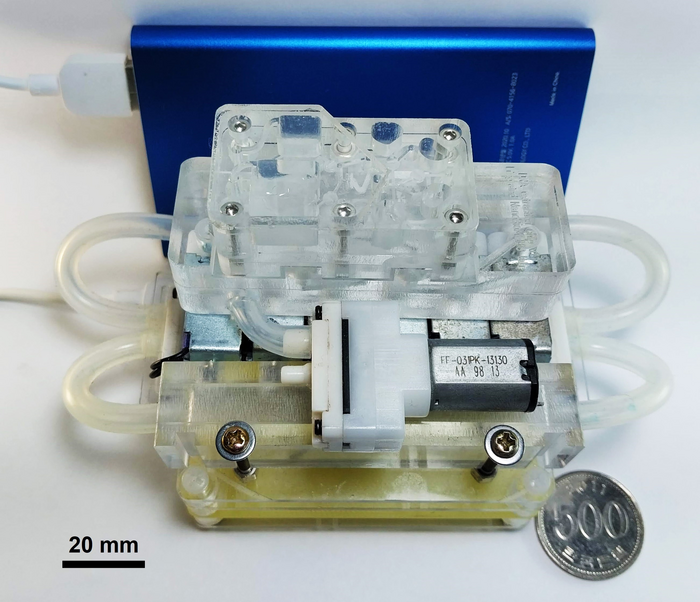
Credit: Adapted from ACS Sensors 2023, DOI: 10.1021/acssensors.2c01849
Smart voice assistants are a popular way for people to get quick answers or play their favorite music. That same technology could make the laboratory safer for scientists and technicians who handle potentially infectious samples. Researchers in ACS Sensors now report a small, voice-activated device that can extract and pretreat bacterial DNA, helping protect those on the front lines of disease outbreaks. The system could also help scientists with disabilities conduct studies more easily.
Scientists working with samples containing pathogens need to work with the smallest amounts possible to avoid accidental infection. And for highly contagious bacterial diseases, on-site sample analysis is ideal for rapid diagnoses. In addition, scientists who have visual or other physical impairments may find it difficult to operate complex instruments, especially those designed for tiny volumes. Hands-free devices that operate quickly through voice commands could make this process easier and safer. So, Tae Seok Seo and colleagues wanted to combine a speech recognition app with a miniaturized extraction system to do just that.
The researchers first made a microfluidic chip with multiple chambers linked together by six 3-way solenoid valves, which were operated by a micro-controller connected to a Bluetooth module. The palm-sized device weighed only 11 ounces and could be powered by a portable battery or a 5V smartphone charger. Then, using existing speech recognition software, the team customized a smartphone app to listen for specific voice commands. Here’s how it works:
- Once a user says one of the operation commands out loud, the app wirelessly sends an initiation signal to the micro-controller.
- After receiving the signal, the micro-controller automatically starts a series of steps, including sample loading, washing and releasing the purified DNA into a collection chamber.
The system currently requires the user to touch the smartphone to start the speech recognition software, but the researchers say that the whole operation could be made entirely hands-free in the future with the addition of virtual assistant software.
In tests, the voice-controlled device extracted DNA from Salmonella Typhimurium, purifying a 10-µL sample with an efficiency of 70% in less than a minute. Although the system had a lower performance than a traditional DNA extraction kit, the researchers say that its voice control, portability and quick automation give it an advantage for convenient and safe bacterial DNA testing.
The authors acknowledge funding from the Korea Health Technology R&D Project/Korea Health Industry Development Institute (KHIDI); the Ministry of Health and Welfare of South Korea; and the Engineering Research Center of Excellence Program of the National Research Foundation of Korea.
The paper’s abstract will be available on Feb. 1 at 8 a.m. Eastern time here: http://pubs.acs.org/doi/abs/10.1021/acssensors.2c01849
For more of the latest research news, register for our upcoming meeting, ACS Spring 2023. Journalists and public information officers are encouraged to apply for complimentary press registration by completing this form.
The American Chemical Society (ACS) is a nonprofit organization chartered by the U.S. Congress. ACS’ mission is to advance the broader chemistry enterprise and its practitioners for the benefit of Earth and all its people. The Society is a global leader in promoting excellence in science education and providing access to chemistry-related information and research through its multiple research solutions, peer-reviewed journals, scientific conferences, eBooks and weekly news periodical Chemical & Engineering News. ACS journals are among the most cited, most trusted and most read within the scientific literature; however, ACS itself does not conduct chemical research. As a leader in scientific information solutions, its CAS division partners with global innovators to accelerate breakthroughs by curating, connecting and analyzing the world’s scientific knowledge. ACS’ main offices are in Washington, D.C., and Columbus, Ohio.
To automatically receive news releases from the American Chemical Society, contact [email protected].
Follow us: Twitter | Facebook | LinkedIn | Instagram
Journal
ACS Sensors
DOI
10.1021/acssensors.2c01849
Article Title
Function of the speech recognition of the smartphone to automatically operate a portable sample pretreatment microfluidic system
Article Publication Date
1-Feb-2023