Ancient fossils shed new light on evolution of sea worm
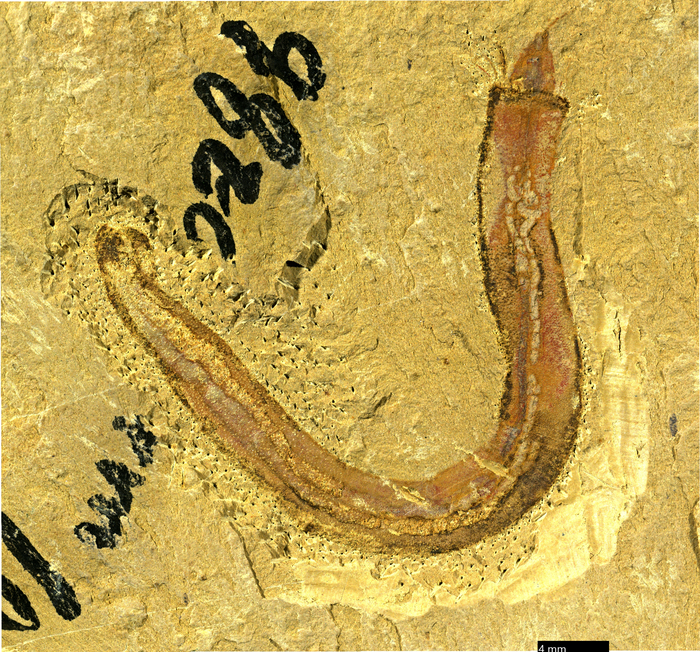
Credit: Credit: Zhang Zhifei
Ancient fossils shed new light on evolution of sea worm
Embargoed until 00.01 GMT Wednesday 01 February/19.01 EST Tuesday 31 January 2023 (Proceedings of the Royal Society B embargo)
-With pictures-
Ancient fossils have shed new light on a type of sea worm linking it to the time of an evolutionary explosion that gave rise to modern animal life.
Researchers at Durham University, UK, and Northwest University, Xi’an, China, examined 15 exceptionally preserved fossils of the annelid worm Iotuba chengjiangensis dating from the early Cambrian period 515 million years ago.
The fossilised remains included evidence of the worms’ guts and kidneys and revealed they had an unexpectedly complex structure similar to that of other annelid worms.
The researchers say this means that annelids – or segmented worms – diversified into different lineages some 200 million years earlier than previously thought and were part of the evolutionary leap known as the Cambrian explosion.
The Cambrian explosion saw a huge rise in organisms between 540 and 530 million years ago – as shown by fossil records – and saw the appearance of many of the major groups that make up animal life on Earth.
The findings are published in the journal Proceedings of the Royal Society B.
Study co-author Dr Martin R. Smith, in the Department of Earth Sciences, Durham University, said: “We know that the main animal lines we see today emerged during the Cambrian explosion, but we always thought annelid worms were late to the party, and their major subgroups didn’t begin to diversify until nearly 200 million years later.
“But the amazingly preserved fossils we have studied and the structure of these amazing little creatures challenge this picture, and show that annelid worms – including Iotuba chengjiangensis – seemed to follow the pattern of events initiated by the Cambrian explosion.
“Detailed fossils of this type of worm are extremely rare, so it was great to be able to study the fossilised record of this tiny animal in such detail.
“It turns out they weren’t late to the party at all, they were just hiding in a side room.”
The researchers say that Iotuba chengjiangensis was a cage worm able to move its head in and out of a cage made of bristly spines.
This makes the worm a close relative of families of annelid sea worms such as Flabelligeridae and Acrocirridae.
Dr Smith added: “These families are like the top rungs on an evolutionary ladder. For these groups to have appeared so early in the day, there must have been a dramatic unseen origin of modern annelid diversity in the heat of the Cambrian explosion.
“It turns out that many of the annelids we know and love today may have begun to evolve much sooner than we think.”
Research lead author Dr Zhifei Zhang, Northwest University, Xi’an, China said: “Annelids are one of the largest and most successful phyla of animals that are flourishing in both terrestrial and marine ecosystems with the most diversified living lineage, Polychaeta, living in the sea.
“The most well-known are, for example, earth worms, leeches and clam worms. There are also at least 20,000 species and 80 families of Polychaete in the modern sea.
“However, their earliest geological records of fossils in Cambrian deposits, even in the well-known Konservat-Lagerstätten are quite rare.
“Is this because the delicate worms didn’t exist, or simply didn’t preserve? Our research gives the first insightful answer: biodiversification of the segmented worms occurs much earlier than thought before.”
The research was funded by the National Natural Science Foundation of China and Changjiang Scholars Program of the Chinese Ministry of Education.
ENDS
Journal
Proceedings of the Royal Society B Biological Sciences
DOI
10.1098/rspb.2022.2014
Method of Research
Observational study
Subject of Research
Not applicable
Article Title
The Cambrian cirratuliform Iotuba denotes an early annelid radiation
Article Publication Date
1-Feb-2023