A new study led by scientists at The Neuro (Montreal Neurological Institute-Hospital) of McGill University finds a correlation between neurodegeneration in obese people and Alzheimer’s disease (AD) patients, suggesting that losing excess weight could slow cognitive decline in aging and lower risk for AD.
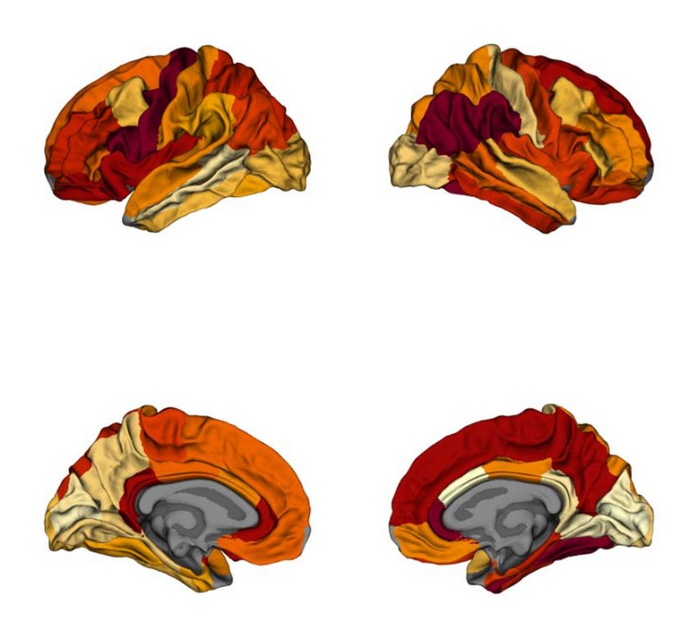
Credit: Filip Morys
A new study led by scientists at The Neuro (Montreal Neurological Institute-Hospital) of McGill University finds a correlation between neurodegeneration in obese people and Alzheimer’s disease (AD) patients, suggesting that losing excess weight could slow cognitive decline in aging and lower risk for AD.
Previous research has shown that obesity is linked with Alzheimer’s disease (AD)-related changes, such as cerebrovascular damage and amyloid-β accumulation. However, to date no research has made a direct comparison between brain atrophy patterns in AD and obesity.
Using a sample of over 1,300 individuals, the researchers compared patterns of grey matter atrophy in obesity and AD. They compared the AD patients with healthy controls, and obese with non-obese individuals, creating maps of grey matter atrophy for each group.
The scientists found that obesity and AD affected grey matter cortical thinning in similar ways. For example, thinning in the right temporo-parietal cortex and left prefrontal cortex were similar in both groups. Cortical thinning may be a sign of neurodegeneration. This suggests that obesity may cause the same type of neurodegeneration as found in people with AD.
Obesity is increasingly recognized as a multisystem disease affecting respiratory, gastrointestinal, and cardiovascular systems, among others. Published in the Journal of Alzheimer’s Disease on Jan. 31, 2022, this study helps reveal a neurological impact as well, showing obesity may play a role in the development of Alzheimer’s and dementia.
“Our study strengthens previous literature pointing to obesity as a significant factor in AD by showing that cortical thinning might be one of the potential risk mechanisms,” says Filip Morys, a PhD researcher at The Neuro and the study’s first author. “Our results highlight the importance of decreasing weight in obese and overweight individuals in mid-life, to decrease the subsequent risk of neurodegeneration and dementia.”
This study was funded with a Foundation Scheme award to AD from the Canadian Institutes of Health Research, computing resources from Calcul Quebec and Compute Canada, and by a postdoctoral fellowship from Fonds de Recherche du Québec – Santé.
The Neuro
The Neuro – The Montreal Neurological Institute-Hospital – is a bilingual, world-leading destination for brain research and advanced patient care. Since its founding in 1934 by renowned neurosurgeon Dr. Wilder Penfield, The Neuro has grown to be the largest specialized neuroscience research and clinical center in Canada, and one of the largest in the world. The seamless integration of research, patient care, and training of the world’s top minds make The Neuro uniquely positioned to have a significant impact on the understanding and treatment of nervous system disorders. In 2016, The Neuro became the first institute in the world to fully embrace the Open Science philosophy, creating the Tanenbaum Open Science Institute. The Montreal Neurological Institute is a McGill University research and teaching institute. The Montreal Neurological Hospital is part of the Neuroscience Mission of
Journal
Journal of Alzheimer s Disease
DOI
10.3233/JAD-220535
Method of Research
Observational study
Subject of Research
People
Article Title
Obesity-Associated Neurodegeneration Pattern Mimics Alzheimer’s Disease in an Observational Cohort Study
Article Publication Date
31-Jan-2023