Chestnut Hill, Mass (1/26/2023) – Quantum sensors can be used to reveal a surprising new mechanism for converting light into electricity in Weyl semimetals, Boston College Assistant Professor of Physics Brian Zhou and colleagues report in the journal Nature Physics.
Credit: Zhou Lab, Boston College
Chestnut Hill, Mass (1/26/2023) – Quantum sensors can be used to reveal a surprising new mechanism for converting light into electricity in Weyl semimetals, Boston College Assistant Professor of Physics Brian Zhou and colleagues report in the journal Nature Physics.
A number of modern technologies, such as cameras, fiber optic networks, and solar cells rely on the conversion of light into electrical signals. But with most materials, shining a light onto their surface will not generate any electricity because there is no preferred direction for the electricity to flow. The unique properties of electrons in Weyl semimetals have made them a focus of researchers trying to overcome those limits and develop novel optoelectronic devices.
“Most photoelectrical devices require two different materials to create an asymmetry in space,” said Zhou, who worked with eight BC colleagues and two researchers from the Nanyang Technological University in Singapore. “Here, we showed that the spatial asymmetry within a single material – in particular the asymmetry in its thermoelectric transport properties – can give rise to spontaneous photocurrents.”
The team studied the materials tungsten ditelluride and tantalum iridium tetratelluride, which both belong to the class of Weyl semimetals. Researchers have suspected that these materials would be good candidates for photocurrent generation because their crystal structure is inherently inversion asymmetric; that is to say, the crystal does not map onto itself by reversing directions about a point.
Zhou’s research group set out to understand why Weyl semimetals are efficient at converting light into electricity. Previous measurements could only determine the amount of electricity coming out of a device, like measuring how much water flows from a sink into a drainpipe. To better understand the origin of the photocurrents, Zhou’s team sought to visualize the flow of electricity within the device – similar to making a map of the swirling water currents in the sink.
“As part of the project, we developed a new technique using quantum magnetic field sensors called nitrogen-vacancy centers in diamond to image the local magnetic field produced by the photocurrents and reconstruct the full streamlines of the photocurrent flow,” graduate student Yu-Xuan Wang, lead author on the manuscript, said.
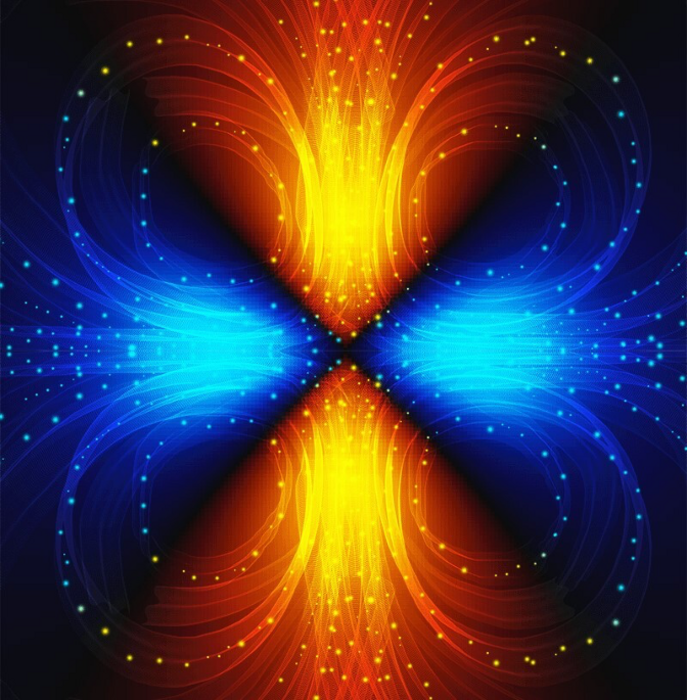
The team found the electrical current flowed in a four-fold vortex pattern around where the light shined on the material. The team further visualized how the circulating flow pattern is modified by the edges of the material and revealed that the precise angle of the edge determines whether the total photocurrent flowing out of the device is positive, negative, or zero.
“These never-before-seen flow images allowed us to explain that the photocurrent generation mechanism is surprisingly due to an anisotropic photothermoelectric effect – that is to say, differences in how heat is converted to current along the different in-plane directions of the Weyl semimetal,” Zhou said.
Surprisingly, the appearance of anisotropic thermopower is not necessarily related to the inversion asymmetry displayed by Weyl semimetals, and hence, may be present in other classes of materials.
“Our findings open a new direction for searching for other highly photoresponsive materials,” Zhou said. “It showcases the disruptive impact of quantum-enabled sensors on open questions in materials science.”
Zhou said future projects will use the unique photocurrent flow microscope to understand the origins of photocurrents in other exotic materials and to push the limits in detection sensitivity and spatial resolution.
In addition to Zhou and Wang, co-authors of the report “Visualization of bulk and edge photocurrent flow in anisotropic Weyl semimetals” include Boston College Associate Professor of Physics Ying Ran, Professor of Physics David Broido, and Assistant Professor of Physics Fazel Tafti; graduate students Xin-Yue Zhang, Thomas Graham, and Xiaohan Yao; and post-doctoral researcher Chunhua Li; as well as Nanyang Technological University Professor Zheng Liu and post-doctoral researcher Ruihuan Duan.
Journal
Nature Physics
DOI
10.1038/s41567-022-01898-0
Method of Research
Experimental study
Subject of Research
Not applicable
Article Title
Visualization of bulk and edge photocurrent flow in anisotropic Weyl semimetals
Article Publication Date
19-Jan-2023