BLOOMINGTON, Ind. — Indiana University researchers are part of a five-year, $11.24 million initiative from the U.S. Department of Energy to solve challenging and complex issues central to advancing knowledge in nuclear physics. The effort brings together the world’s top nuclear theorists to advance theoretical frameworks for the accurate prediction of nuclear interactions and properties of nuclear matter.
Credit: Image by Vincent Mathieu, JPAC
BLOOMINGTON, Ind. — Indiana University researchers are part of a five-year, $11.24 million initiative from the U.S. Department of Energy to solve challenging and complex issues central to advancing knowledge in nuclear physics. The effort brings together the world’s top nuclear theorists to advance theoretical frameworks for the accurate prediction of nuclear interactions and properties of nuclear matter.
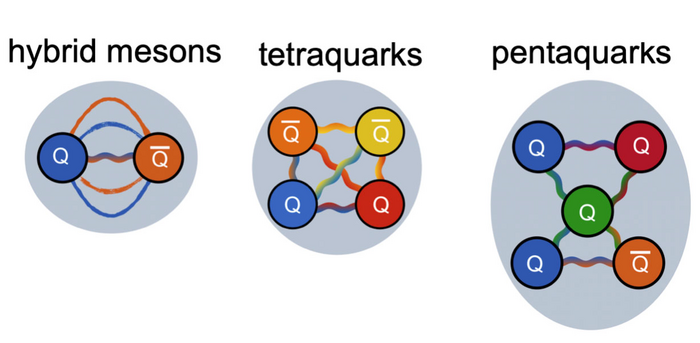
As part of this work, IU’s Adam Szczepaniak is leading a project called “ExoHad,” which explores the physics of exotic hadrons — a largely unexplored group of subatomic particles governed by rules that still need to be discovered. Of the Department of Energy’s award, $1.8 million supports ExoHad, which includes other IU researchers and collaborators from across the world.
“We are excited to work on these very important issues, which may ultimately provide us with a better understanding of matter itself,” said Szczepaniak, a professor of physics in the IU Bloomington College of Arts and Sciences’ Department of Physics and director of the Joint Physics Analysis Center. “We are expecting a lot of novel phenomena that we have not seen yet, even though we cannot predict exactly what those will be.”
While nuclear physics examines particles at an incredibly small scale, it can have a big impact — helping advance understanding of the universe itself. Having a thorough understanding of nuclear physics can lead to advancements in many fields, including medicine or climatology, Szczepaniak said.
To better understand exotic hadron physics, Szczepaniak’s project brings together three teams: one conducting experiments, one developing theory and numerical simulations, and one that will combine the results of experiments with predictions from the calculations. The researchers’ approach emphasizes the need for common tools, based on hadron scattering amplitudes, to simultaneously analyze experimental data and numerical simulation. They hope their approach will allow for a more robust determination of the spectrum of exotic hadron resonances.
“The exotic hadrons that the collaboration is hoping to unravel are expected to contain many gluons, which are the most mysterious particles know in physics,” Szczepaniak said. “They only exist deep inside atomic nuclei and are responsible for over 95 percent of visible matter in the universe, but how this happens is still a mystery.”
This project allows Szczepaniak and his colleagues to apply knowledge learned as members of the Joint Physics Analysis Center. The center started in 2013 to provide theory support to experiments taking place at the Thomas Jefferson National Accelerator Facility in Virginia and later expanded to laboratories around the world. In the decade since, the center has produced over 100 research papers and mentored more than two dozen students and postdoctoral researchers. With support from IU’s Global Classroom Initiative, the center has developed specialized graduate courses that have connected students and more senior researchers from around the world.
IU student researchers are critical to this work, said Szczepaniak, who hopes the project will inspire students to pursue this field and help build the next generation of nuclear physicists.
Other IU collaborators on the project include Jinfeng Liao, professor of physics, and Emilie Passemar, associate professor of physics.