• HOME
  • NEWS
  • EXPLORE
    • CAREER
      • Companies
      • Jobs
    • EVENTS
    • iGEM
      • News
      • Team
    • PHOTOS
    • VIDEO
    • WIKI
  • BLOG
  • COMMUNITY
    • FACEBOOK
    • INSTAGRAM
    • TWITTER
Saturday, May 2, 2026
BIOENGINEER.ORG
No Result
View All Result
  • Login
  • HOME
  • NEWS
  • EXPLORE
    • CAREER
      • Companies
      • Jobs
        • Lecturer
        • PhD Studentship
        • Postdoc
        • Research Assistant
    • EVENTS
    • iGEM
      • News
      • Team
    • PHOTOS
    • VIDEO
    • WIKI
  • BLOG
  • COMMUNITY
    • FACEBOOK
    • INSTAGRAM
    • TWITTER
  • HOME
  • NEWS
  • EXPLORE
    • CAREER
      • Companies
      • Jobs
        • Lecturer
        • PhD Studentship
        • Postdoc
        • Research Assistant
    • EVENTS
    • iGEM
      • News
      • Team
    • PHOTOS
    • VIDEO
    • WIKI
  • BLOG
  • COMMUNITY
    • FACEBOOK
    • INSTAGRAM
    • TWITTER
No Result
View All Result
Bioengineer.org
No Result
View All Result
Home NEWS Science News Chemistry

Artificial photosynthesis uses sunlight to make biodegradable plastic

Bioengineer by Bioengineer
January 25, 2023
in Chemistry
Reading Time: 2 mins read
0
Fumaric acid synthesis from CO2 using solar energy
Share on FacebookShare on TwitterShare on LinkedinShare on RedditShare on Telegram

Osaka, Japan – In recent years, environmental problems caused by global warming have become more apparent due to greenhouse gases such as CO2. In natural photosynthesis, CO2 is not reduced directly, but is bound to organic compounds which are converted to glucose or starch. Mimicking this, artificial photosynthesis could reduce CO2 by combining it into organic compounds to be used as raw materials, which can be converted into durable forms such as plastic.
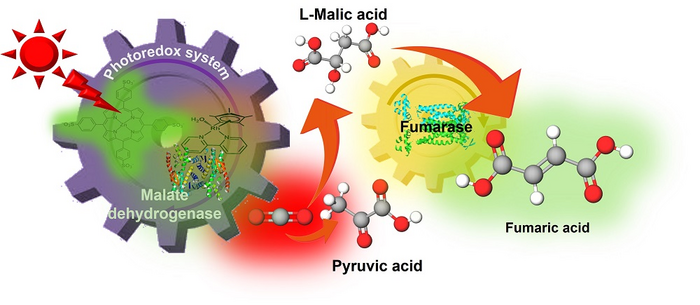
Fumaric acid synthesis from CO2 using solar energy

Credit: Yutaka Amao, Osaka Metropolitan University

Osaka, Japan – In recent years, environmental problems caused by global warming have become more apparent due to greenhouse gases such as CO2. In natural photosynthesis, CO2 is not reduced directly, but is bound to organic compounds which are converted to glucose or starch. Mimicking this, artificial photosynthesis could reduce CO2 by combining it into organic compounds to be used as raw materials, which can be converted into durable forms such as plastic.

A research team led by Professor Yutaka Amao from the Research Center for Artificial Photosynthesis and graduate student Mika Takeuchi, from the Osaka Metropolitan University Graduate School of Science, have succeeded in synthesizing fumaric acid from CO2, a raw material for plastics, powered—for the first time—by sunlight. Their findings were published in Sustainable Energy & Fuels.

Fumaric acid is typically synthesized from petroleum, to be used as a raw material for making biodegradable plastics such as polybutylene succinate, but this discovery shows that fumaric acid can be synthesized from CO2 and biomass-derived compounds using renewable solar energy.

“Toward the practical application of artificial photosynthesis, this research has succeeded in using visible light—renewable energy—as the power source,” explained Professor Amao. “In the future, we aim to collect gaseous CO2 and use it to synthesize fumaric acid directly through artificial photosynthesis.”

###

About OMU
Osaka Metropolitan University is a new public university established by a merger between Osaka City University and Osaka Prefecture University in April 2022. For more science news, see https://www.omu.ac.jp/en/, and follow @OsakaMetUniv_en, or search #OMUScience. 


Journal

Sustainable Energy & Fuels

DOI

10.1039/D2SE01533A

Method of Research

Experimental study

Subject of Research

Not applicable

Article Title

Visible-light driven fumarate production from CO2 and pyruvate by the photocatalytic system with dual biocatalysts

Article Publication Date

13-Dec-2022

Share12Tweet8Share2ShareShareShare2

Related Posts

Using Epigenetics to Monitor Environmental Arsenic Exposure — Chemistry

Using Epigenetics to Monitor Environmental Arsenic Exposure

May 1, 2026
Innovative Nanoreactor Design Enhances Catalysis by Optimizing Transport and Reaction Kinetics — Chemistry

Innovative Nanoreactor Design Enhances Catalysis by Optimizing Transport and Reaction Kinetics

May 1, 2026

Swift Creation of Conductive Organic Compounds via Mechanochemistry

May 1, 2026

Scientists Reveal Atomic Mechanism Behind Water-Induced Hydroxylation in CoOx Nanostructures

May 1, 2026

POPULAR NEWS

  • Research Indicates Potential Connection Between Prenatal Medication Exposure and Elevated Autism Risk

    832 shares
    Share 333 Tweet 208
  • New Study Reveals Plants Can Detect the Sound of Rain

    714 shares
    Share 285 Tweet 178
  • Scientists Investigate Possible Connection Between COVID-19 and Increased Lung Cancer Risk

    67 shares
    Share 27 Tweet 17
  • Salmonella Haem Blocks Macrophages, Boosts Infection

    61 shares
    Share 24 Tweet 15

About

We bring you the latest biotechnology news from best research centers and universities around the world. Check our website.

Follow us

Recent News

Family Health Needs of Disabled Elders Explored

Mcu Controls Bone Growth Through Mitochondrial Calcium

Physical Disorders, ADLs, Cognition, Depression in Nursing Homes

Subscribe to Blog via Email

Success! An email was just sent to confirm your subscription. Please find the email now and click 'Confirm' to start subscribing.

Join 82 other subscribers
  • Contact Us

Bioengineer.org © Copyright 2023 All Rights Reserved.

Welcome Back!

Login to your account below

Forgotten Password?

Retrieve your password

Please enter your username or email address to reset your password.

Log In
No Result
View All Result
  • Homepages
    • Home Page 1
    • Home Page 2
  • News
  • National
  • Business
  • Health
  • Lifestyle
  • Science

Bioengineer.org © Copyright 2023 All Rights Reserved.