Biomedical engineers at the University of California, Davis, have created semi-living “cyborg cells.” Retaining the capabilities of living cells, but unable to replicate, the cyborg cells could have a wide range of applications, from producing therapeutic drugs to cleaning up pollution. The work was published Jan. 11 in Advanced Science.
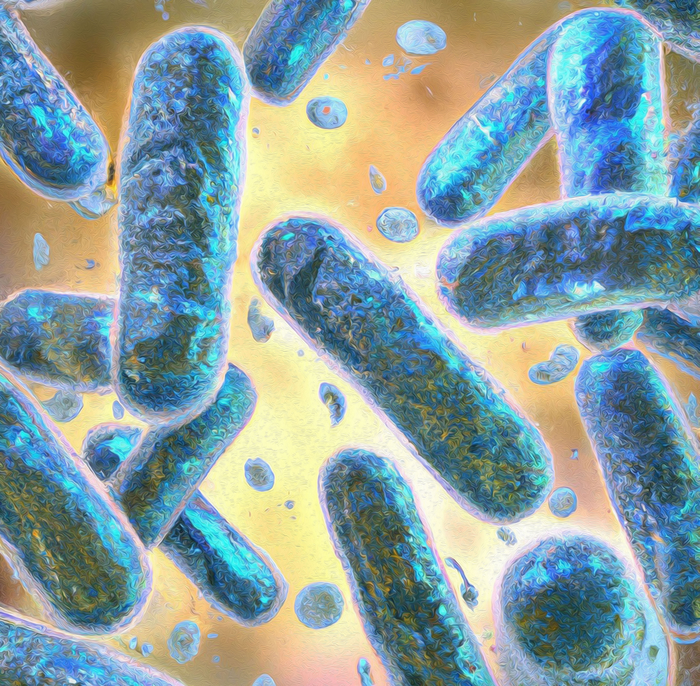
Credit: Illustration by Cheemeng Tan/UC Davis.
Biomedical engineers at the University of California, Davis, have created semi-living “cyborg cells.” Retaining the capabilities of living cells, but unable to replicate, the cyborg cells could have a wide range of applications, from producing therapeutic drugs to cleaning up pollution. The work was published Jan. 11 in Advanced Science.
Synthetic biology aims to engineer cells that can carry out novel functions. There are essentially two approaches in use, said Cheemeng Tan, associate professor of biomedical engineering at UC Davis and senior author on the paper. One is to take a living bacterial cell and remodel its DNA with new genes that give it new functions. The other is to create an artificial cell from scratch, with a synthetic membrane and biomolecules.
The first approach, an engineered living cell, has great flexibility but is also able to reproduce itself, which may not be desirable. A completely artificial cell cannot reproduce but is less complex and only capable of a limited range of tasks.
Infused with artificial polymer
Tan and the UC Davis team came up with a third approach. They infused living bacterial cells with the basic units of an artificial polymer. Once inside the cell, polymer was cross-linked into a hydrogel matrix by exposure to ultraviolet light. The cells could maintain their biological activity but could not reproduce.
“The cyborg cells are programmable, do not divide, preserve essential cellular activities, and gain nonnative abilities,” Tan said.
The cyborg cells were more resistant to stressors that would kill normal cells, such as exposure to hydrogen peroxide, antibiotics or high pH, the researchers found.
Finally, they were able to engineer the cells so that they could invade cancer cells grown in the lab.
The group is carrying out further research on how to create and control cyborg cells and on the effects of different matrix materials. They also hope to explore their use in a wide range of applications, from meeting environmental challenges to diagnosing and treating diseases.
“Finally, we are interested in the bioethics of applying cyborg cells as they are cell-derived biomaterials that are neither cells nor materials,” Tan said.
Additional co-authors on the paper are: Luis Contreras-Llano, Conary Meyer, Ofelya Baghdasaryan, Shahid Khan, and Aijun Wang, UC Davis Department of Biomedical Engineering; Tanner Henson, UC Davis Department of Surgery; Yu-Han Liu, Chi-Long Lin, Che-Ming J. Hu, Academia Sinica, Taiwan.
An application has been submitted for a provisional patent on the process. The work was supported in part by grants from the National Institutes of Health.
Journal
Advanced Science
DOI
10.1002/advs.202204175
Method of Research
Experimental study
Subject of Research
Cells
Article Title
Engineering Cyborg Bacteria Through Intracellular Hydrogelation
Article Publication Date
11-Jan-2023
COI Statement
Authors L.E.C-L., C.M.H., and C.T submitted a provisional patent application covering the process described in this study. The rest of the authors declare no competing interests.