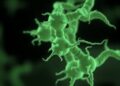
An estimated ninety percent of deaths from breast cancer are due to complications resulting from metastasis, a process in which cancer cells break away from where they first formed, travel through the blood or lymph circulatory system, and form new, metastatic tumors in other parts of the body.

Credit: Courtesy Bar-Ilan University
An estimated ninety percent of deaths from breast cancer are due to complications resulting from metastasis, a process in which cancer cells break away from where they first formed, travel through the blood or lymph circulatory system, and form new, metastatic tumors in other parts of the body.
With no effective treatment to block this process, there is a need to target not only the primary tumor, but also its metastatic potential when highly-invasive types of breast cancer and/or breast cancer at an advanced stage are diagnosed.
Cancer cells use feet-like protrusions called invadopodia to degrade underlying tissue, enter the bloodstream and form metastases in other organs. Approximately four years ago Dr. Hava Gil-Henn and researchers from the Azrieli Faculty of Medicine of Bar-Ilan University in Israel revealed two important clues about the formation of invadopodia: the cellular level of the proteins Pyk2 and cortactin suspiciously increased when the cell entered its malignant phase, but when the cell lost its ability to produce Pyk2, no metastasis was observed whatsoever.
In a recent study expanding on this finding, Dr. Gil-Henn and Prof. Jordan Chill, of Bar-Ilan’s Department of Chemistry, characterized the interaction between these partner proteins and showed that this interaction is a prerequisite for metastasis formation of cancer cells. Further, they determined the mechanism in which the cortactin-Pyk2 interaction affects invadopodia formation and defined the structure of the complex between these two proteins. The findings of the research team, which also included Dr. Shams Twafra and Dr. Chana Sokolik, were published in the journal Oncogene.
In the recent study the researchers defined the precise segment of the protein involved in the interaction between Pyk2 and cortactin. The small segment, known as a peptide, was synthesized in the laboratory and administered to breast cancer-bearing mice. The synthesized peptide successfully competed with the natural Pyk2 protein for the “attention” of cortactin and essentially blocked Pyk2’s access to it. This inhibited the formation of the feet-like invadopodia and, as a result, the lungs of the mice remained much healthier, with very few, if any, metastases.
“We were very excited to see that the idea to use the Pyk2-binding motif to cortactin as an inhibitor for invadopodia worked in vivo quite well,” says study co-author Dr. Hava Gil-Henn. “This served to prove the clinical potential of inhibiting the newly-discovered interaction.”
Amazingly, all this was achieved using a very small segment of Pyk2, spanning only 19 of its 1,009 amino acid building blocks. This was seen, as noted, in the decrease in lung metastasis in the mouse model of breast cancer. In addition, it greatly reduced the invasiveness of breast tumor cells, stopped the maturation of invadopodia in tumor cells, and lowered the rate of polymerization of actin, which is needed for progression in invadopodia formation. All these findings together provided unequivocal evidence that the 19-amino acid peptide actually blocks metastasis.
Prof. Jordan Chill, who specializes in determining the three-dimensional structure of proteins, joined the research team to determine how the peptide blocks metastasis. “The process of developing a successful drug from an inhibiting peptide is extremely demanding and is almost impossible to complete without a structural view of the complex between the peptide and its target, in this case cortactin,” says Prof. Chill. Through an NMR experiment known as NOESY, the position of each of the 881 atoms of the cortactin protein and 315 atoms of the peptide was determined, creating a three-dimensional picture of the structure. The spatial position of the atoms is the secret to understanding the strength of the bond between the proteins, which is critical to creating a drug that will effectively prevent that bond. To illustrate this, it was found that amino acid #10 in the peptide fits exactly into the “slot” in cortactin and must not be changed, while amino acid #11 faces outward and its exact identity is less important.
Dr. Gil-Henn and Prof. Chill are now focused on transforming the peptide into a better drug candidate. Different sequences of amino acids are being tested to produce a product that will provide a stronger and more specific binding at the target site of cortactin. Specificity is crucial because the site in cortactin where the binding takes place, known as SH3, is similar to SH3 sites in other proteins, and any unwanted binding to another protein may cause side effects.
The combination of cellular biology (discovering the two proteins and showing that we can effectively block metastasis) and structural biology (giving us the how and why of this binding event) brings science ever so close to fighting breast cancer in a way not possible before. The researchers hope that this advancement will lead to the development of a drug that inhibits metastasis formation and will become part of the therapeutic approaches available to improve survival chances and quality of life of patients diagnosed with invasive breast cancer and other metastatic cancers.
This research was funded by the Israel Cancer Research Fund and the Israel Cancer Association (Dr. Gil-Henn) and grants from the Israel Science Foundation (to Dr. Gil-Henn and Prof. Chill).
Journal
Oncogene
Article Publication Date
18-Oct-2022