• HOME
  • NEWS
  • EXPLORE
    • CAREER
      • Companies
      • Jobs
    • EVENTS
    • iGEM
      • News
      • Team
    • PHOTOS
    • VIDEO
    • WIKI
  • BLOG
  • COMMUNITY
    • FACEBOOK
    • INSTAGRAM
    • TWITTER
Thursday, May 21, 2026
BIOENGINEER.ORG
No Result
View All Result
  • Login
  • HOME
  • NEWS
  • EXPLORE
    • CAREER
      • Companies
      • Jobs
        • Lecturer
        • PhD Studentship
        • Postdoc
        • Research Assistant
    • EVENTS
    • iGEM
      • News
      • Team
    • PHOTOS
    • VIDEO
    • WIKI
  • BLOG
  • COMMUNITY
    • FACEBOOK
    • INSTAGRAM
    • TWITTER
  • HOME
  • NEWS
  • EXPLORE
    • CAREER
      • Companies
      • Jobs
        • Lecturer
        • PhD Studentship
        • Postdoc
        • Research Assistant
    • EVENTS
    • iGEM
      • News
      • Team
    • PHOTOS
    • VIDEO
    • WIKI
  • BLOG
  • COMMUNITY
    • FACEBOOK
    • INSTAGRAM
    • TWITTER
No Result
View All Result
Bioengineer.org
No Result
View All Result
Home NEWS Science News Chemistry

Theoretical computations identify a solid-state hydrogen storage material’s key bottleneck

Bioengineer by Bioengineer
January 13, 2023
in Chemistry
Reading Time: 2 mins read
0
Figure 1
Share on FacebookShare on TwitterShare on LinkedinShare on RedditShare on Telegram

A group of researchers has identified the key stumbling block of a common solid-state hydrogen material, paving the way for future design guidelines and widespread commercial use.
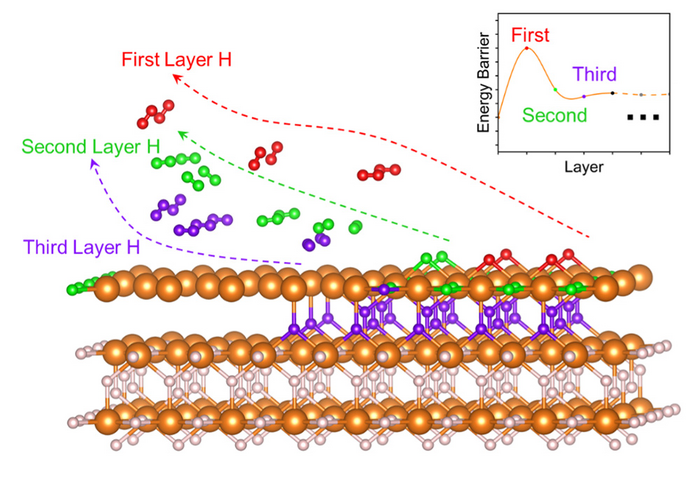
Figure 1

Credit: Hao Li et al.

A group of researchers has identified the key stumbling block of a common solid-state hydrogen material, paving the way for future design guidelines and widespread commercial use.

Details of their findings were published in the Journal of Materials Chemistry A, where the article was featured as a Front Cover Article.

Hydrogen will play a significant role in powering our future. It’s abundant and produces no harmful emissions when burned. But the storage and transportation of hydrogen is both costly and risky.

Currently, hydrogen is stored by three methods: high-pressure gaseous hydrogen storage, low-temperature liquid hydrogen storage, and solid-state hydrogen storage. Among solid-state hydrogen storage, solid-state materials are generally the safest and provide the most hydrogen storage density.

Metal hydrides have long been explored for their large hydrogen storage potentiality and their low cost. As these metals come into contact with gaseous hydrogen, hydrogen gets absorbed onto the surface. Further energy input leads to hydrogen atoms finding their way into the metal’s crystal lattices until the metal becomes saturated with hydrogen. From there, the material can absorb and desorb hydrogen in larger amounts.

Magnesium hydride (MgH2) has shown immense promise for superior hydrogen storage capacity. However, a high temperature is necessary for MgH2 to decompose and produce hydrogen. Furthermore, the material’s complex hydrogen migration and desorption, which result in sluggish dehydrogenation kinetics, have stymied its commercial application.

For decades, scientists have debated why dehydrogenation within MgH2 is so difficult. But now, the research group has uncovered an answer.

Using calculations based on spin-polarized density functional theory with van der Waals corrections, they unearthed a ‘burst effect’ during MgH2’s dehydrogenation. The initial dehydrogenation barriers measured at 2.52 and 2.53 eV, whereas subsequent reaction barriers were 0.12-1.51 eV.

The group carried out further bond analysis with the crystal orbital Hamilton population method, where they confirmed the magnesium-hydride bond strength decreased as the dehydrogenation process continued.

“Hydrogen migration and hydrogen desorption is much easier following the initial burst effect,” points out Hao Li, associate professor at Tohoku University’s Advanced Institute for Materials Research (WPI-AIMR) and corresponding author of the paper. “Structural engineering tweaks that promote this desorption process could be the key to facilitating the hydrogen desorption of MgH2.”

Li and his colleagues demonstrated that hydrogen vacancies maintained a high degree of electronic localization when the first layer of atomic hydrogen exists. Analyses of the kinetic characteristics of MgH2 after surface dehydrogenation, performed by ab initio molecular dynamics simulations, also provided additional evidence.

“Our findings provide a theoretical basis for the MgH2’s dehydrogenation kinetics, providing important guidelines for modifying MgH2-based hydrogen storage materials,” adds Li.


Journal

Journal of Materials Chemistry A

DOI

10.1039/D2TA06458H

Article Title

The “burst effect” of hydrogen desorption in MgH2 dehydrogenation

Article Publication Date

14-Nov-2022

Share12Tweet8Share2ShareShareShare2

Related Posts

Scientists Achieve Breakthrough in Molecular ‘Sandwich’ Assembly — Chemistry

Scientists Achieve Breakthrough in Molecular ‘Sandwich’ Assembly

May 21, 2026
Advancing In Vivo and In Situ Monitoring: Science Bulletin Highlights Host-Based Antifouling Gold Nanotube Sensor for Selective Detection of Mechanically Sensitive Serotonin Release in Intestinal Mucosa — Chemistry

Advancing In Vivo and In Situ Monitoring: Science Bulletin Highlights Host-Based Antifouling Gold Nanotube Sensor for Selective Detection of Mechanically Sensitive Serotonin Release in Intestinal Mucosa

May 20, 2026

How Magnetic Orientation Could Influence the Building Blocks of Life

May 20, 2026

Breaking a 200-Year-Old Belief: Novel Surface Design Achieves Two Distinct Wetting States on One Substrate

May 20, 2026

POPULAR NEWS

  • blank

    New Study Reveals Plants Can Detect the Sound of Rain

    733 shares
    Share 292 Tweet 183
  • ESMO 2025: mRNA COVID Vaccines Enhance Efficacy of Cancer Immunotherapy

    304 shares
    Share 122 Tweet 76
  • Research Indicates Potential Connection Between Prenatal Medication Exposure and Elevated Autism Risk

    846 shares
    Share 338 Tweet 212
  • Breastmilk Balances E. coli and Beneficial Bacteria in Infant Gut Microbiomes

    58 shares
    Share 23 Tweet 15

About

We bring you the latest biotechnology news from best research centers and universities around the world. Check our website.

Follow us

Recent News

Innovative Reusable Brick Walls Revolutionize Construction Industry

Nonlinear Atomic Tunneling Enhanced by Bright Squeezed Vacuum

Label-Free Super-Resolution Imaging of Live Cells

Subscribe to Blog via Email

Enter your email address to subscribe to this blog and receive notifications of new posts by email.

Join 82 other subscribers
  • Contact Us

Bioengineer.org © Copyright 2023 All Rights Reserved.

Welcome Back!

Login to your account below

Forgotten Password?

Retrieve your password

Please enter your username or email address to reset your password.

Log In
No Result
View All Result
  • Homepages
    • Home Page 1
    • Home Page 2
  • News
  • National
  • Business
  • Health
  • Lifestyle
  • Science

Bioengineer.org © Copyright 2023 All Rights Reserved.