Quantum computers can more rapidly process large amounts of data, because they carry out many computation steps in parallel. The information carrier of the quantum computer is a qubit. Qubits do not only possess the information of “0” and “1,” but also values in between. However, the difficulty consists in producing qubits that are small enough and can be switched quickly enough to execute quantum calculations. A very promising option are superconducting circuits. Superconductors are materials that have no electrical resistance at extremely low temperatures and, hence, conduct electrical current without any losses. This is important to maintain the quantum state of qubits and to connect them efficiently.
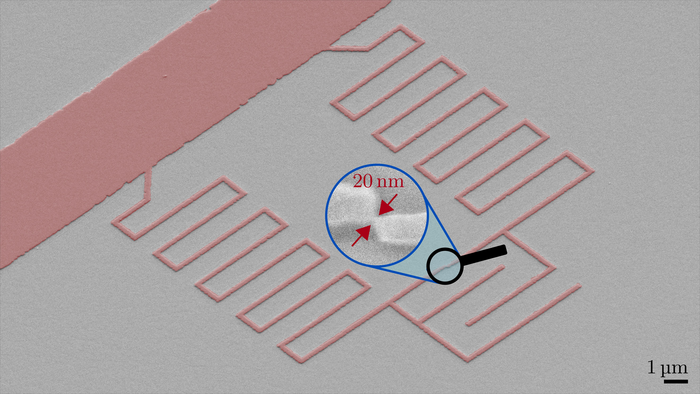
Credit: Graphics: Dennis Rieger, KIT
Quantum computers can more rapidly process large amounts of data, because they carry out many computation steps in parallel. The information carrier of the quantum computer is a qubit. Qubits do not only possess the information of “0” and “1,” but also values in between. However, the difficulty consists in producing qubits that are small enough and can be switched quickly enough to execute quantum calculations. A very promising option are superconducting circuits. Superconductors are materials that have no electrical resistance at extremely low temperatures and, hence, conduct electrical current without any losses. This is important to maintain the quantum state of qubits and to connect them efficiently.
Gralmonium Qubits: Superconducting and Sensitive
KIT researchers have now succeeded in developing novel, unconventional superconducting qubits. “The core of a superconducting qubit is a so-called Josephson junction that serves to store quantum information. Here, we made a crucial modification,” says Dr. Ioan M. Pop from KIT’s Institute for Quantum Materials and Technologies (IQMT). As a rule, such Josephson junctions for superconducting quantum bits are obtained by a thin oxide barrier separating two aluminum layers. “For our qubits, we use a single layer of granular aluminum, a superconductor made of aluminum grains of a few nanometers in size that are embedded in an oxide matrix,” Pop says. Then, the material self-structures in a three-dimensional network of Josephson junctions. “It is fascinating to see that all properties of our qubit are dominated by a very small junction of 20 nm only. Consequently, it acts like a magnifying glass of microscopic material defects in superconducting qubits and offers a promising option for improvement,” Simon Günzler, IQMT, adds.
Qubits Entirely Made of Granular Aluminum
The progress achieved by the team is based on a previously tested approach using so-called fluxonium qubits. Parts of this predecessor version were made of granular aluminum, others consisted of conventional aluminum. Now, the entire qubits are made of granular aluminum. “As if a quantum circuit would be cut out of a metal film. This results in entirely new opportunities for industrial production by etching processes and extended application of qubits, for example in strong magnetic fields,” says Dennis Rieger from KIT’s Physikalisches Institut.
This invention is protected by a European patent.
Original Publication
D. Rieger, S. Günzler, M. Spiecker, P. Paluch, P. Winkel, L. Hahn, J. K. Hohmann, A. Bacher, W. Wernsdorfer, and I. M. Pop: Granular Aluminium Nanojunction Fluxonium Qubit. Nature Materials, 2022. DOI: 10.1038/s41563-022-01417-9
https://www.nature.com/articles/s41563-022-01417-9
Details on KIT Materials Center: https://www.kit.edu/topics/materials.php
Being “The Research University in the Helmholtz Association”, KIT creates and imparts knowledge for the society and the environment. It is the objective to make significant contributions to the global challenges in the fields of energy, mobility, and information. For this, about 9,800 employees cooperate in a broad range of disciplines in natural sciences, engineering sciences, economics, and the humanities and social sciences. KIT prepares its 22,300 students for responsible tasks in society, industry, and science by offering research-based study programs. Innovation efforts at KIT build a bridge between important scientific findings and their application for the benefit of society, economic prosperity, and the preservation of our natural basis of life. KIT is one of the German universities of excellence.
DOI
10.1038/s41563-022-01417-9
Method of Research
Experimental study
Subject of Research
Not applicable
Article Title
Granular aluminium nanojunction fluxonium qubit
Article Publication Date
8-Dec-2022