Filamentous fungi have long been a good friend of sake brewers, but they might soon also be a sidekick for environmentalists. Osaka Metropolitan University researchers have revealed the regulatory mechanisms of enzyme production in a filamentous fungus that allows for efficient degradation of plant biomass, an alternative energy resource to petroleum.
Credit: Shuji Tani, Osaka Metropolitan University
Filamentous fungi have long been a good friend of sake brewers, but they might soon also be a sidekick for environmentalists. Osaka Metropolitan University researchers have revealed the regulatory mechanisms of enzyme production in a filamentous fungus that allows for efficient degradation of plant biomass, an alternative energy resource to petroleum.
Filamentous fungi (molds) are microorganisms with a long history of use in the fermentation of sake, soy sauce, cheese, and many other products. Such fermentation is a good example of the industrial use of filamentous fungi’s ability to secrete various enzymes in large quantities. Currently, plant biomass is attracting attention as an alternative to petroleum, which will eventually be depleted. Since hard plant cell walls are composed of various aromatics and polysaccharides, their degradation requires a large number of enzymes with diverse characteristics. Consequently, studies have been conducted to utilize filamentous fungi as a prominent source of enzymes for plant biomass degradation.
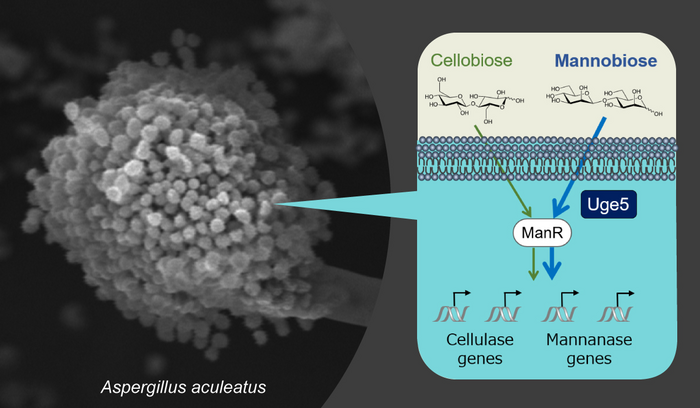
Delving into this field, a research team led by Associate Professor Shuji Tani, from the Graduate School of Agriculture at Osaka Metropolitan University, analyzed the regulatory mechanisms of carbohydrate-hydrolyzing enzyme production in the filamentous fungus Aspergillus aculeatus, which produces enzymes that have an excellent ability to degrade plant biomass.
Uridine diphosphate (UDP)-glucose 4-epimerase (Uge5) is well known as an enzyme involved in galactose metabolism. However, the team discovered that Uge5 also regulates the expression of degrading enzyme genes in A. aculeatus. This is the very first report of Uge5’s roles in selective gene expression in response to different types of inducing sugars in filamentous fungi.
These findings address the current technology challenge in establishing a much-wanted comprehensive high production method for various enzymes in filamentous fungi.
Professor Tani explained, “We constructed and screened a library containing approximately 9,000 gene-disrupted strains of Aspergillus aculeatus, and identified Uge5 as a novel regulatory factor that regulates the production of carbohydrate-hydrolyzing enzymes. The discovery of this new function took us by surprise. We plan to continue our research to elucidate phenomena that existing knowledge cannot explain.”
The research results were published in Applied Microbiology and Biotechnology on January 10, 2023.
###
About OMU
Osaka Metropolitan University is a new public university established by a merger between Osaka City University and Osaka Prefecture University in April 2022. For more science news, see https://www.omu.ac.jp/en/, and follow @OsakaMetUniv_en, or search #OMUScience.
Journal
Applied Microbiology and Biotechnology
DOI
10.1007/s00253-022-12337-8
Method of Research
Experimental study
Subject of Research
Not applicable
Article Title
A new function of a putative UDP-glucose 4-epimerase on the expression of glycoside hydrolase genes in Aspergillus aculeatus
Article Publication Date
10-Jan-2023