A team from Nagoya University in Japan has observed, for the first time, the energy transferring from resonant electrons to whistler-mode waves in space. Their findings offer direct evidence of previously theorized efficient growth, as predicted by the non-linear growth theory of waves. This should improve our understanding of not only space plasma physics but also space weather, a phenomenon that affects satellites.
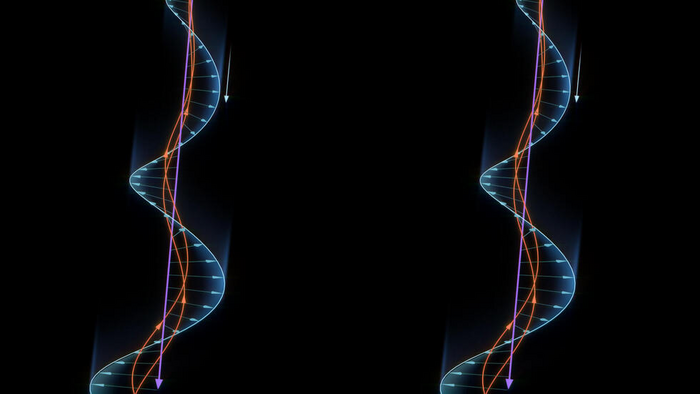
Credit: University of Tokyo
A team from Nagoya University in Japan has observed, for the first time, the energy transferring from resonant electrons to whistler-mode waves in space. Their findings offer direct evidence of previously theorized efficient growth, as predicted by the non-linear growth theory of waves. This should improve our understanding of not only space plasma physics but also space weather, a phenomenon that affects satellites.
When people imagine outer space, they often envision it as a perfect vacuum. In fact, this impression is wrong because the vacuum is filled with charged particles. In the depths of space, the density of charged particles becomes so low that they rarely collide with each other. Instead of collisions, the forces related to the electric and magnetic fields filling space, control the motion of charged particles. This lack of collisions occurs throughout space, except for very near to celestial objects, such as stars, moons, or planets. In these cases, the charged particles are no longer traveling through the vacuum of space but instead through a medium where they can strike other particles.
Around the Earth, these charged-particle interactions generate waves, including electromagnetic whistler-mode waves, which scatter and accelerate some of the charged particles. When diffuse auroras appear around the poles of planets, observers are seeing the results of an interaction between waves and electrons. Since electromagnetic fields are so important in space weather, studying these interactions should help scientists predict variations in the intensity of highly energetic particles. This might help protect astronauts and satellites from the most severe effects of space weather.
A team comprising Designated Assistant Professor Naritoshi Kitamura and Professor Yoshizumi Miyoshi of the Institute for Space and Earth Science (ISEE) at Nagoya University, together with researchers from the University of Tokyo, Kyoto University, Tohoku University, Osaka University, and Japan Aerospace Exploration Agency (JAXA), and several international collaborators, mainly used data obtained using low-energy electron spectrometers, called Fast Plasma Investigation-Dual Electron Spectrometers, on board NASA’s Magnetospheric Multiscale spacecraft. They analyzed interactions between electrons and whistler-mode waves, which were also measured by the spacecraft. By applying a method of using a wave particle interaction analyzer, they succeeded in directly detecting the ongoing energy transfer from resonant electrons to whistler-mode waves at the location of the spacecraft in space. From this, they derived the growth rate of the wave. The researchers published their results in Nature Communications.
The most important finding was that the observed results were consistent with the hypothesis that non-linear growth occurs in this interaction. “This is the first time anybody has directly observed the efficient growth of waves in space for the wave-particle interaction between electrons and whistler-mode waves,” explains Kitamura. “We expect that the results will contribute to research on various wave-particle interactions and to also improve our understanding of the progress of plasma physics research. As more specific phenomena, the results will contribute to our understanding of the acceleration of electrons to high energies in the radiation belt, which are sometimes called ‘killer electrons’ because they inflict damage on satellites, as well as the loss of high-energy electrons in the atmosphere, which form diffuse auroras.”
//Funding//
This work was supported by Grant-in-Aid for Scientific Research (17H06140, 18H03727, 21K13979) from Japan Society for the Promotion of Science.
Journal
Nature Communications
DOI
10.1038/s41467-022-33604-2
Article Title
Direct observations of energy transfer from resonant electrons to whistler-mode waves in magnetosheath of Earth
Article Publication Date
28-Oct-2022