• HOME
  • NEWS
  • EXPLORE
    • CAREER
      • Companies
      • Jobs
    • EVENTS
    • iGEM
      • News
      • Team
    • PHOTOS
    • VIDEO
    • WIKI
  • BLOG
  • COMMUNITY
    • FACEBOOK
    • INSTAGRAM
    • TWITTER
Saturday, February 7, 2026
BIOENGINEER.ORG
No Result
View All Result
  • Login
  • HOME
  • NEWS
  • EXPLORE
    • CAREER
      • Companies
      • Jobs
        • Lecturer
        • PhD Studentship
        • Postdoc
        • Research Assistant
    • EVENTS
    • iGEM
      • News
      • Team
    • PHOTOS
    • VIDEO
    • WIKI
  • BLOG
  • COMMUNITY
    • FACEBOOK
    • INSTAGRAM
    • TWITTER
  • HOME
  • NEWS
  • EXPLORE
    • CAREER
      • Companies
      • Jobs
        • Lecturer
        • PhD Studentship
        • Postdoc
        • Research Assistant
    • EVENTS
    • iGEM
      • News
      • Team
    • PHOTOS
    • VIDEO
    • WIKI
  • BLOG
  • COMMUNITY
    • FACEBOOK
    • INSTAGRAM
    • TWITTER
No Result
View All Result
Bioengineer.org
No Result
View All Result
Home NEWS Science News Chemistry

Entire color palette of inexpensive fluorescent dyes

Bioengineer by Bioengineer
January 4, 2023
in Chemistry
Reading Time: 2 mins read
0
Fluorescent dyes
Share on FacebookShare on TwitterShare on LinkedinShare on RedditShare on Telegram

Novel fluorescent dyes developed by ETH researchers are relatively simple and inexpensive to produce. The dyes are polymers with a modular structure. They consist of a different number of subunits depending on their colour. The subunits used are chemically simple molecules that are either commercially available or can be produced by chemists in one reaction step.
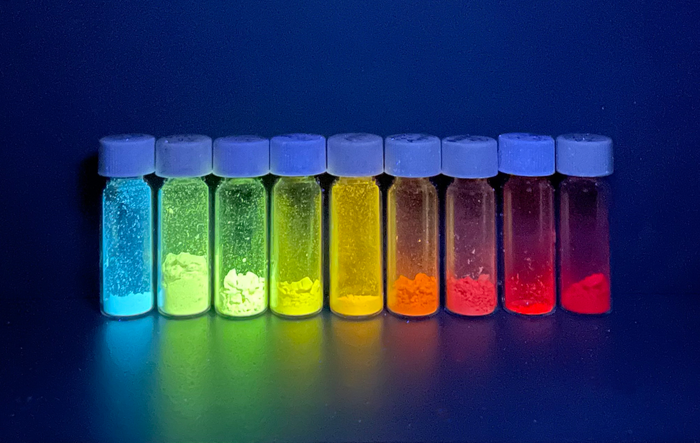
Fluorescent dyes

Credit: ETH Zurich

Novel fluorescent dyes developed by ETH researchers are relatively simple and inexpensive to produce. The dyes are polymers with a modular structure. They consist of a different number of subunits depending on their colour. The subunits used are chemically simple molecules that are either commercially available or can be produced by chemists in one reaction step.

Now, scientists led by Yinyin Bao have succeeded in using the new approach to produce a wide range of colours, including red, which was previously difficult to produce. Bao is a senior scientist in the groups of ETH professors Jean-​Christophe Leroux and Chih-​Jen Shih. Together with scientists from RMIT University in Melbourne, the team developed artificial intelligence algorithms that help decide which molecule subunits are needed in what numbers for a particular colour.

Potential applications for the fluorescent inks include UV-​activated security inks for banknotes, certificates, passports or for encrypting information. The method can also be used to produce inks that change colour after prolonged UV illumination. In their new work, which the scientists published in the scientific journal Chem, they demonstrated this using the example of two initially red fluorescent inks, one of which turns blue after several minutes of UV illumination, while the other remains red. This property can also be used for security features.

Other applications for the new fluorescent molecules are in solar power plants, or they could one day be combined with semiconducting molecules to produce low-​cost organic light-​emitting diodes (OLEDs) for displays.


Journal

Chem

DOI

10.1016/j.chempr.2022.12.003

Method of Research

Experimental study

Subject of Research

Not applicable

Article Title

Machine Learning-Assisted Exploration of a Versatile Polymer Platform with Charge Transfer-Dependent Full-Color Emission

Article Publication Date

2-Jan-2023

Share12Tweet8Share2ShareShareShare2

Related Posts

blank

Breakthrough in Environmental Cleanup: Scientists Develop Solar-Activated Biochar for Faster Remediation

February 7, 2026
blank

Cutting Costs: Making Hydrogen Fuel Cells More Affordable

February 6, 2026

Scientists Develop Hand-Held “Levitating” Time Crystals

February 6, 2026

Observing a Key Green-Energy Catalyst Dissolve Atom by Atom

February 6, 2026

POPULAR NEWS

  • Robotic Ureteral Reconstruction: A Novel Approach

    Robotic Ureteral Reconstruction: A Novel Approach

    82 shares
    Share 33 Tweet 21
  • Digital Privacy: Health Data Control in Incarceration

    63 shares
    Share 25 Tweet 16
  • Study Reveals Lipid Accumulation in ME/CFS Cells

    57 shares
    Share 23 Tweet 14
  • Breakthrough in RNA Research Accelerates Medical Innovations Timeline

    53 shares
    Share 21 Tweet 13

About

We bring you the latest biotechnology news from best research centers and universities around the world. Check our website.

Follow us

Recent News

Evaluating Pediatric Emergency Care Quality in Ethiopia

TPMT Expression Predictions Linked to Azathioprine Side Effects

Improving Dementia Care with Enhanced Activity Kits

Subscribe to Blog via Email

Success! An email was just sent to confirm your subscription. Please find the email now and click 'Confirm' to start subscribing.

Join 73 other subscribers
  • Contact Us

Bioengineer.org © Copyright 2023 All Rights Reserved.

Welcome Back!

Login to your account below

Forgotten Password?

Retrieve your password

Please enter your username or email address to reset your password.

Log In
No Result
View All Result
  • Homepages
    • Home Page 1
    • Home Page 2
  • News
  • National
  • Business
  • Health
  • Lifestyle
  • Science

Bioengineer.org © Copyright 2023 All Rights Reserved.